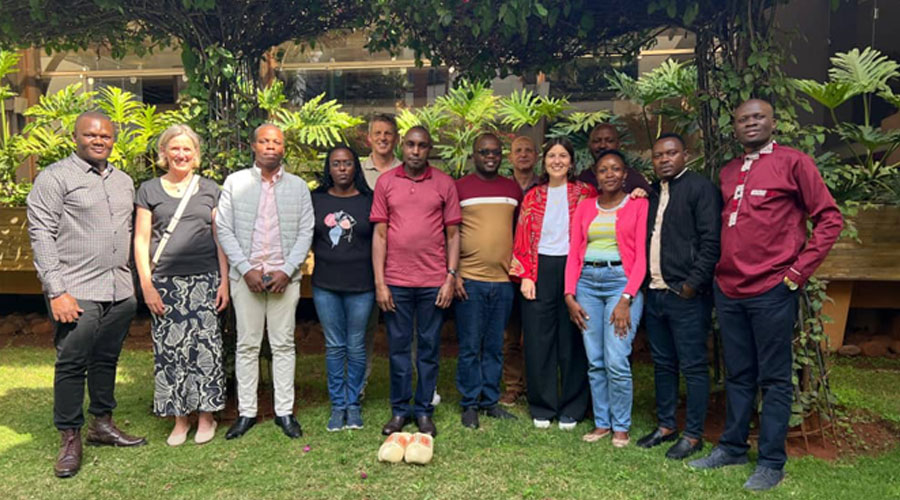
Our consortium will explore and evaluate approaches to defining health benefit packages (HBPs) in Kenya and Rwanda, including investigating the risk of making decisions under weak evidence, the political economy of HBP design and implementation, strategies for engaging patients and communities, the implications of HBPs for the health system.
Shaping Health Packages and Researching Priorities (SHARP) Research Consortium
Governments' funding decisions for Universal Health Coverage include choosing health services among a wide range of options that vary in costs, health, and societal impacts, within a limited budget envelope.
One approach to deciding which services to fund is defining ‘health benefit packages’ (HBPs). HBPs list the services to be publicly funded and guaranteed to the population. Collating locally relevant evidence on proposed services and involving key local stakeholders can help governments and national insurers prioritise the health services they include in the HBP and provide legitimacy to these choices. This process can be challenging when considering the range of evidence required (whether services provide value for money, improve equity, and are feasible to deliver at scale), the complexity of engaging various stakeholders, and the challenge of ensuring HBPs are adopted by healthcare providers.
Over a period of 4 years, our NIHR funded project will investigate these challenges. We will evaluate whether HBP design follows legitimised processes and their proposed outcomes alongside examining the political economy of the reforms. The project will also explore how evidence is produced and used to inform design, the role of different stakeholders including patients and the community, and the implementation challenges for HBP recommendations. This research will be embedded in HBP revision processes in Rwanda and Kenya, with the aim of informing the wider African region.
Our research will be undertaken by a partnership comprising University of Rwanda, University of Nairobi, KEMRI, London School of Hygiene and Tropical Medicine and Radboud University.
LSHTM
- Lorna Guinness (Co-PI)
- Francis Ruiz
- Project coordinator: Afroditi Georgopoulou with Kyllikkie Hamutumwa
KEMRI-Wellcome Trust
- Edwine Barasa (Co-PI)
- Jacob Kazungu
- Evelyn Kabia
- Dennis Waithaka
- Phd Student: Nancy Waithera
- Project coordinator: Zipporah Muchoki
University of Rwanda
- James Humuza
- Jean Marie Sindambiwe
- Yvonne Delphine Nsaba Uwera
- PhD student: Isabelle deValois
University of Nairobi
- Julius Korir
- Daniel Mwai
- Evans Kirui
- PhD student: Brian Obiero
Radboud University Nijmegen Medical Center
- Rob Baltussen
- Cassie Nemzoff
- Anna Socha
Strengthening multi-stakeholder approaches to health benefit package design in Rwanda and Kenya that account for data, time and capacity constraints
Adopting a range of mixed methods approaches including literature reviews, modelling, stakeholder interviews and workshops, our research aims to:
- inform and design an approach to selecting the best evidence assessment method for evidence informed priority setting for health benefits packages (HBPs) in Rwanda and Kenya
- inform and design strategies for effective patient and community involvement in HBP revision through the identification of the key stakeholders, and determining their interests and preferences
- develop an approach to selecting which health systems functions and costs should be considered in HBP design to identify the implications of HBPs for the health system
- assess whether HBPs achieve the procedural aims of evidence-informed priority setting processes in Rwanda and Kenya
- assess the consequentialist outcomes of evidence-informed priority setting processes in HBP design in Rwanda and Kenya
- understand how HBPs impact the allocation of resources and power between key actors
- pilot a self-reflective evaluation for stakeholders involved in evidence-informed priority setting and HBPs to determine 1) how and why priority setting processes succeed or fail; 2) how success or failure relates to underlying interests; and 3) what lessons other countries can learn from Rwanda and Kenya
- strengthen training and capacity, and foster community engagement and involvement for HBP design processes in Rwanda and Kenya
Health Benefit Packages (HBPs) seek to define health sector priorities and improve population health
HBPs are a policy instrument aimed at defining health sector priorities aiming to improve population health. Moreover, by ensuring a transparent and inclusive approach to priority setting, HBPs aim to improve the legitimacy of health sector priority setting. HBPs require institutional development of health sector processes and structures, including capacity strengthening and the engagement of a wide number of stakeholders. As such, we conceptualise HBPs as both a technocratic and political mechanism to navigate contested interests around health service priorities, where the characteristics of these interests, and the capacity of the health system, both constrain and enable HBP institutionalisation.
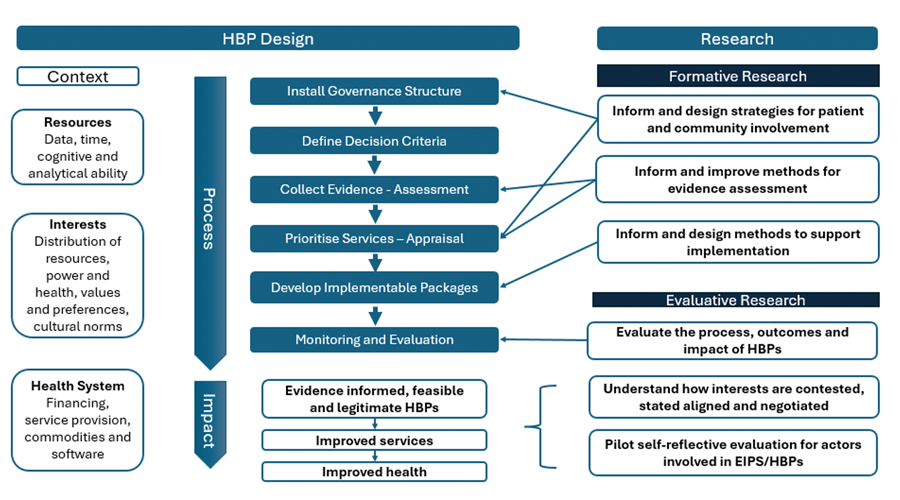
Our framework brings together several previous frameworks used to understand HBPs and evidence-informed priority setting. We have used it to define a set of research work packages organised into two categories. Work packages 1.1-1.3 concern research to inform HBP design and includes enhancing procedural and methods aspects (Formative Research). Work packages 2.1-2.3 relate to whether the evidence-informed priority setting process has achieved its intended outcomes, and involves self-reflective research by the consortium (Evaluative Research).
The SHARP project highlights the critical importance and integral nature of capacity strengthening as part of its work, across all work packages. Effective evidence informed priority setting (EIPS) for HBP design requires the building of skills and knowledge across multiple stakeholders while relying on the creation of institutionalised structures with defined roles and responsibilities. As such, it is both possible and necessary to set out in the capacities required by different stakeholders group and the specific skills and competencies required by individuals.
The United Nations Development Programme INNE Model describes four general categories of capacity needs: Individual, Node, Network and Enabling Environment (see illustrative figure (pdf)). Each category implies a different segment of the population – or stakeholder – with specific capacity needs. This framing implies that a spectrum of activities that identifies the different roles and skill sets of all involved in the process is required to build effective capacity. Tailored approaches are needed for each stakeholder category.
Mentorship and postgraduate training, and organisational strengthening are an essential feature of all of SHARP’s work packages, and network-based actions through leveraging ongoing Africa Health Economics Study Group (AfHESG) training and engagement with Africa CDC and other regional actors.
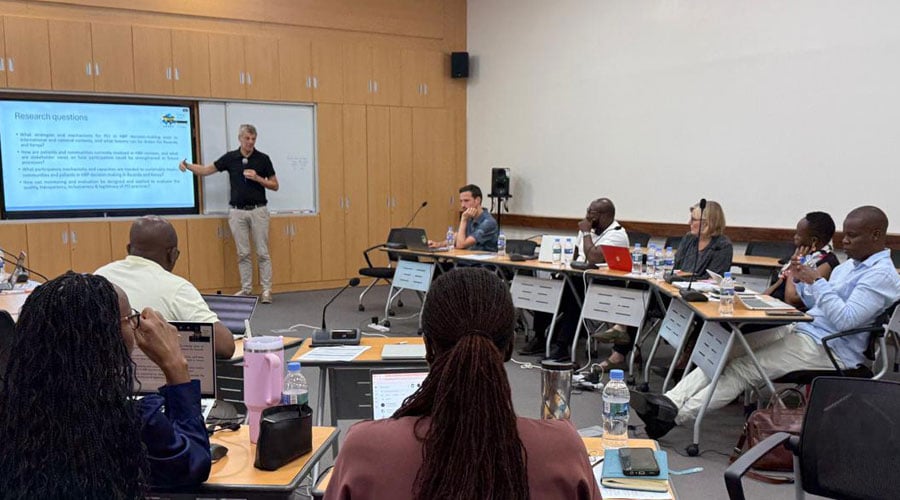
SHARP researchers gathered in Kigali for their second collaborators meeting to discuss progress and next steps across all the work packages. The SHARP project supported PhD students and early career researchers on presenting their findings on decision criteria, patient and community involvement and the political economy of Health Benefit Package (HBP) design.
SHARP researchers are undertaking both formative and evaluative research, using mixed methods techniques, to enhance our understanding of the design and implementation of HBPs in Kenya and Rwanda, and beyond.
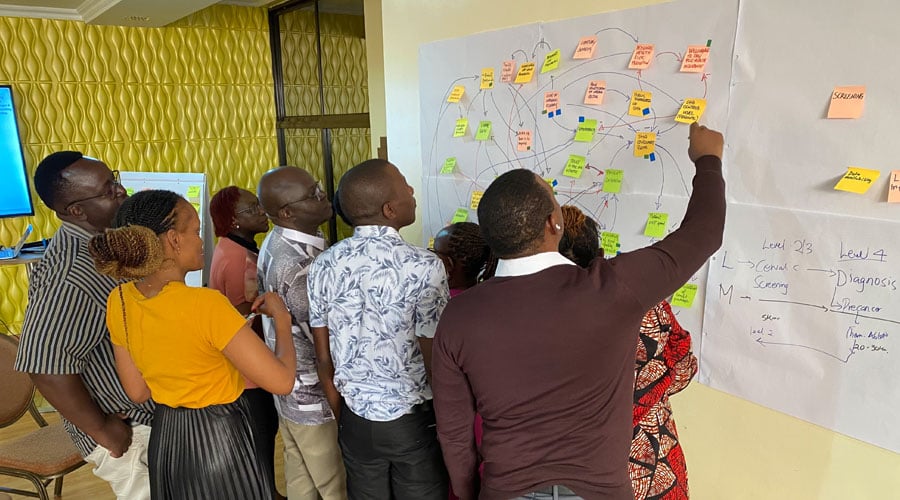
SHARP researchers met in Kenya to engage local key stakeholders on understanding factors that would facilitate or hinder implementation of Health Benefit Packages (HBPs) because of their potential to impact health systems.
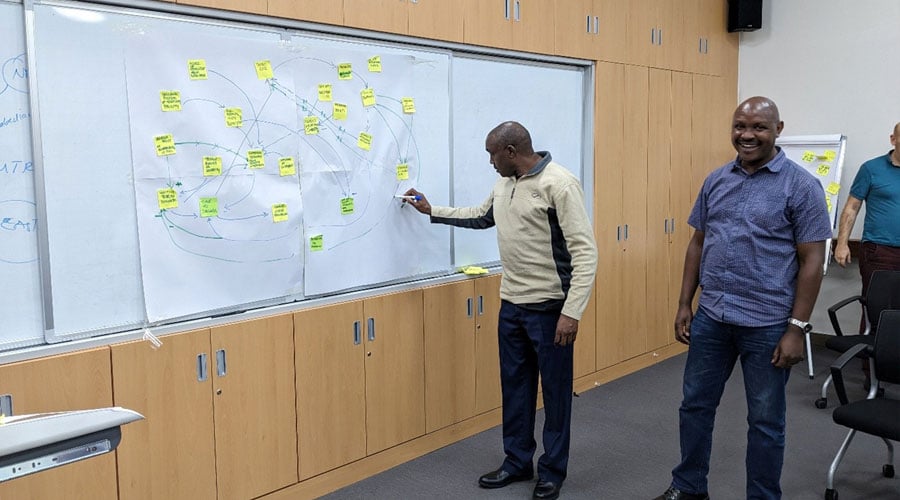
To explore these issues and examine its potential to inform HBP development, we are using systems dynamics modelling (SDM), where local stakeholders are guided to develop a causal loop diagram (CLD) of the elements and relationships within the health system that relate to HBP implementation.
The African Health Economics Study Group is a network of health economists convened by Kemri-Wellcome Trust in Kenya. Kemri-Wellcome Trust hosts monthly health economic training in the form of hybrid workshops. The SHARP project has been supporting this initiative since January 2025 and in the last quarter or 2025, we facilitated sessions on Health Technology Assessment and Health Benefit Package design.
In November 2025, the University of Rwanda hosted an African Health Economics Study Group training on Health Benefit Package Design facilitated by members of the SHARP team and the Rwandan Health Benefit Package assessment team.
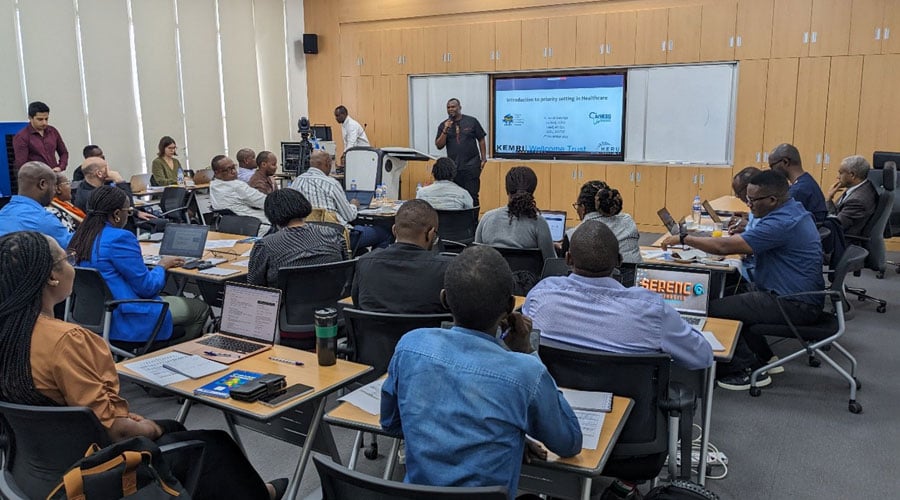
As part of Work Package 1.3, the SHARP project will use systems dynamic modelling to explore the health system impacts and implementation challenges of HBPs. We held a workshop in Kigali to train the research team members in this method, including a mock group model building exercise.
The SHARP advisory committee, chaired by Prof Ole Norheim (Harvard School of Public Health), met for the first time virtually along with SHARP project team members. The advisory committee provide SHARP with technical and strategic oversight and are comprised of international experts in HBP design and the specific research methods that the project is applying across the different work packages.
The advisory committee members are: Professor Ole Norheim (Chair), Professor Manuela Joore, Dr Deepa Rajan, Prof Karen Diacono, Prof Shankar Prinja, Prof John Ataguba, Dr Oguchukwu, Prof Justice Novignon, Prof Felix Massiy.
The SHARP project formally launched with an in-person consortium meeting in Nairobi, Kenya. This milestone marks the start of a regional effort, bringing together partners from around the world to shape better health systems.