Teens question the point of calorie labels, ahead of new public consultation
3 June 2026 London School of Hygiene & Tropical Medicine London School of Hygiene & Tropical Medicine https://lshtm.ac.uk/themes/custom/lshtm/images/lshtm-logo-black.png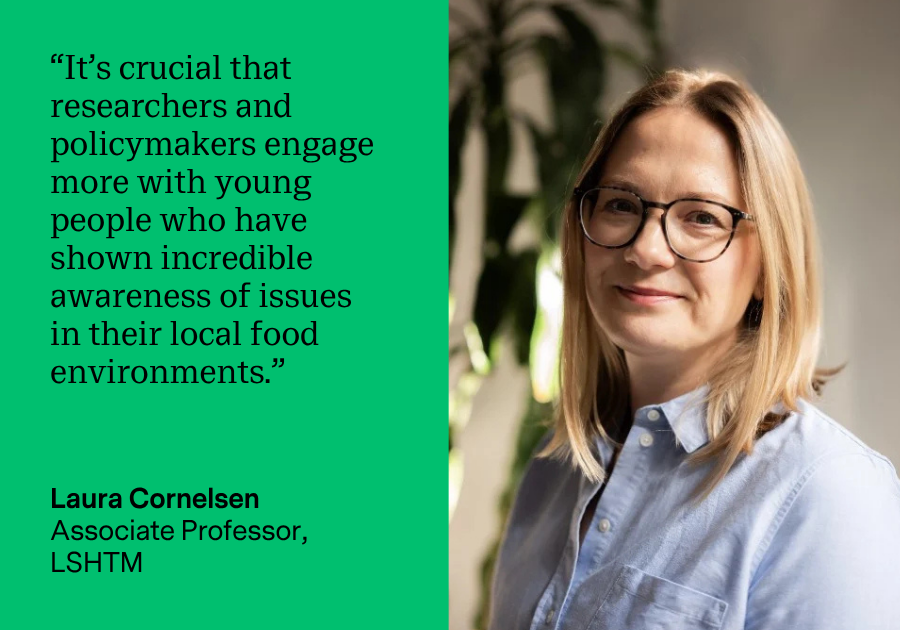
Research with young people revealed uncertainty around how helpful the law mandating calorie labelling for large restaurants serving food for consumption outside of home has been, and its broader impact on people’s relationship to food.
The findings are part of the team’s wider project, which has been looking at the use of calorie labels since they were mandated for large food businesses in England since 2022. Their research has already found that calorie labels rarely influence takeaway choices made by consumers and there was no observable change in calories purchased before and after the policy was introduced.
Published in BMC Public Health, the current study included two groups of young people - in inner city London and a coastal town in Devon - who took photos of their local food environment, including calorie labels on menus. The groups then discussed how they use and interpret the labels and presented their findings as part of a photography exhibit in their local community.
The research was led by the London School of Hygiene & Tropical Medicine and the University of Exeter. Comments from group discussions consistently said that more information than calories would be required for labelling to be truly helpful for them to tell if a food is more or less healthy. Though some recognised problems with the traffic light scheme used in supermarkets, participants felt this was more informative than displaying the calories alone. Young people also raised their concerns that labelling may be harmful, particularly around the potential to worsen eating disorders.
Discussions also explored their understanding of how commercial influences shape diets and how they value food beyond the calories or energy it provides. The role of business was a major talking point as the young people discussed their concerns for advertising tactics (for example price promotions, celebrity advertising) that promoted unhealthy food to children.
Laura Cornelsen, Associate Professor at LSHTM, said: “It is crucial that research, as well as policymakers, engage more with our young people. They have shown incredible awareness of the issues in their local food environments and as future consumers, their concerns on needing more meaningful approaches to regulating out-of-home food offer should be heard.”
Participants also reflected on the socioeconomic context that influences how people choose food. The young people were aware that families with lower incomes had less access to healthier foods and how this worsens health inequalities.
Another recent paper from the researchers, published in Health & Place, analysed online menus from food delivery platforms between June 2022 and October 2023 to see how menu composition may have changed but also who are exposed to calorie labelling. While showing some potential health benefits as the median number of calories per dish went down by 14 kcal, the authors found some evidence to suggest that the policy may unintentionally widen inequalities.
A greater proportion of restaurants in the least deprived areas (14% of total restaurants) displayed menu calories than the most deprived where 9% of total restaurants showed calories. The current laws only obligate large chain takeaways and restaurants to display calories, which could widen inequalities as areas with greater deprivation have more smaller businesses that don’t need to display calories on menus.
Young people emphasised the importance of supporting local, smaller businesses who were seen to have stronger links with local communities. This was linked to broader support for outlets considered more ethical and sustainable; covering many issues such as being less wasteful with food, exploitation via low-wage labour, and how livestock were treated.
The group also discussed why people might choose to go to a restaurant or takeaway that might sell unhealthy food. As well as going to restaurants where they could comfortably socialise with friends, many said they would continue to support businesses where they had strong links. For example, supporting restaurants that serve food from their cultural background.
There is consistent evidence that younger people in the UK are more likely to be frequent consumers of fast food and takeaways, including using online delivery services – a sector that has seen significant growth in recent years. The team say more discussions need to take place with young people directly, as they try to navigate complex food environments, with information that is often misleading, conflicting, or confusing.
Er V, Forbes C, Marks D et al. ‘We should be focusing on why we eat, what we eat and how it makes us feel, not how many calories it has’: a photovoice study exploring young people’s views on the out-of-home calorie labelling policy in England and their priorities for changing the local food environment. BMC Public Health, 2026.
Kalbus A, Tanasache OA, Law C. How did labelling provision on menus for online food delivery change after implementation of England's calorie labelling regulations? Health & Place, 2026.
If you enjoyed this article and would like to build a career in global health, we offer a range of MSc programmes covering health and data, infectious and tropical diseases, population health, and public health and policy.
Available on campus or online, including flexible study that works around your work and home life, be part of a global community at the UK's no.1 public health university.