From prediabetes to cancer: Why early intervention matters
20 April 2026 London School of Hygiene & Tropical Medicine London School of Hygiene & Tropical Medicine https://lshtm.ac.uk/themes/custom/lshtm/images/lshtm-logo-black.png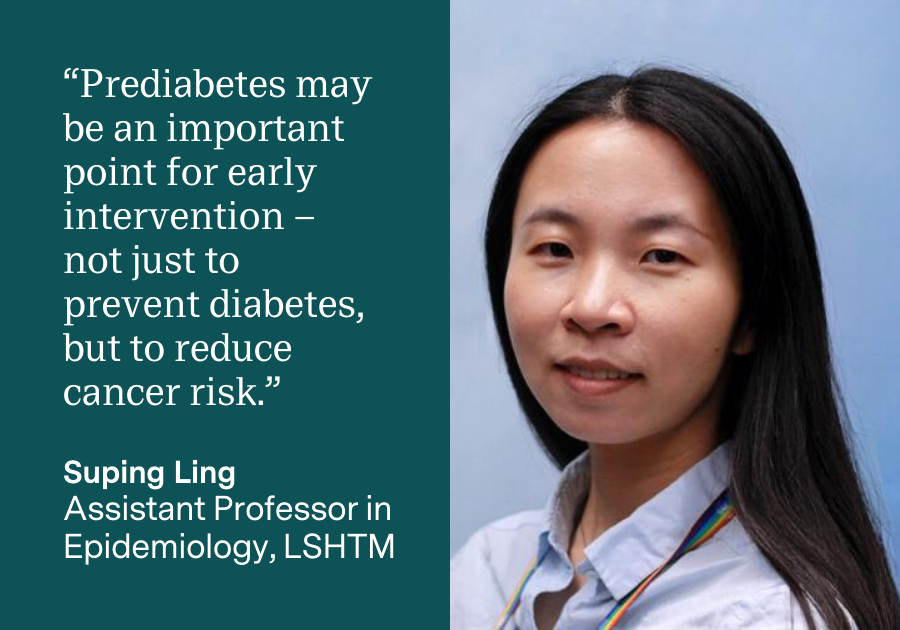
Dr Suping Ling is an Assistant Professor in Epidemiology at the London School of Hygiene & Tropical Medicine (LSHTM), working within the Inequalities in Cancer Outcomes Network (ICON) group.
What is prediabetes and how serious is it?
Prediabetes refers to a state where blood glucose levels are higher than normal but not yet high enough for a diagnosis of type 2 diabetes. It is often symptomless, yet affects around one in twelve people in the UK. While it is widely recognised as a precursor to diabetes and cardiovascular disease, growing evidence suggests it may also be linked to increased cancer risk.
What was the focus of your recent study?
I worked with researchers at the University of Leicester to try to understand what happens after a diagnosis of prediabetes. Specifically, we looked at how many people go on to develop type 2 diabetes or cancer, and how this varies across different groups. To do this, we analysed anonymised primary care data from over 330,000 individuals in England diagnosed with prediabetes between 1998 and 2018.
What motivated you to explore the link between prediabetes and cancer?
My background spans both diabetes and cancer epidemiology, and I became interested in both the gaps and overlaps between these two fields. Previous studies have shown that people with type 2 diabetes have a higher risk of certain cancers, including colorectal, liver and pancreatic cancers. Looking at prediabetes offers a window to explore how cancer risks may develop earlier than we typically consider, which may help us catch cancer earlier.
What causes the link between diabetes and cancer?
These mechanisms are not yet fully understood, but one possible explanation is that insulin resistance and high levels of insulin in the blood may activate biological pathways that promote tumour growth.
What did your study find?
One of the key findings was that cancer incidence rates following prediabetes were similar to those observed after a diagnosis of type 2 diabetes. This suggests that the metabolic processes that can lead to cancer may begin before diabetes is clinically diagnosed. We also found that the risk of developing and living with cancer following a prediabetes diagnosis is greater in those aged between 55 and 75 years than any other age groups.
Were there any other differences in risk between population groups?
Yes – as well as age at prediabetes diagnosis – we found that risk varies depending on factors such as body mass index (BMI), ethnicity, smoking status and socioeconomic position. For example, higher BMI in people with prediabetes was associated with an increased risk of developing both type 2 diabetes and cancer over a ten-year period.
What are the implications for public health and prevention?
Our findings suggest that prediabetes may be an important point for early intervention – not just to prevent diabetes, but potentially to reduce cancer risk as well. More awareness is also needed among healthcare professionals and patients about the connection between diabetes and cancer.
How should health systems respond?
To be cost-effective and deliver real health benefits, interventions should consider the age at prediabetes diagnosis and other risk factors. For example, in younger people with prediabetes, interventions should focus more on reversing prediabetes or preventing the development of type 2 diabetes, but such interventions may not be as effective in older populations. In older populations with prediabetes or type 2 diabetes, more emphasis is needed on interventions that promote early diagnosis of cancer.
What’s next for this research?
Further work is needed to identify the most effective points for intervention. I’d like to explore how the cancer diagnostic pathway can be optimised for people with prediabetes and type 2 diabetes, as well as how cancer surveillance and care can be better integrated in (pre)diabetes management.
This could include evaluating whether it would be cost effective to expand cancer screening programmes for these populations; assessing whether the two-week-wait cancer referral criteria should be tailored for people with diabetes (for example, by lowering the threshold for bowel cancer screening tests); and considering whether cancer risk should be routinely discussed during patients’ annual diabetes review.
Secondly, given that life expectancy is increasing, more people are expected to develop multiple long-term conditions over the course of their life, including diabetes, cardiovascular disease and cancer. I’m interested to look at whether the transitions between order of appearance of these conditions affect people’s experience in accessing healthcare. For example, do cardiovascular complications in people with (pre)diabetes complicate the process of cancer diagnosis and treatment?
What is your key takeaway from this work?
Looking more broadly, this research highlights the importance of looking at how diseases develop over time – and the value of bridging traditionally separate fields to do so.
Research paper
Zaccardi F, Ling S, Gillies C et al. Trajectories of type 2 diabetes and cancer in 330 000 individuals with prediabetes: 20-year observational study in England. The Lancet Diabetes & Endocrinology, 2025; 14, 41-49
If you enjoyed this article and would like to build a career in global health, we offer a range of MSc programmes covering health and data, infectious and tropical diseases, population health, and public health and policy.
Available on campus or online, including flexible study that works around your work and home life, be part of a global community at the UK's no.1 public health university.