Gaps within care for people living with TB
2 April 2026 London School of Hygiene & Tropical Medicine London School of Hygiene & Tropical Medicine https://lshtm.ac.uk/themes/custom/lshtm/images/lshtm-logo-black.png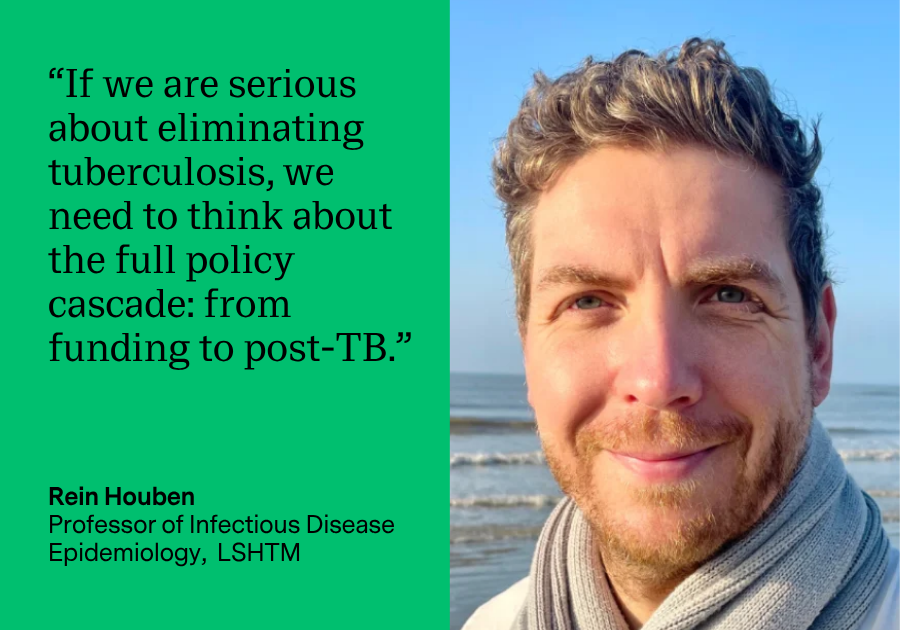
When someone talks about recovering from a major illness or infection, most people think of the trip to the doctor. What was their diagnosis? How long do you need to take the medicine they prescribed to you? How long did it take to really recover?
As public health officials have focused on ending tuberculosis since its declaration as a public health emergency in 1993, it’s perhaps unsurprising that their focus has been on the clinical process from diagnosis to treatment. And while improving diagnostics and technology has led to progress against TB, that doesn’t cover the whole cycle.
On the contrary, as a new commentary involving Rein Houben from the London School of Hygiene & Tropical Medicine shows, there is increasing concern that current care cascades disregard many steps at the starting and end points for TB infections. TB isn’t just an infection; it is a social disease where true recovery is influenced by broader social factors. As progress in reducing cases stalls and becomes more vulnerable, more people are arguing for a broader public health approach that can tackle TB’s social elements.
Life before the clinic
Public health approaches are defined by the TB care cascade, which usually shows the steps required for someone with TB to receive complete, successful care. Collectively, they map how many people reach each step to understand where high levels of drop-off occur, so we can see what the best approaches might be to prevent this. And it’s within this pathway where we can also see where steps that are missing.
The conventional first step of focus would be to look at the number of people screened for TB in health clinics. How many people who have TB can be identified by the health system? But this metric only considers people who are actively checking whether they have TB, or at best specific targeted groups that are offered/obligated to seek tests. That however excludes over 95% of the population.
While it’s understandable for institutes that need to carefully spend limited funds, the reality is that by excluding 95% of the population for screening, it becomes impossible to eliminate TB.
New approaches for outreach will be needed to help close this gap. Fortunately, there are already some good examples, as shown by the CAST/CAST-TB+ campaign in Uganda. To reach more people, the organisers enlisted the help of key community leaders, as well as volunteers, for proactive outreach about TB and the importance of screening. This effort allowed campaigners to reach new groups of people who would otherwise have missed public health messaging tackling stigma around TB and seeking treatment.
More people to screen also means more resources required – a side effect of the current focus on clinic-based care, many important stakeholders are not involved despite their potential to contribute. In a climate of austerity and abrupt funding cuts, it’s more important than ever to engage with new stakeholders who can find creative new sources of funding to match the expanded ambition of TB programmes. One example would be the ‘sin tax’ that the Philippines introduced on tobacco and alcohol to support their health budgets.
Post-TB? More problems
On the other side of the cascade, we need to think about life after TB as recent research shines a spotlight on broader social factors which shape our response to TB care.
As part of a major NIHR-funded study jointly led by LSHTM and Stellenbosch University, an increasing focus is coming on the long-term damage for ‘post-TB’ patients might mean they’re unable to work the same job, enjoy certain hobbies like sport, or become shunned by their community, despite no longer being infectious. New stages in TB care cascades are needed to acknowledging these long-term problems. Communicating this to policymakers is essential for building the long-term healthcare and welfare programmes that can support ‘post-TB’ patients.
The reality is that chronic ‘post-TB’ and long-term disabilities and its conditions aren’t factored into current care programmes for TB, and are not in the usual care cascades. This is made all the more difficult by a major technical oversight: a lack of an ICD code for ‘post-TB’.
One example of a ‘post-TB condition’ is post-TB lung disease (PTLD), which affects many of the 155 million people who have survived TB across the world. For those with PTLD, they will continue to have breathing problems that affect their every-day life and a great risk of early death.
The disease itself has been well-known for hundreds of years, and recently even got an official definition from the World Health Organization. However, the disease remains invisible to healthcare systems as they lack an International Classification of Diseases (ICD) code.
As Rein Houben and colleagues highlighted in their Lancet Respiratory Medicine commentary, ICD codes categorise disease for clinical diagnosis, which structures any activities related to the disease within research, healthcare systems, and public health governance. No official diagnosis can be given, even when the doctors know it’s PTLD, meaning they have to creatively label it as an alternate diagnosis like emphysema, and manually adding #post-TB notes on written charts.
This distorts numbers for other conditions, and undermines efforts to take people’s livelihoods seriously after TB. After all, healthcare and insurance systems cannot provide effective care for a disease that it cannot recognise. This particular problem has a simple solution: create and implement a new primary ICD code for PTLD.
The two commentaries, and associated research by members of the Centre for Mathematical Modelling of Infectious Diseases and the TB Centre at LSHTM, show a clear case for expanding our understanding of TB care. If the public health community is serious about eliminating TB, we need to look at more paths where TB arises and lingers and we need to work with more stakeholders.
There are numerous gaps at the start and end of TB care that, when plugged, will not just improve the lives of millions who are directly affected by TB but improve everyone’s lives. The cost of TB is felt across communities and families who watch people’s quality-of-life suffer and lose valued members.
Publications
Vo LNQ et al. Pursuing policymakers, payors and public – expanding the beginning and end of the tuberculosis care cascade to reflect whole-of-society ambitions. PLOS Global Public Health, 2026. DOI: https://doi.org/10.1371/journal.pgph.0006018
Allwood B et al. #Post-tuberculosis lung disease: no ICD code, no problem? The Lancet Respiratory Medicine, 2026. DOI: https://doi.org/10.1016/ S2213-2600(26)00081-0
If you enjoyed this article and would like to build a career in global health, we offer a range of MSc programmes covering health and data, infectious and tropical diseases, population health, and public health and policy.
Available on campus or online, including flexible study that works around your work and home life, be part of a global community at the UK's no.1 public health university.