Experts receive almost £4m to tackle diet-related disease and obesity
14 May 2026 London School of Hygiene & Tropical Medicine London School of Hygiene & Tropical Medicine https://lshtm.ac.uk/themes/custom/lshtm/images/lshtm-logo-black.png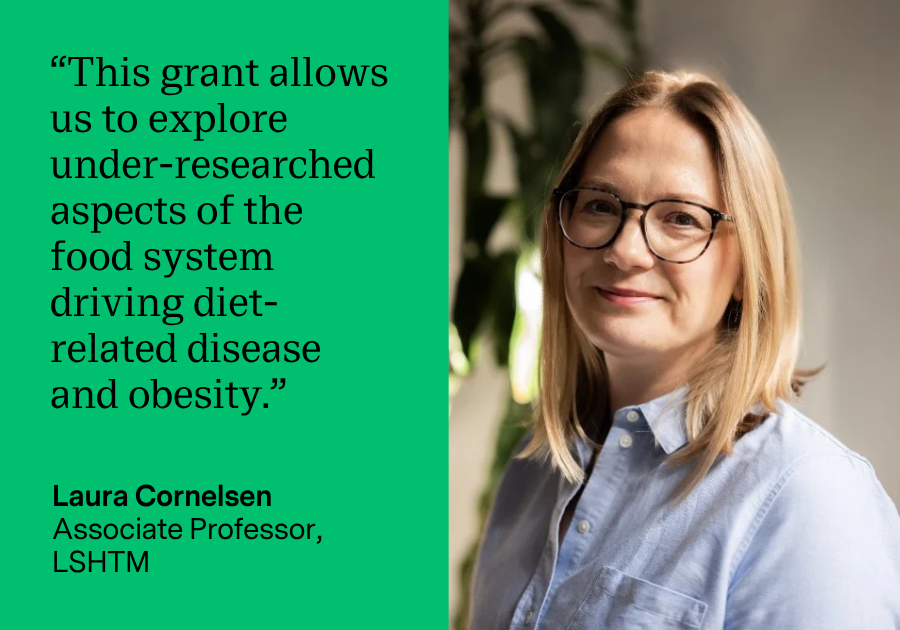
A team of experts, including members of the London School of Hygiene & Tropical Medicine, have secured almost £4m to deliver a 5-year project to better understand the UK’s food environment.
The ‘food environment’ is the combination of physical, economic and social conditions that affect what and how much the public eat. In the UK, unhealthy food products are common, widely promoted, cheap to buy and available in lots of different places. This makes it far more likely that people consume unhealthy diets, leading to diseases including obesity heart disease and diabetes.
Thanks to £3.9m funding from the National Institute for Health and Care Research (NIHR), Professor Eric Robinson will lead a team of experts from the University of Liverpool, University of Oxford, City St George’s University of London and London School of Hygiene & Tropical Medicine, to research the benefits of current actions to tackle this national health challenge and highlight possible new ones.
Laura Cornelsen, Associate Professor at LSHTM, said: “This grant provides a valuable opportunity to explore new and under-researched aspects of the food system driving diet-related disease and obesity. Our team is particularly excited to focus on the out-of-home food environment, which is an increasingly important part of the system, to collect novel data and develop and test interventions with real potential to improve health equity.”
Eric Robinson, Professor of Psychology at the University of Liverpool, said: “Local and national governments have recently tried to improve the food environment by taking new actions – including banning outdoor unhealthy food adverts. While these actions are promising, they cannot solve the problem as a whole.
"Over the next five years, we aim to generate robust evidence to support reductions in NHS costs and decrease the number of patients requiring care. By providing this evidence, we increase the likelihood that our research will drive meaningful action and lead to improvements in public health.”
Charlotte Buckley, post-doctoral researcher at the University of Liverpool, said: “A main aim of our project is to evaluate existing food environment policy interventions and identify new ones. Importantly, we will work in collaboration with communities and the public to guide and inform our work as it progresses.”
The research team brings together academic expertise from four different UK universities as well as charity Diabetes UK. Together they will use a variety of research methods to work with the public and policy makers to better understand how the food environment could be changed to improve diet and health. A key area of research will focus on areas of socio-economic deprivation, where there is a high prevalence of unhealthy diet and health conditions.
This story was adapted from a press release by the University of Liverpool.
If you enjoyed this article and would like to build a career in global health, we offer a range of MSc programmes covering health and data, infectious and tropical diseases, population health, and public health and policy.
Available on campus or online, including flexible study that works around your work and home life, be part of a global community at the UK's no.1 public health university.