Expert comment: World Cup heat warning over player safety
14 May 2026 London School of Hygiene & Tropical Medicine London School of Hygiene & Tropical Medicine https://lshtm.ac.uk/themes/custom/lshtm/images/lshtm-logo-black.png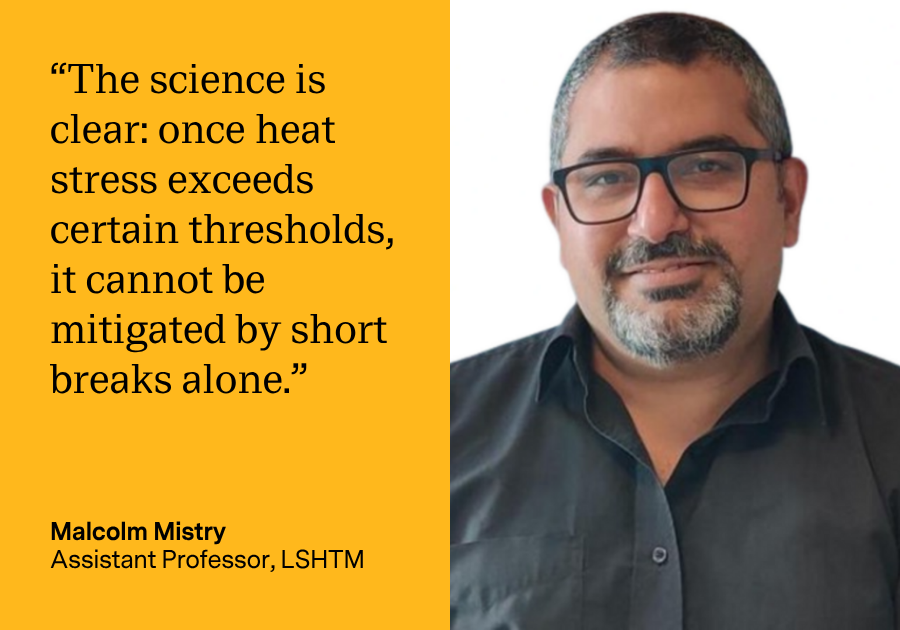
A group of leading scientists and medical experts, including from the London School of Hygiene & Tropical Medicine (LSHTM), have called on football governing body FIFA to address dangerous heat stress risk for players in the World Cup.
The 2026 men’s tournament, which starts in June, is being held in the US, Canada and Mexico. Temperatures in stadiums are expected to soar, particularly in parts of the southern US and Mexico where average daytime temperatures are in the low-to-mid 30s°C, and can reach 40°C during hotter periods.
FIFA has introduced special measures for the World Cup to protect player welfare such as mandatory three-minute cooling breaks and climate-controlled benches for technical staff and substitutes at all outdoor matches.
These are based on the Wet Bulb Globe Temperature (WBGT) measure, which assesses physical heat stress on the body and combines multiple factors such as temperature, humidity, wind and sunlight. A WBGT of around 28°C is widely considered the point at which heat stress becomes a significant concern for elite athletes engaged in high metabolic activity.
In an open letter coordinated by the New Weather Institute and Fossil Free Football, experts in health, sport and climate say that FIFA’s standard guidelines – which set the safety threshold at a WBGT of more than 32°C - need to be updated.
The letter notes that a WBGT of 32°C is equivalent to an air temperature of 45°C and relative humidity of 20% (with no direct sunlight and wind speed of 1m/s), and warns that FIFA’s current safe levels for player activity under extremely hot conditions are “impossible to justify”, even for acclimatised athletes.
With climate change due to burning oil, coal and gas making extreme heat more likely, the authors of the letter to FIFA also say the “active promotion” of fossil fuels (through Aramco sponsorship) represents “a conflict of interest with the protection of player welfare”.
Malcolm Mistry, Assistant Professor in Climate and Geo-spatial Modelling in the Environment and Health Modelling Lab at LSHTM, is one of the signatories on the letter.
He said: “Athletes performing in endurance outdoor sports, such as football, marathon and cycling, often experience high ambient heat stress, which when combined with high metabolic activity can prove lethal.
“FIFA’s 2025 medical strategy provides limited evidence of factoring in recent research regarding the escalating risks of dangerous heat stress in a warming climate on elite footballers' health, including others such as on pitch referees.
“The science is clear: once heat stress exceeds certain thresholds, it cannot be mitigated by short breaks alone. We therefore encourage FIFA to align its tournament protocols with contemporary exercise physiology and the best available science to protect player health.”
The concerns about the World Cup also raise wider questions about how other elite sport competitions adapt to increasing heat risks in a warming climate.
Earlier this year, Dr Mistry warned that extreme heat is becoming a growing threat across international sporting events, with lessons for organisers, governing bodies and athlete welfare protocols beyond football alone.
If you enjoyed this article and would like to build a career in global health, we offer a range of MSc programmes covering health and data, infectious and tropical diseases, population health, and public health and policy.
Available on campus or online, including flexible study that works around your work and home life, be part of a global community at the UK's no.1 public health university.