Expert comment: Extreme heat lessons for elite sport competitions
26 February 2026 London School of Hygiene & Tropical Medicine London School of Hygiene & Tropical Medicine https://lshtm.ac.uk/themes/custom/lshtm/images/lshtm-logo-black.png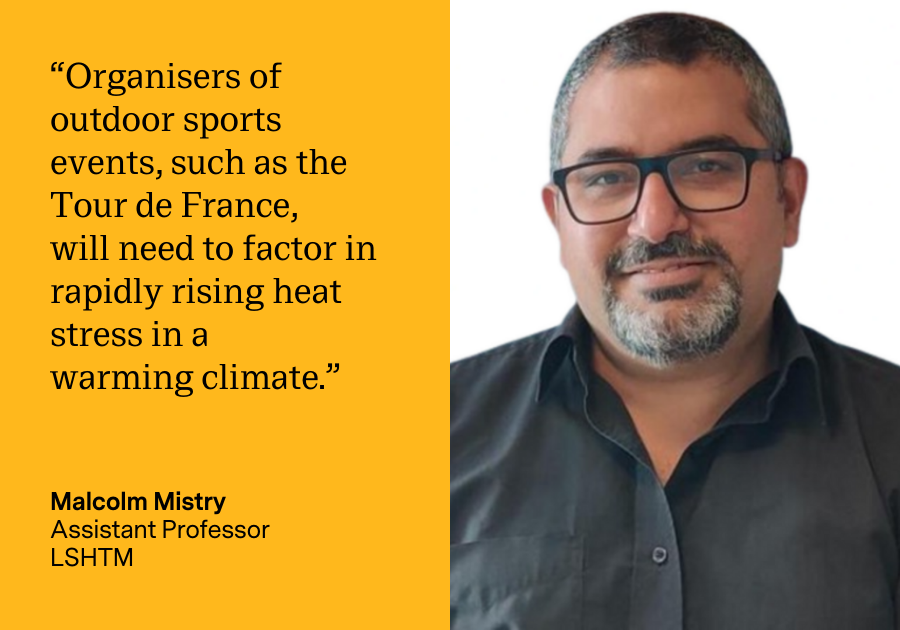
Organisers of outdoor sporting events may need to change timings, format or location to protect athletes from increasing levels of extreme heat, according to a new study.
Researchers including from the London School of Hygiene & Tropical Medicine (LSHTM) found heat stress conditions across France have risen over the past 50 years.
This has implications for the Tour de France road cycling race that is historically held in July, but also for other sports competitions such as the football World Cup being held in the US, Mexico and Canada in the summer of 2026, or the 2028 Olympic Games in Los Angeles.
The research, published in Scientific Reports, was led by the French National Research Institute for Sustainable Development (IRD), in collaboration with LSHTM, the Barcelona Institute for Global Health (ISGlobal), and other partners.
Using the Wet Bulb Globe Temperature – a metric that captures the combined effects of temperature, humidity, wind and solar radiation – the team found many locations along the Tour de France route are now more frequently crossing thresholds associated with high risk to athlete health.
They suggest that adjustments to race timings and routes may be needed in the future, with potential implications for planning and mitigating actions in other high endurance sporting events.
Dr Malcolm Mistry, Assistant Professor in Climate and Geo-spatial Modelling in the Environment and Health Modelling Lab at LSHTM and co-author on the study, said:
“Outdoor sports fixtures, especially those involving high metabolic activities and spanning prolonged daytime hours such as road cycling and marathon, are physically demanding for athletes even under optimum thermal conditions.
“Now imagine high heat stress - a combination of moderate to high air temperature, humidity and exposure to sunlight. Such ambient conditions when experienced even by average healthy spectators at the sidelines can lead to heat exhaustion. For athletes pushing their bodies over the line, the toxic combination of physical exertion and high ambient heat stress can not only reduce their physical performance, but also pose a significant health risk.
“The 2026 Australian Open (Tennis) and the 2024 Paris summer Olympics are classic examples of the serious threat extreme heat posed to competitors, with the athletes expressing their concerns on the dangers to performance, health and even the fear of heat-related deaths. Likewise, the 2022 Qatar World Cup Football event was staged in the months of November and December to shield the players and spectators from the intense summer heat, a decision that was widely welcomed by the participating teams and stakeholders.
“Findings from our new study suggests that the organisers of outdoor sports events, such as the Tour de France, will need to factor in the rapidly rising heat stress in a warming climate, depending both on the place and the time of the year when such events are held.
“While adaptive measures are common across most major sports fixtures, such as new rules in Formula 1 to cool drivers in extreme heat, or extended breaks or suspending play in grand slam tennis competitions during periods of high heat stress, the pace at which the planet is warming may ultimately leave little or no room for athletes to participate in competitive outdoor events.”
Publication
I Cvijanovic, JD Begg, MN Mistry, D Petrova, C Brimicombe, B Sultan. The future of European outdoor summer sports through the lens of 50 years of the Tour de France. Scientific Reports. DOI: 10.1038/s41598-025-30129-8
If you enjoyed this article and would like to build a career in global health, we offer a range of MSc programmes covering health and data, infectious and tropical diseases, population health, and public health and policy.
Available on campus or online, including flexible study that works around your work and home life, be part of a global community at the UK's no.1 public health university.