Donated social media data will be used to evaluate UK's proposed restrictions
18 November 2026 London School of Hygiene & Tropical Medicine London School of Hygiene & Tropical Medicine https://lshtm.ac.uk/themes/custom/lshtm/images/lshtm-logo-black.png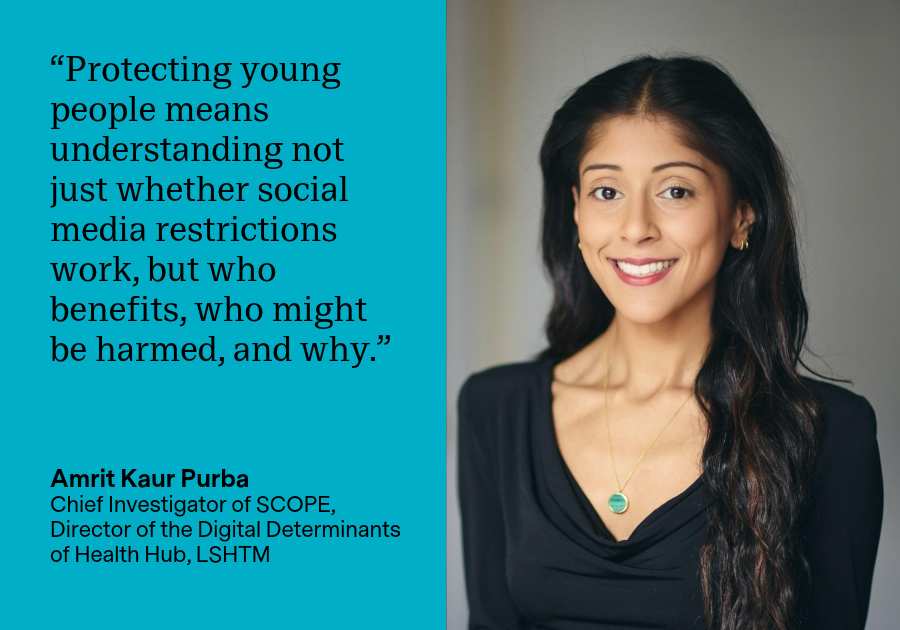
Social media data donated by young people will be used to build a picture of the content they encounter, as part of a major, independent evaluation of proposed UK social media restrictions announced today (18 November 2026).
The UK Government has proposed restricting access to social media for under-16s, alongside additional protections for 16- and 17-year-olds. The measures, which are still being finalised, are expected to be introduced in Spring 2027.
Rather than simply asking if a ban works, SCOPE, funded by Wellcome and led by Dr Amrit Kaur Purba at the Digital Determinants of Health Hub at the London School of Hygiene & Tropical Medicine (LSHTM), will examine the wider public health consequences of changing young people's digital environments. It will investigate whether restrictions improve young people's mental health and wellbeing, how and why any changes occur, who benefits or is disadvantaged, and what unintended consequences arise.
Wellcome announced SCOPE as part of a £9.3m investment into ten projects described as the world’s largest scientific assessment of social media restrictions and mental health. LSHTM researchers are also involved in another of the Wellcome-funded evaluations, building on The IRL Trial, which is testing if reductions in social media reduce levels of anxiety, and affect other outcomes such as sleep, bullying, and time spent with friends and family. Around 4,000 school pupils aged 12-15 are being recruited for The IRL Trial, that will involve a smartphone app that puts limits on social media use, short questionnaires, and interviews. The new study will evaluate the UK social media restrictions using the extensive Born in Bradford adolescent research infrastructure, including existing mental health and social media data collected before the policy is introduced.
A distinctive feature of SCOPE is its use of voluntarily donated social media data. This enables it to move beyond traditional measures of screen time and use computational methods and AI-assisted content classification to build a picture of the actual content young people encounter, including potentially harmful material relating to alcohol, drugs and antisocial behaviour, alongside commercial content and its sources.
It will investigate whether restrictions change young people's access to social media, reduce potentially harmful exposures, or lead them to alternative platforms, gaming environments, AI tools or offline activities. It will also examine whether restrictions unintentionally reduce access to supportive communities, health information, friendships and social connection.
Alongside mental health and wellbeing, the evaluation will also explore outcomes relating to alcohol and drug use, bullying and antisocial behaviour.
A major strength of SCOPE is that it does not rely on one dataset, comparison, or statistical method. It brings together multiple sources of evidence, including data from approximately 1,200 school pupils aged 14–15 and 2,000 young adults aged 18–24, in-depth discussions with young people and families, de-identified healthcare records, and two established national longitudinal studies. Studying these sources together will enable the researchers to investigate whether changes in mental health are consistent with effects of the restrictions rather than unrelated trends occurring at the same time.
SCOPE approaches social media as a commercially designed environment, rather than simply an individual behaviour. Recommendation systems, advertising, platform design and commercial incentives all shape what young people encounter online. The evaluation will investigate whether risks are reduced, displaced or accompanied by the loss of beneficial online experiences, helping policymakers understand if restrictions address the underlying determinants of harm.
Its findings will provide policymakers with evidence not simply on whether mental health outcomes change following the restrictions, but on how the policy is implemented, how young people respond, what mechanisms may explain observed effects, and whether benefits and harms are distributed equally.
Dr Amrit Kaur Purba, Chief Investigator of SCOPE, Wellcome Fellow, Director of the Digital Determinants of Health Hub at LSHTM, said: "For too long, the debate about social media and young people's health has been reduced to screen time and mental health. What young people encounter online matters just as much as how long they spend there. Their digital environments are shaped by powerful commercial interests, exposing them to content relating to alcohol, drugs, violence and other potentially harmful behaviours.
“What makes SCOPE different is that we're not simply asking whether social media restrictions work. We're investigating what happens when you fundamentally change young people's digital environments: whether harms are reduced, whether they move elsewhere, and whether some young people lose vital sources of connection and support.
“A social media ban may change who can access a platform, but that doesn't necessarily change the commercial systems driving harmful exposure. If we're serious about protecting children, we need to understand whether these policies tackle the causes of harm or simply move the problem somewhere else.
“Protecting young people means understanding not just whether social media restrictions work, but who benefits, who might be harmed, and why.”
The SCOPE team brings extensive expertise in public health evaluation methods to the emerging challenges of digital regulation. With expertise in causal epidemiology, public health policy evaluation, digital health, health inequalities and mixed-methods research, the team includes researchers with experience evaluating major population-level public health interventions, including Scotland's minimum unit pricing for alcohol, unhealthy food advertising restrictions, and the Soft Drinks Industry Levy.
Young people are actively involved in shaping the evaluation through the Digital Determinants of Health Hub's established Youth Advisory Group. This group will ensure young people’s perspectives and experiences are taken into account at every stage.
SCOPE began in November 2026 and runs for three years, covering the period before and several years after the proposed restrictions are introduced. Set-up is underway with data collection beginning in January 2027.
About SCOPE
SCOPE is led by Chief Investigator Dr Amrit Kaur Purba, Director of the Digital Determinants of Health Hub (DDH-Hub), with Professor Mark Petticrew at the London School of Hygiene & Tropical Medicine (LSHTM), in collaboration with researchers at LSHTM, and the Universities of Bath and Glasgow.
Dr Purba is a public health researcher specialising in causal epidemiology, adolescent health and the digital determinants of health. She previously served as Deputy Director of the UK Government's DSIT Commission on Social Media and Youth Health and led a major systematic review examining social media and adolescent health-risk behaviours, drawing on evidence involving approximately 1.4 million young people.
If you enjoyed this article and would like to build a career in global health, we offer a range of MSc programmes covering health and data, infectious and tropical diseases, population health, and public health and policy.
Available on campus or online, including flexible study that works around your work and home life, be part of a global community at the UK's no.1 public health university.