Rapid reaction: UK under-16s social media ban
15 June 2026 London School of Hygiene & Tropical Medicine London School of Hygiene & Tropical Medicine https://lshtm.ac.uk/themes/custom/lshtm/images/lshtm-logo-black.png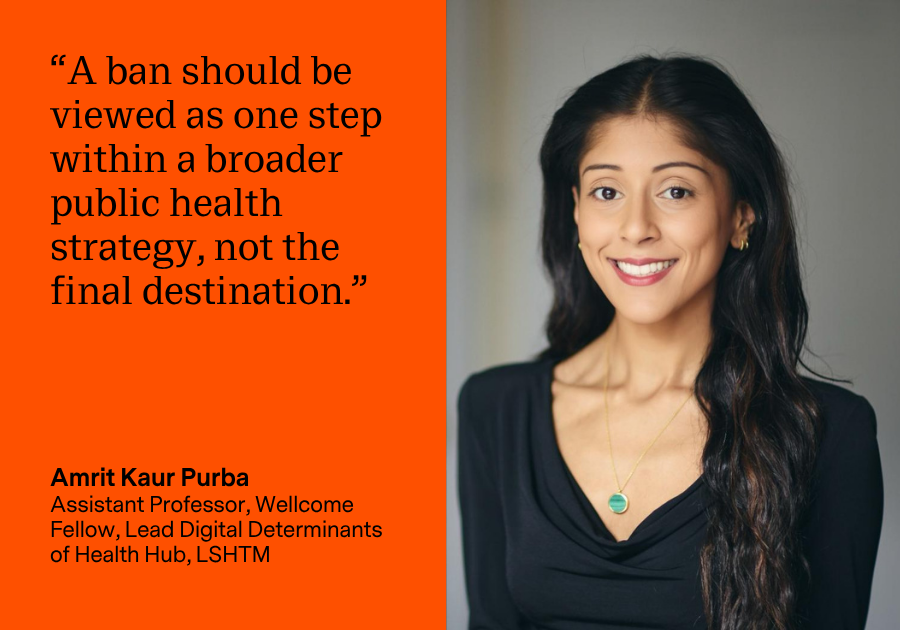
The UK Government announced on 15 June 2026 its plans to ban social media platforms from offering services to under-16s in the UK.
It is planned that the ban, that will include platforms like Snapchat, TikTok, YouTube, Instagram, Facebook, and X, will come into force by spring 2027.
Dr Amrit Kaur Purba, Assistant Professor, Wellcome Fellow, Academic Lead of the Digital Determinants of Health Hub at the London School of Hygiene & Tropical Medicine (LSHTM), said:
“There is a strong public health rationale for taking action to protect children online. We know that many young people are exposed to harmful content online, and growing evidence suggests that digital environments can influence a wide range of health, behavioural and developmental outcomes. Many parents will therefore welcome efforts to strengthen protections for children. However, it is important that we do not view social media restrictions as a simple solution to a complex problem.
“From a public health perspective, social media restrictions should be understood as complex systems interventions. Digital platforms are embedded within wider social, technological, commercial and political systems involving young people, families, schools, governments, advertisers, content creators and technology companies. When interventions are introduced into complex systems, the system adapts. Young people may migrate to alternative platforms, gaming environments, encrypted services or AI-based tools. Companies may redesign products, alter recommendation systems, strengthen age-verification processes, or shift activity into less regulated spaces. As a result, harms may be reduced, but they may also shift, evolve or be redistributed in ways that are difficult to predict.
“Importantly, success should not be judged solely by changes in mental health or reductions in screen time. Social media is increasingly recognised as a broader determinant of health. Digital environments can influence exposure to violence, self-harm and harmful content, substance use, sleep, physical activity, educational engagement, social relationships, social connectedness, identity development, civic participation, inequalities, and young people's wider opportunities to thrive. The key question is not simply whether social media use falls, but whether children's lives become healthier, safer and more equitable as a result.
“The other crucial point is that a ban should be viewed as one step within a broader public health strategy, not the final destination. Many concerns about social media arise not simply because platforms exist, but because of how they are designed. Features such as algorithmic amplification, infinite scrolling, engagement-driven recommendation systems, livestreaming, stranger contact, persuasive design and data-driven business models can shape what young people see, how long they remain engaged, and the risks they encounter. If we focus only on restricting access, we risk addressing symptoms while leaving some of the underlying drivers of harm untouched.
“The government's decision to combine age restrictions with measures targeting specific platform features is therefore particularly important. The key question is not simply whether a ban is introduced, but how effectively it is implemented, enforced and evaluated over time. Ultimately, the success of the policy will depend not only on whether it reduces platform use, but whether it reduces harmful exposures, improves health and wellbeing, avoids widening inequalities, and responds effectively to how young people and industry adapt over time. The priority now should be rigorous independent evaluation so we understand not only whether the policy works, but how it works, for whom it works, and whether there are unintended consequences across the wider digital ecosystem.
“Ultimately, the goal should not simply be to create children who spend less time online. It should be to create digital environments that are healthier, safer and fairer for children. A ban may be an important step towards that goal, but lasting progress will also require platforms to become safer by design.”
This is a rapid reaction to a breaking news story.
About Dr Amrit Kaur Purba
Dr Amrit Kaur Purba is funded by the Wellcome Trust and leads the Digital Determinants of Health Hub at the London School of Hygiene & Tropical Medicine. She has provided unpaid advisory input to the UK government and regulatory bodies, including the Home Office, the Department for Science, Innovation and Technology, Ofcom, the Metropolitan Police, and No 10 Downing Street, on issues related to online harms, digital regulation, youth violence, and adolescent health. She also holds unpaid advisory roles with the Alliance 4 Children and the UK Department for Education’s Technical Advisory Board (Education and Outcomes Panel) and has contributed to advisory activities related to youth digital technology use and public health through WHO and United Nations initiatives. She has received honoraria from academic institutions, government bodies, and public health organisations for invited talks relating to social media, online harms, and adolescent health.
If you enjoyed this article and would like to build a career in global health, we offer a range of MSc programmes covering health and data, infectious and tropical diseases, population health, and public health and policy.
Available on campus or online, including flexible study that works around your work and home life, be part of a global community at the UK's no.1 public health university.