The value of a global network: Noeleen’s LSHTM experience
27 October 2026 London School of Hygiene & Tropical Medicine London School of Hygiene & Tropical Medicine https://lshtm.ac.uk/themes/custom/lshtm/images/lshtm-logo-black.png
Academically, I've always been interested in social change, but public health was not necessarily what I had in mind for my career at the beginning. In my undergraduate degree, I studied sustainable development, with a range of focuses including human population change, demographics and economic development. I then ended up working in roles in East and Southern Africa, on a range of different public health issues. In South Africa, I was working with an organisation focused on HIV prevention and sexual reproductive health for adolescents. When I started full-time there, my focus was gender-based violence prevention and that became my primary interest, particularly around behaviour change and gender norms change.
I had always wanted to go to LSHTM as I knew it was the right fit for what I was doing and so I ended up getting the PIC scholarship to study MSc Reproductive & Sexual Health Research at LSHTM.
What I enjoyed about the MSc Reproductive & Sexual Health Research
I really enjoyed the range of things we were taught, and I thought the professors were extremely approachable. The research that was going on was fascinating, and much of it was at the frontier of reproductive and sexual health research. There was a lot of overlap between the professors, the work I had been doing, and the network that I had built up.
I knew about LSHTM research before I applied. I had been to many conferences with LSHTM professors, and as I was working on related research at the time, the name kept popping up, and therefore it seemed like the place to be.
Within the programme, there were people very much focused on reproductive health and others on sexual health - I was firmly on the sexual health side of the spectrum. There were a lot of professors who were working on very interesting topics, especially gender-based violence prevention, and I got to know most of them through classes.
The programme was quite quantitative, but at an approachable level which was great. I really liked the approach LSHTM took in its teaching of quantitative methods as I felt very supported and guided through it. I also loved that the MSc was on the smaller side as I'm still very close to a lot of my course mates.
My MSc project
I found a project opportunity in South Africa at a centre called Wits Reproductive Health and HIV Institute (Wits RHI) that collaborates closely with LSHTM. There were a lot of professors already doing research between the two institutions, so the LSHTM name and recommendation from our team helped me get in there.
The project focused on trialling contraceptive rings and looking at how they could do a combination of contraceptive and Pre-Exposure Prophylaxis (PrEP). It was about the impact of a combination contraceptive ring and PrEP on young women in vulnerable positions in South Africa and Tanzania, and I did a meta-analysis of the data.
The data had already been collected, but they wanted to do some checking on the combinations, how well it worked, how effective it was, and adherence. I ended up doing meta-research on a couple of different options which I really enjoyed. I was based out of Johannesburg at Wits RHI and I was going back and forth between South Africa and London. I had a supervisor at Wits RHI and a supervisor at LSHTM, and I managed to spend time with them both, which was great experience for getting diverse perspectives on the project.
My favourite memories
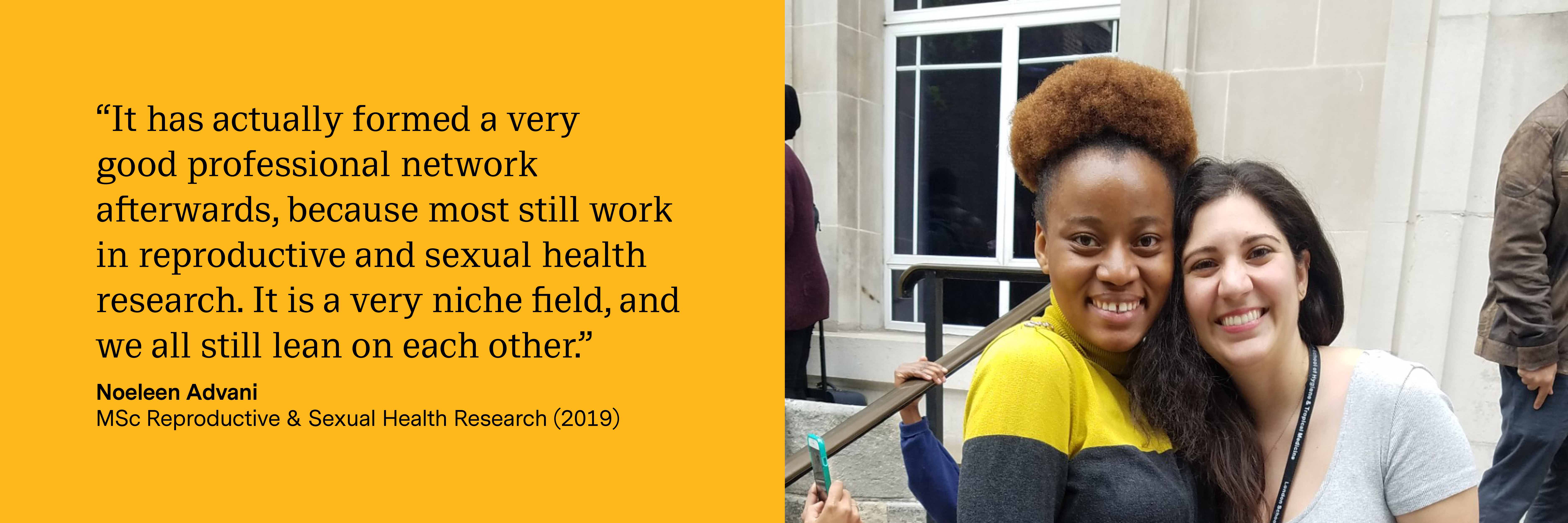
For me, I think it was hanging out with my course mates, we had really good connections! There was a mix of people with many years of work experience and some without, and there was a lot of cross-learning because we spent a lot of time together.
How the MSc has supported my career
MSc Reproductive & Sexual Health Research was definitely the right programme for me. After LSHTM, I worked at a development consultancy in London. The roles were not only focused on sexual and reproductive health, so the skills that I got from LSHTM around data management, research, reporting and writing, and translating research into policy briefs, were some of the most useful things that I gained and have used since.
After that, I decided I was more interested in sexual and reproductive health so I moved onto a role as an independent monitoring, evaluation and learning advisor, based between London and Cyprus. A lot of my recent work has been on the prevention of child sexual exploitation, where I led monitoring, evaluation and learning for a global advocacy and research network. Most recently, I have also moved into third-party monitoring of World Bank projects in Afghanistan, learning and evaluation for UK Aid civil society funds, mentoring climate and environment groups on data systems, and water treatment studies in Nigeria, Chad and Somalia. None of those were my particular field before, but many of the networks, approaches and research methods are similar, and that is what has let me move between them.
Whilst others may have learned on the job, LSHTM gave me a more technical edge to fall back on. I can go into more traditional academic research if I want, due to the skills I gained at LSHTM. Being able to grapple with and dig into research is something I find very useful in my field.
A global network
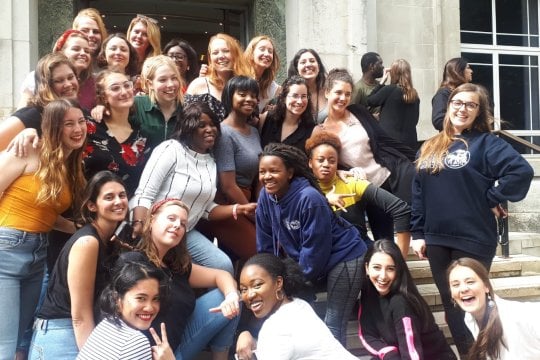
For me, what I got out of LSHTM was having the network to be able to go into different spaces and understand what is going on, and then try to focus on my niche. LSHTM was the right place because I wanted the network, and it was truly global. I have course mates and friends in many different places around the world all working in different areas of the field. I knew my niche in South Africa, in the gender-based violence prevention space, but there were all these other technical areas of the same sector that I got to know through LSHTM too.
What I loved about LSHTM most was the diversity of experiences and people from everywhere and it is a network that I want to tap into more as an alumni. When I was at LSHTM, I was part of the founding student group/community exploring decolonising global health at the School. I wanted to understand the field that I was going into and the history of both the School and my role in it. Being part of that was something that felt like a pioneering movement. It was just the beginning of a conversation that continues at the School since I graduated, but we felt we needed to be talking about it and thinking about the things we can do at an institutional level and at an individual level.
My advice for prospective students
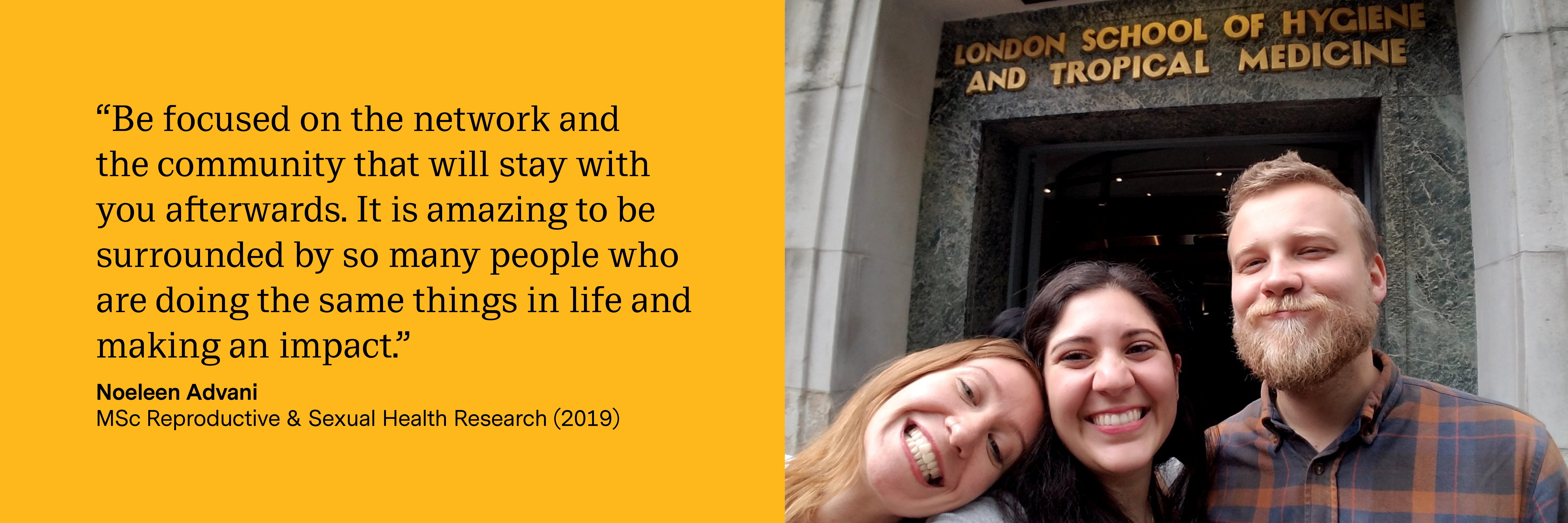
My advice would be that it is a very short programme as a 1-year full-time course, and you should use that time really well. Take the opportunity to network, make sure you get involved in the research that you find most interesting, and explore as much as possible. I would say don’t have it be so focused on getting the hard skills, because the hard skills will come with LSHTM coursework, and they really support you through it. Find the communities that really matter to you, because I think it is a rare place to find them, and difficult to find them afterwards.
- Explore our programmes in Reproductive & Sexual Health Research:
- Learn more about our research and centres