
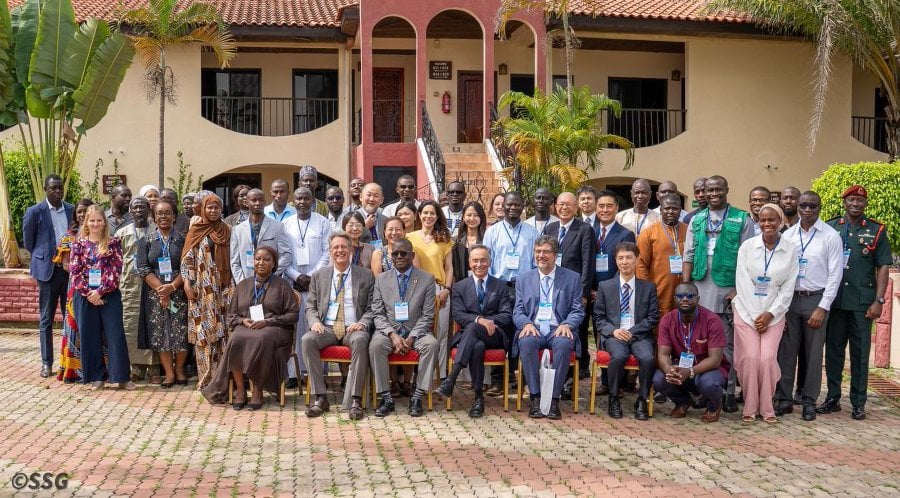
The event was organised by the National Hepatitis Control Program (NHCP) at the Gambian Ministry of Health in collaboration with the Medical Research Council Unit The Gambia at the London School of Hygiene & Tropical Medicine (MRCG at LSHTM) and global partners including the World Health Organisation (WHO), the Center for Operational Research on Hepatitis B (COR-HEPB), the Japan Institute for Health Security (JIHS) and Fujirebio Inc. The workshop, supported by a grant from the Ministry of Health, Labour and Welfare of Japan, marked a key milestone in The Gambia’s roadmap toward the elimination of Mother-to-Child Transmission (MTCT) of HIV, syphilis, and hepatitis B (HBV), which is a national public health priority.
Strengthening integration of hepatitis B testing and prevention into antenatal care
While The Gambia has made significant progress in reducing MTCT of HIV and syphilis through antenatal care, HBV prevention remains a challenge, largely due to limited access to hepatitis B virus DNA testing, which is essential for identifying pregnant women at high risk of transmitting the virus to their babies.
The workshop brought together national and international experts, policymakers, researchers and health system implementers to share the latest evidence and best practices for integrating the new highly sensitive hepatitis B e antigen (HBeAg-hs) rapid diagnostic test. This innovative point-of-care test can identify high-risk pregnant women who need prophylaxis, expanding access to HBV prevention services within maternal health programs.
Professor Umberto D'Alessandro, MRCG Unit Director stated, “MRCG at LSHTM has worked on HBV hand in hand with the Ministry of Health for many years and remains committed to supporting HBV elimination in The Gambia and beyond. The outcomes of HBV research in The Gambia continue to inform public health policies across Africa and globally.”
The event provided a platform for knowledge exchange on programmatic experiences in preventing MTCT of HIV, syphilis and HBV, and for identifying opportunities to strengthen the integration of HBV screening and treatment into existing antenatal services.
Collaboration to drive progress in triple elimination
The workshop featured remarks and participation from representatives of WHO, UNICEF, the Coalition for Global Hepatitis Elimination (CGHE), Fujirebio, JIHS, and the British High Commission and Embassy of France in The Gambia, demonstrating strong multi-sectoral collaboration and global commitment to advancing maternal and child health.
Discussions underscored the importance of innovation, evidence-based action, and coordinated partnerships in achieving the global triple elimination targets. Integrating HBV prevention into routine antenatal care represents a critical step in strengthening health systems and ensuring healthier futures for mothers and babies across The Gambia. Building capacity for frontline healthcare workers.
Following the workshop, a two-day hands-on training was held for nurses, midwives, and laboratory personnel on implementation of the HBeAg-hs rapid diagnostic test. Conducted in collaboration with the Ministry of Health and Fujirebio, the training enhanced participants’ technical skills and knowledge of HBV prevention and diagnostics within the broader Triple Elimination Strategy.
Participants gained practical experience in performing and interpreting the new rapid test, which is expected to improve early identification and intervention for pregnant women at risk of HBV transmission.
Dr Gibril Ndow, Assistant Professor at MRCG at LSHTM and Director of Research at COR-HEPB; said the HBeAg-hs rapid test is a promising point-of-care tool that can enable decentralised HBV screening and prophylaxis within antenatal settings. “This workshop and the subsequent stakeholder engagements and capacity building for nurses, midwives, and laboratory staff, could be a game changer for hepatitis B elimination in The Gambia.”
The Gambia’s leadership in integrating innovative diagnostics and prevention measures reflects its growing momentum toward achieving triple elimination of HIV, syphilis and hepatitis B. Through collaboration, research and capacity strengthening, the country is laying the foundation for sustainable, long-term improvements in maternal and child health.
If you enjoyed this article and would like to build a career in global health, we offer a range of MSc programmes covering health and data, infectious and tropical diseases, population health, and public health and policy.
Available on campus or online, including flexible study that works around your work and home life, be part of a global community at the UK's no.1 public health university.