
Medicines that treat gout by targeting blood urate levels have been found to also reduce the risk of heart attack and stroke in people with gout, according to a landmark study.
Results published in JAMA Internal Medicine show that patients with gout that reduced their blood urate levels to 360 micromol/L or lower within the first year of treatment were less likely to have a heart attack or a stroke over the next five years.
The study was led by the University of Nottingham and involved collaborators at the London School of Hygiene & Tropical Medicine (LSHTM) as well as Keele University, Gothenburg University and Polytechnic University of Marche.
Gout is a common form of arthritis that affects one in 40 adults across the UK and EU. Gout is caused by excess uric acid created by the breakdown of substances found in the body and in certain foods. High levels of uric acid form crystals in the joints, leading to sudden attacks of severe pain and swelling. Gout flares are associated with increased risk of heart attacks and strokes.
Urate-lowering drugs such as allopurinol reduce urate levels in the blood to make gout flares less frequent. This study explored, for the first time, the cardiovascular outcomes of gout patients’ whose blood urate levels were reduced to lower than 360 micromol/L. This is the benchmark level in blood tests to confirm a gout diagnosis.
The team analysed primary care data linked to hospital and mortality records of nearly 110,000 patients in England from 2007 to 2021. They looked at whether there was a major adverse cardiovascular event (i.e., heart attack, stroke or death due to cardiovascular disease) within five years of the first prescription for a urate lowering drug.
Professor Abhishek, Professor of Rheumatology at the University of Nottingham and lead author on the paper, said:
“The findings of our study are very positive and show that patients with gout who were prescribed urate lowering drugs and achieved serum urate levels of lover than 360 micromol/L (6 mg/dL) within 12 months, had a much lower risk of a heart attack or stroke over the next five years. Previous research from Nottingham showed treat-to-target urate lowering treatment prevents gout flares. This current study provides an added benefit of reduced risk of heart attack, stroke, and death due to these diseases.”
Dr Clémence Leyrat, Associate Professor at LSHTM and a co-author on the paper, said:
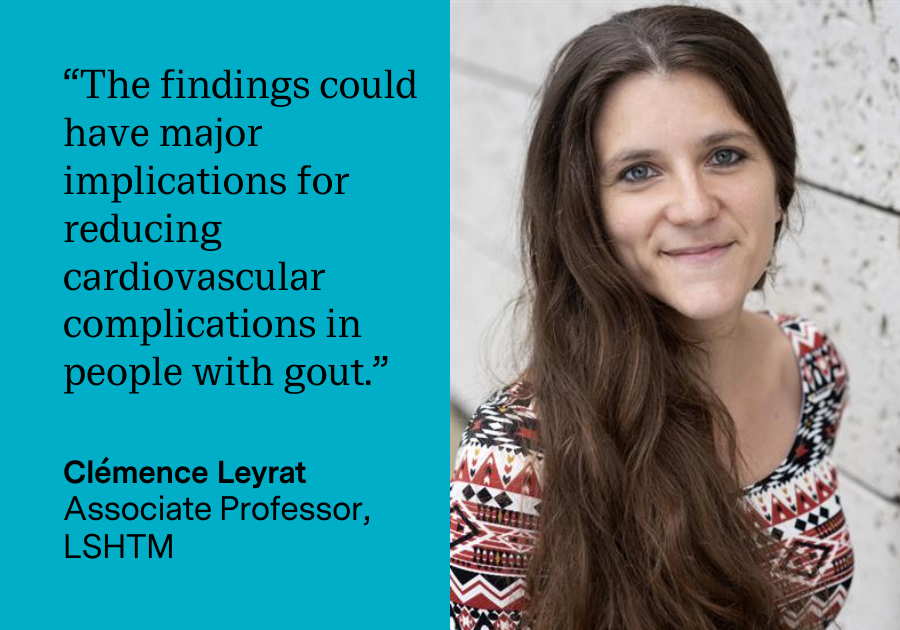
“This is the first large-scale real-world study on this topic, and the findings could have major implications for reducing cardiovascular complications in people with gout. The results suggest the importance of finding the right dose of urate lowering drugs to achieve target blood urate levels, which would in turn reduce cardiovascular risk.”
The analysis used a target trial emulation framework to analyse real-world data, allowing results to be generated more quickly and at lower cost than traditional clinical trials.
Because the data come from routine healthcare rather than a randomised trial, people in the comparison groups may differ in ways that are difficult to fully account for. These differences could influence the results, even with careful study design and statistical adjustment.
This story is based on an original press release issued by the University of Nottingham.
Publication
Edoardo Cipolletta, Tatiana Zverkova Sandströ, Davide Rozza et al. Treat-to-Target Urate-Lowering Treatment and Cardiovascular Outcomes in Patients With Gout. Jama Internal Medicine
If you enjoyed this article and would like to build a career in global health, we offer a range of MSc programmes covering health and data, infectious and tropical diseases, population health, and public health and policy.
Available on campus or online, including flexible study that works around your work and home life, be part of a global community at the UK's no.1 public health university.