
Research led by the London School of Hygiene & Tropical Medicine, published in The Lancet Regional Health (Southeast Asia), has highlighted the significant economic burden of typhoid fever across India.
The study estimated costs at 123 billion Indian rupees, or 1.5 billion US dollars. Individuals and families were directly responsible for 91% of these costs, which led to over 70,000 families facing ‘catastrophic health costs’. This is defined as payments exceeding a threshold/ proportion of costs (over 40%), meaning families cannot pay for other basic needs, such as food or housing.
The research shows that a majority of costs were associated with children under 10 years old, and about more than half of the cases are coming from five Indian states: Maharashtra, West Bengal, Tamil Nadu, Uttar Pradesh and Andhra Pradesh. Identifying the key age groups and states in India provides essential information for prioritising public health programmes to control typhoid fever.
Antimicrobial resistance was found to be responsible for 87% of the total calculated costs of typhoid fever. While treatment costs increase due to antimicrobial resistance, most of the cost is driven by the sheer number of cases it creates. This highlights the need for stewardship programmes that guide prescriptions and prevent the overuse of antimicrobial treatments.
Understanding the economic impact of typhoid illness is important for setting priorities and developing the best strategies for rolling out typhoid vaccines. This study addresses the gaps in fragmented evidence on the importance of typhoid fever prevention and treatment activities by providing a national-level analysis.
The results show the need for public health efforts to tackle typhoid fever, including introducing vaccination programmes and expanding social health insurance to relieve the financial burdens. While modest savings would also be made for India’s healthcare system, the biggest impact would be seen by individuals and families in their ‘out-of-pocket’ expenses.
Typhoid fever is an infection spread through contaminated food or water that causes illness and can lead to serious complications such as intestinal bleeding. The illness poses a major public health challenge in India, as shown by recent research estimating millions of cases in 2023. India’s National Technical Advisory Group on Immunisation recommended typhoid vaccines for the country’s Universal Immunisation Programme in 2022, and, with Gavi support, the Government of India is actively planning to introduce the typhoid conjugate vaccine.
As India accounts for a large share of the world’s typhoid fever cases, any successful programmes in India would have a major impact on global efforts to tackle the disease.
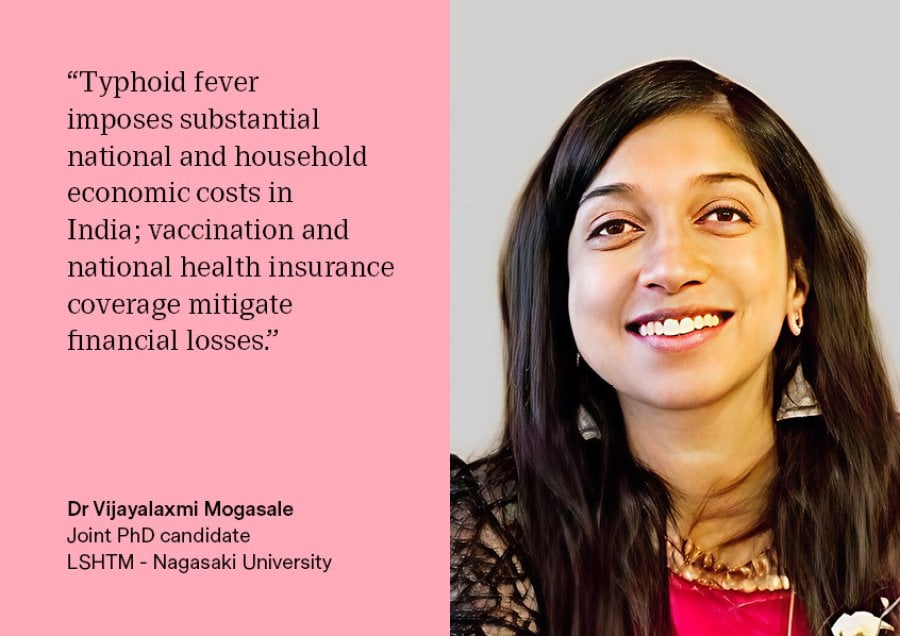
Dr Vijayalaxmi Mogasale, Joint PhD Candidate, LSHTM-Nagasaki University and first author of this paper said: “Typhoid fever and its associated antibiotic resistance impose a considerable financial burden on the nation and on affected Indian households. For many, out-of-pocket costs for typhoid treatment are so high that they limit their ability to meet basic livelihood needs. Implementing vaccination programmes, responsible antibiotic use, and expanding social health insurance coverage can mitigate the economic impact of this disease at the national level.”
Professor Jacob John, CMC Vellore, India, said: “With drug-resistant typhoid now driving over 80% of hospitalisations, this is as much an economic crisis for Indian families as it is a medical one. The study makes it clear: the scale of the challenge is immense, but so is India's capacity to solve it.
While long-term progress requires safe water, food hygiene and better diagnostics, the Typhoid Conjugate Vaccine (TCV) is our most powerful immediate tool. As a global manufacturing powerhouse, India has the means to lead the world in typhoid elimination. It is time to prioritise the integration of TCV into our national programme to protect our most vulnerable children and secure our economic future."
Dr Arindam Ray, Gates Foundation, India, said: “A majority of costs were associated with children under 10 years old and about more than half of the cases is coming from five states: Maharashtra, West Bengal, Tamil Nadu, Uttar Pradesh and Andhra Pradesh, particularly the urban areas – which may help the Government of India in prioritising geographies to introduce typhoid conjugate vaccine (TCV) in the country.
A la model of phased Hepatitis B vaccine roll-out in the country starting with 40 cities in 2002, India may plan to introduce indigenous TCV, first in the high burden metropolis like Mumbai, at 16-24 months age in routine immunisation like Nepal, with minimal resource requirements. Such pragmatic and economic introduction of TCV in India in phases would not only save costs for India’s healthcare system and prevent huge ‘out-of-pocket’ expenses for individuals but would also have a major impact on global efforts to tackle typhoid.”
Publication
Mogasale VV, John J, Ray A, Hasan Farooqui H, Mogasale V, Hutubessy R, Dhoubhadel BG, Edmunds WJ, Clark A, Abbas K. 'Economic burden of typhoid fever by antimicrobial resistance in India: a modelling study 2023'. The Lancet Regional Health - Southeast Asia, 47:100748, 2026. DOI: 10.1016/j.lansea.2026.100748
If you enjoyed this article and would like to build a career in global health, we offer a range of MSc programmes covering health and data, infectious and tropical diseases, population health, and public health and policy.
Available on campus or online, including flexible study that works around your work and home life, be part of a global community at the UK's no.1 public health university.