Risk of dengue patients developing nerve condition calculated for first time
16 April 2026 London School of Hygiene & Tropical Medicine London School of Hygiene & Tropical Medicine https://lshtm.ac.uk/themes/custom/lshtm/images/lshtm-logo-black.png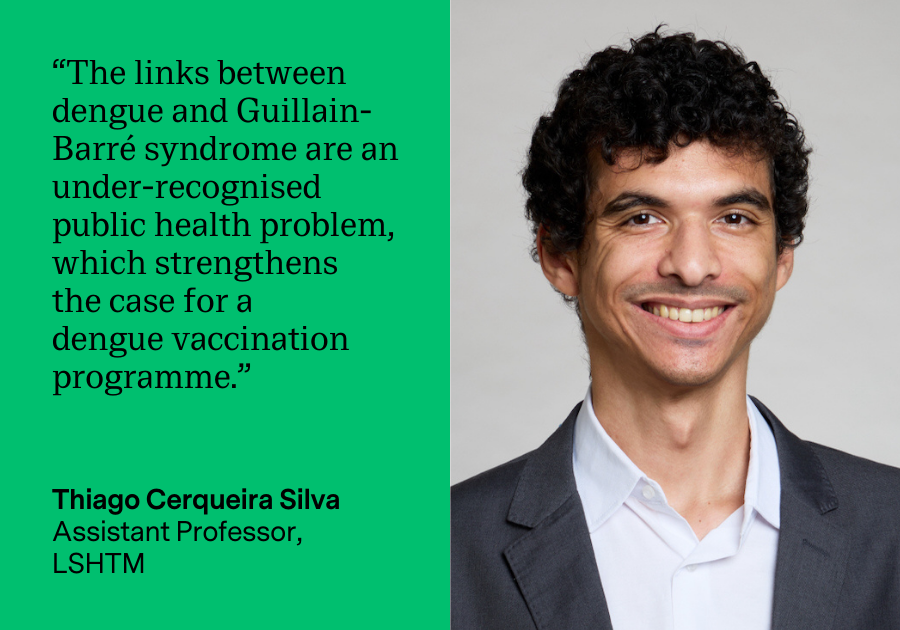
Researchers at the London School of Hygiene & Tropical Medicine have found that, within two weeks of infection, people with dengue were 30-times more likely to subsequently develop the nerve condition Guillain-Barré syndrome (GBS).
Published in the New England Journal of Medicine, the study is the first to use large-scale health data to link dengue to GBS and has important insights for clinicians and public health measures.
GBS is a nerve condition that affects the senses, ability to move, and key bodily functions such as breathing and heartbeat. This is due to the immune system attacking the body’s nerves. If left untreated, GBS can cause paralysis and death.
Various case reports and case-series have previously linked dengue to Guillain-Barré syndrome. However, there has yet to be a large-scale study to support this link and calculate the likelihood that dengue patients will develop GBS.
The authors analysed national databases in Brazil between 2023-24, analysing the health records for hospitalisation and mortality rates of people with dengue. These data were used to calculate the risk that patients would develop GBS at any point from one day to six weeks after dengue, compared to the time before dengue or six weeks after dengue.
Results found that, during the six-week period following a dengue infection, people were 16-times more likely to develop GBS than in all other periods. The greatest risk was observed within the first two weeks of infection: people were 30-times more likely to develop GBS than those not infected with dengue. The level of risk only returned to normal levels six-weeks after infection.
As the first analysis to calculate the risk of developing GBS after a dengue infection, its results show that the risk is comparable to other well-known infectious diseases that trigger GBS.
Dengue is commonly placed within the arboviral group of viruses that are spread mainly by mosquitoes. Notably, some arboviruses (chikungunya and Zika) have also recently been linked to GBS and, within endemic regions, are responsible for the greatest proportion of GBS cases.
Dr Thiago Cerqueira Silva, Assistant Professor at LSHTM, said: “Our study shows that dengue increases the risk an individual will subsequently develop Guillain-Barré syndrome. It highlights an under-recognised neurological burden from dengue disease.
“The risk of GBS post-dengue is lower than that reported for the Zika virus. However, when put in context, the number of dengue cases worldwide, 14 million, leads to a much greater number of GBS cases. This strengthens the case for greater public health measures to tackle dengue, including vector control and expanding vaccination programmes.”
These results also highlight the need for clinicians to suspect GBS when people show symptoms of weakening, including feelings of numbness or tingling in their hands and feet shortly after a dengue infection. Early treatments are essential to prevent symptoms progression to serious, life-threatening cases and a speedier recovery. The authors hope their research can inform clinical guidelines for dengue and GBS.
This research was led by members of LSHTM with collaborators based at Brazilian institutes including: Oswaldo Cruz Foundation, INCT-DigiSaude, the Federal University of Bahia, and the Brazilian Ministry of Health.
Publication
Cerqueira Silva T, Paixão E, Vinícius Araújo G, et al. Risk of Guillain-Barré Syndrome Following Laboratory-Confirmed Dengue Infection. New England Journal of Medicine, 2026. DOI: 10.1056/NEJMc2519008
If you enjoyed this article and would like to build a career in global health, we offer a range of MSc programmes covering health and data, infectious and tropical diseases, population health, and public health and policy.
Available on campus or online, including flexible study that works around your work and home life, be part of a global community at the UK's no.1 public health university.