Barbados Ministry of Health & Wellness implements new dengue outbreak model
19 August 2025 London School of Hygiene & Tropical Medicine London School of Hygiene & Tropical Medicine https://lshtm.ac.uk/themes/custom/lshtm/images/lshtm-logo-black.png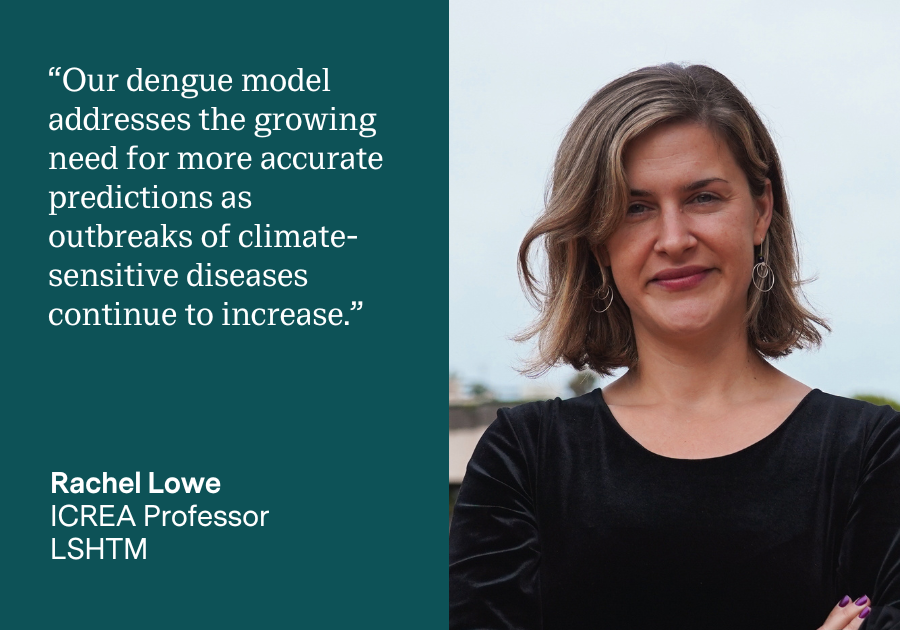
A model, developed by a team including the London School of Hygiene & Tropical Medicine (LSHTM), which forecasts the risk of dengue outbreak, will be used in a new early warning system in Barbados.
It follows a successful pilot at the 2024 Men’s T20 World Cup cricket tournament hosted in Barbados. Using climate-based factors that capture temperature, drought and excess rainfall, the model can predict the likelihood of a dengue outbreak three months ahead of time.
It was co-developed by researchers from institutes worldwide including LSHTM and the Barcelona Supercomputing Center (BSC), as well as health and meteorological agencies in Barbados and the Caribbean.
Results from the modelling framework, including the 2024 pilot, have been published in The Lancet Planetary Health. The model was created by analysing previous dengue outbreaks and weather conditions to identify a three-staged weather pattern that precedes dengue outbreaks.
Using the model, the authors found that extremely dry conditions around five months before an outbreak, followed by temperature anomalies of extreme heat three months prior, and finally excess rain one month beforehand would lead to the greatest risk of a dengue outbreak. This approach outperformed traditional surveillance models, correctly identifying past outbreaks 81% of the time.
This model was piloted in an early warning system for dengue outbreaks in Barbados at the International Cricket Council Men's T20 World Cup, held in June 2024. After predicting a 95% chance of an outbreak during the T20 World Cup, the Barbados government took various public health initiatives to prevent an outbreak and minimise infections. This included additional checks and retreatments of known mosquito breeding sites around the cricket grounds and surrounding communities.
Starting in 2025, the model will be implemented in a new early warning system for dengue outbreaks applied throughout Barbados, with ongoing monitoring and evaluation to ensure its reliability in practice. Progress and any further developments to the model will continue to be co-ordinated between national and Caribbean regional-level health and meteorological agencies, and an international team of researchers.
Professor Rachel Lowe, ICREA Professor and Royal Society Dorothy Hodgkin Fellow at LSHTM, said: “As well as further work refining the model and evaluating its impact in Barbados, we believe the modelling approach could be adapted and applied to other endemic diseases that are sensitive to variations in climate conditions. This could be applied to early warning systems for a variety of diseases in many different countries.
The model also highlights the impact of climate change on the spread of disease. Many island states in the Caribbean have experienced an increase in outbreaks of climate-sensitive diseases like dengue or Zika virus in the last 15 years. The Caribbean region recorded the largest dengue epidemic in 2023, showing a growing need for accurate predictions to minimise outbreaks.”
Chloe Fletcher, first author and PhD student at the Barcelona Supercomputing Center, said: “This modelling approach allows us to account for the effect of successive extreme weather events on disease outbreak risk. By focusing on interactions between climatic drivers, we were able to better anticipate dengue outbreak risk in Barbados.
“These forecasts provide local and regional decision-makers with timely, actionable information to mitigate or prevent an outbreak from occurring.”
Alongside the conditions most likely to trigger dengue outbreaks, results from the model found that prolonged dry conditions and cool periods for several months were associated with the lowest risk of outbreaks in Barbados.
The outbreak pattern was established using data of hydrometeorological conditions and confirmed cases of dengue between 1999 and 2022. Alongside international collaborators, researchers from LSHTM and BSC worked with the Barbados Ministry of Health and Wellness (MHW), Barbados Meteorological Services (BMS), Caribbean Institute for Meteorology and Hydrology (CIMH), and the Caribbean Public Health Agency (CARPHA).
The authors acknowledged several limitations including the fact that climate data were only collected from two weather stations in Barbados, which may not be fully representative of island-wide conditions. Dengue infection data only included confirmed cases, which excludes asymptomatic or mild cases of dengue.
The study was funded by the Wellcome Trust, the European Union, European Development Fund and Royal Society.
Read the full paper: Fletcher C et al. Compound and cascading effects of climatic extremes on dengue outbreak risk in the Caribbean: an impact-based modelling framework with long-lag and short-lag interactions. The Lancet Planetary Health, 2025.
If you enjoyed this article and would like to build a career in global health, we offer a range of MSc programmes covering health and data, infectious and tropical diseases, population health, and public health and policy.
Available on campus or online, including flexible study that works around your work and home life, be part of a global community at the UK's no.1 public health university.