New Lancet collection highlights the opportunity of planet-friendly school meals
7 January 2026 London School of Hygiene & Tropical Medicine London School of Hygiene & Tropical Medicine https://lshtm.ac.uk/themes/custom/lshtm/images/lshtm-logo-black.png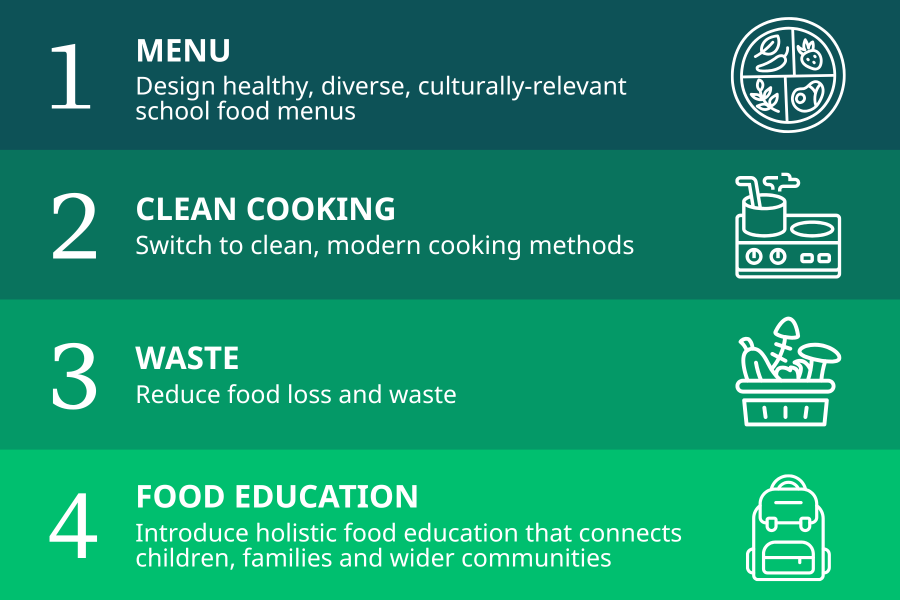
A new collection published in The Lancet Planetary Health by the Research Consortium for School Health and Nutrition – the research initiative of the School Meals Coalition, hosted at the London School of Hygiene & Tropical Medicine (LSHTM) – shows that well-designed school meals programmes represent a major opportunity to improve both human and planetary health.
Drawing together modelling, case studies and evidence from multiple disciplines, the six-paper collection demonstrates how planet-friendly school meals programmes can simultaneously improve child nutrition, reduce the prevalence of long-term diet-related illnesses, lessen climate and environmental pressures, and promote more resilient, diverse food systems.
A framework for transforming food systems
Global food systems are responsible for one-third of all human-induced greenhouse gas emissions and remain a major driver of malnutrition and diet-related illness. National school meal programmes feed 466 million children every day and account for 70% of all publicly procured food – giving governments unparalleled leverage to shift food systems in healthier and more sustainable directions.
The first paper in the new Lancet Planetary Health collection, written by Dr Silvia Pastorino, Diets & Planetary Health Lead for the Research Consortium based at LSHTM, outlines a framework that supports government action aimed at transitioning to planet-friendly school meals programmes.
The framework is structured around four essential pillars: the design of healthy, diverse, culturally relevant school food menus; a transition to clean, modern cooking methods; a reduction in food loss and waste; and the introduction of holistic food education that connects children, families, and wider communities.
Together, these pillars give governments a clear pathway to improve child health and food literacy (the knowledge, skills, and attitudes needed to make informed decisions about food and its impact on health), while strengthening agrobiodiversity, supporting ecological local production and building climate-resilient food systems. Crucially, they must be embedded in public procurement rules, nutrition standards and policy reforms to shift national demand towards healthier and more sustainable food.
Dr Pastorino said: “When meals are healthy, sustainable, and linked to food education, they can improve children’s wellbeing today while helping countries protect biodiversity, reduce emissions, and build more resilient communities. Few interventions deliver such wide-ranging, long-lasting benefits.”
School meals: a strategic investment in human and planetary health
To quantify the potential scale of impact, the second paper in the collection assesses the health, environmental and economic implications of expanding school meal coverage, improving meal composition and reducing food waste.
Led by Professor Marco Springmann, Modelling Lead for the Research Consortium based at University College London (UCL), the assessments use a modelling tool first developed by Professor Springmann for the 2023 EAT-Lancet Commission.
The modelling assessments found that providing a healthy, sustainable meal to every child by 2030 could: reduce global undernourishment by 24%, particularly in food-insecure regions; prevent over one million deaths from diet-related illnesses each year if healthier eating habits were carried into adulthood; and halve food-related environmental impacts including emissions and land use, when meals follow healthy, sustainable dietary patterns.
The study also calculated the costs of increasing school meals coverage against the social costs of carbon emissions and health costs of climate-related illnesses, finding that while expanding global school meals coverage may incur higher costs in the short-term, ensuring they are healthy and planet-friendly offsets those costs by generating savings for health systems throughout the life course.
Professor Springmann said: “Our modelling shows that healthy and sustainable school meals can generate substantial health and environmental gains in every region of the world. Importantly, the climate and health savings that result from healthier diets and lower emissions can help offset the costs of expanding school meal programmes. The evidence is clear: investing in school meals is both effective and economically sound.”
Food, learning, energy, and biodiversity
The four remaining papers in the collection offer deeper analyses into several of the strategic pillars laid out in the conceptual framework. Contributed to by collaborators from across the Research Consortium’s global network, they explore topics of integrating food education into learning to build lifelong sustainable habits, the critical role of clean, reliable energy in delivering safe, planet friendly meals, the importance of agrobiodiversity, and promoting regenerative agriculture and food security through school feeding.
The collection builds on insights first identified in the Research Consortium’s seminal 2023 white paper, School Meals and Food Systems, led by LSHTM in collaboration with 86 organisations, to explore the evidence on school meals to drive food systems transformation.
Collectively, the papers offer the strongest scientific foundation to date for countries seeking to transition to environmentally sustainable, nutritious national school meals programmes as an investment in the future of their school-aged children.
From evidence to action: supporting governments to implement planet-friendly policies
In partnership with international organisations and government partners, the Research Consortium is now developing a Planet-Friendly School Meals Toolkit to help countries assess the specific costs, environmental impacts and health benefits of shifting to sustainable school meal models in their national contexts. Co-created with partners in Kenya and Rwanda, the first results are expected in Spring 2026.
To find out more about the insights presented in the Lancet Planetary Health collection on school meals and planetary health, visit the Research Consortium’s Planet-Friendly School Meals Initiative webpage or email Dr Silvia Pastorino.
If you enjoyed this article and would like to build a career in global health, we offer a range of MSc programmes covering health and data, infectious and tropical diseases, population health, and public health and policy.
Available on campus or online, including flexible study that works around your work and home life, be part of a global community at the UK's no.1 public health university.