More men living longer with incurable prostate cancer
8 October 2026 London School of Hygiene & Tropical Medicine London School of Hygiene & Tropical Medicine https://lshtm.ac.uk/themes/custom/lshtm/images/lshtm-logo-black.png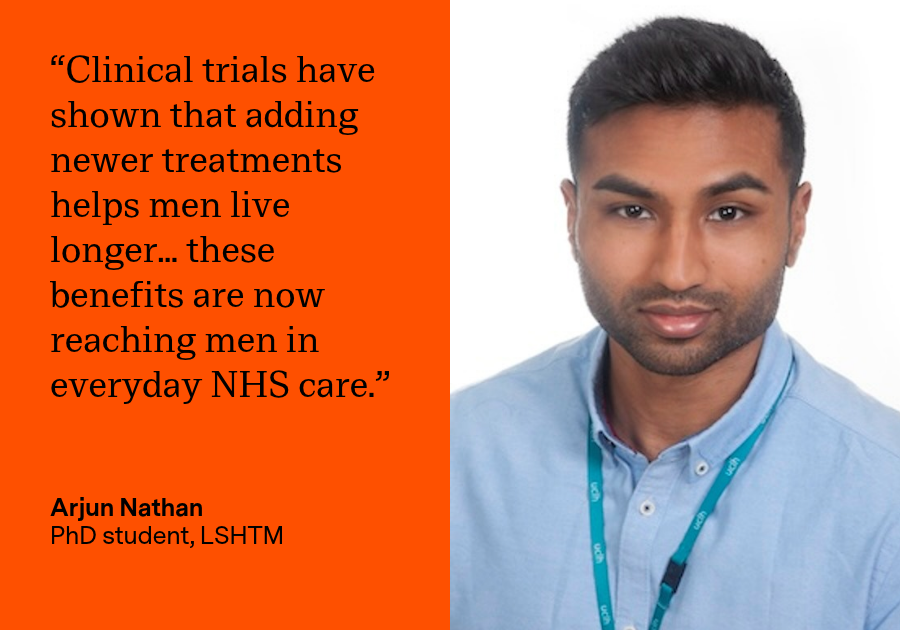
Men in England diagnosed with incurable advanced prostate cancer are more likely to survive for at least three years than they were a decade ago, according to analysis by the London School of Hygiene & Tropical Medicine (LSHTM) and partners.
The team studied data for 45,339 men who were newly diagnosed with metastatic prostate cancer, which is currently incurable, in England between 2015 and 2022, following each man for three years after diagnosis.
Although cases are rising overall, they found the proportion who died within three years fell from 56% in 2015 to 47% in 2022.
The prostate is a gland in the male reproductive system. Prostate cancer often grows slowly with no symptoms in the early stages. However, if it spreads to other parts of the body, such as the bones, it cannot be cured and may cause serious complications.
More men are living longer in part thanks to new treatments for this type of cancer being made available on the NHS.
The findings are published in the latest annual State of the Nation report from the National Prostate Cancer Audit, produced by the National Cancer Audit Collaborating Centre (NATCAN), based at the Clinical Effectiveness Unit, an academic partnership between LSHTM and the Royal College of Surgeons of England.
The report, which includes LSHTM staff among the authors, shows the number of men diagnosed with prostate cancer in England went up by 7% in a single year, to 60,800 in 2025, while the number of men diagnosed with metastatic disease, that has spread beyond the prostate, increased to more than 6,300.
LSHTM experts led further analysis of the audit data, published in BJU International and funded by the National Institute for Health and Care Research (NIHR).
In this study, researchers found the risk of death from prostate cancer dropped by almost a quarter (24%) in seven years from 2015 to 2022, amounting to thousands more men living longer now compared to 10 years ago.
First author Arjun Nathan, PhD student at LSHTM, urology resident surgeon, NIHR Doctoral Research Fellow, and member of the National Prostate Cancer Audit team, said: “This is genuinely encouraging news for men diagnosed with incurable prostate cancer. Looking at more than 45,000 men across England, we found survival has steadily improved: more than half of men now survive at least three years after diagnosis, up from 44% in 2015, and the risk of dying from prostate cancer fell by almost a quarter.
“Clinical trials have shown that adding newer treatments including chemotherapy and novel hormone therapy, which is known as combination therapy, helps men live longer. Our new findings show these benefits are now reaching men in everyday NHS care, not just in clinical trials. Improvements in how care is organised across the NHS, including earlier diagnosis, better scans to identify how advanced the cancer is, and faster access to specialist teams, may also have played a part.
“But almost half of men still do not survive beyond three years, and not everyone who could benefit is receiving these treatments yet. Anyone diagnosed with incurable prostate cancer should talk to their care team about whether combination treatment is right for them.”
Co-senior author Jan van der Meulen, Professor of Clinical Epidemiology at LSHTM and chair of the National Prostate Cancer Audit team, said: “More and more patients are now being diagnosed with prostate cancer at an early stage.
"However, the number of patients diagnosed with prostate cancer that has already spread to the rest of the body is not coming down. For that reason, the results showing improvements in outcomes for these patients is so important.
“There are still a lot of improvements to make, both in the development of new treatments for metastatic prostate cancer and in the prompt adoption of these treatments in clinical practice.”
The team examined trends in 3-year mortality for men with newly diagnosed newly diagnosed metastatic hormone-sensitive prostate cancer in England between 2015 and 2022. They studied diagnosis data from the National Cancer Registration Dataset, with death status, date of death, and cause of death provided by the Civil Registration of Deaths dataset. Follow-up data were available until 1 July 2025 and therefore men diagnosed between 1 January 2015 and 30 June 2022 were included in this study.
They did not include patient-level treatment data, as the aim of the study was to capture the net effect of improvements in care at a population level, to cover the availability and use of new therapies but also other system-level circumstances that determine whether patients access them, such as improvements in identifying what stage the cancer is at, timely referral, and appropriate treatment initiation.
Publication
Arjun Nathan et al. Improved survival in newly diagnosed metastatic prostate cancer: a National Prostate Cancer Audit study. BJU Int 2026. DOI:10.1111/bju.70432
If you enjoyed this article and would like to build a career in global health, we offer a range of MSc programmes covering health and data, infectious and tropical diseases, population health, and public health and policy.
Available on campus or online, including flexible study that works around your work and home life, be part of a global community at the UK's no.1 public health university.