From forecasts to fatalities: Mapping the health impacts of extreme heat
21 July 2025 London School of Hygiene & Tropical Medicine London School of Hygiene & Tropical Medicine https://lshtm.ac.uk/themes/custom/lshtm/images/lshtm-logo-black.png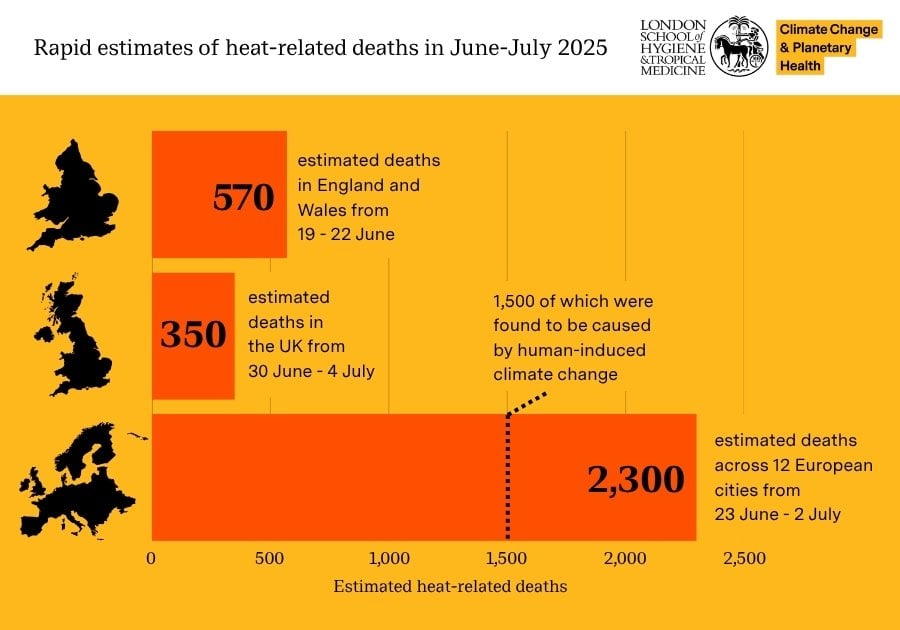
In mid-June 2025, the UK was warned of the first of several heatwaves set to sweep across Europe over the next few weeks. While weather forecasts predicted highs of over 32°C, researchers in the Environment & Health Modelling (EHM) Lab at the London School of Hygiene & Tropical Medicine (LSHTM) were predicting the impacts of soaring temperatures, estimating around 570 heat-related deaths in England and Wales from 19-22 June 2025.
The real-time analysis used data from published research on the relationship between heat and daily death rates in nearly 35,000 locations in England and Wales from 2000-2019 to determine the level of risk, and combined this with high-resolution weather forecasts to provide the final estimate ahead of the heatwave.
A week later saw warnings of a second heatwave, with temperatures in Europe projected to rise to dangerous levels again. The research team predicted another 350 excess deaths in the UK from 30 June-4 July 2025, and hundreds more across European countries. A similar method was used for the second estimate, but the scope widened to include data on heat-related mortality in 854 locations in Europe from two studies published in The Lancet Planetary Health and Nature Medicine.
Though these mortality forecasts can help raise the alarm on the potential toll of heatwaves, they are likely to be an underestimate, according to the researchers involved.
Early heatwaves “more dangerous”
Dr Malcolm Mistry, Assistant Professor in Climate and Geo-Spatial Modelling at LSHTM highlights that the high number of deaths estimated for these heatwaves may be due to their timing. Dr Mistry said: “When heatwaves occur early in the season, the local population has typically not acclimatised. It can prove more dangerous compared to mid- or end-summer heat.”
Heatwaves can be known as a “silent killer”. It takes many months for public health mortality data to be published following a heatwave, and even then, heat is rarely recorded as a cause of death, as many people die from diseases or other risk factors that are exacerbated by heat.
Exposure to heat can increase the risk for vulnerable people already suffering from illnesses such as heart, lung and kidney disease, as well as those who are pregnant, elderly or experiencing homelessness. Heat stress has even been found to impact the development of babies after they’re born up to the age of two.
As extreme heat events become more frequent, intense and prolonged because of climate change, the threat it poses to human health is ever more urgent.
Researchers at LSHTM are leading vital work and developing innovative methods based on years of research to understand and address the health impacts of a warming world.
Linking deaths to climate change
Following the June heatwaves, a rapid analysis led by LSHTM in collaboration with Imperial College London retrospectively assessed the impact of human-induced climate change on the heatwave in Europe between 23 June and 2 July 2025. The study estimated that around 2,300 people may have died as a result of the extreme temperatures recorded across 12 European cities, and that 65% of these deaths were due to global warming, from human activities including the burning of fossil fuels.
Whilst these rapid analyses are an important tool to highlight the immediate health impacts from heat, long-term projection studies can provide insight into what might happen under different future scenarios of climate change, depending on levels of climate action and other factors.
In January 2025, LSHTM researchers projected an estimated 2.3 million additional temperature-related deaths in 854 European cities by the end of this century due to climate change, substantially outweighing any decrease in cold-related deaths, unless action is taken.
More recently, another group of researchers at LSHTM published a study in collaboration with UCL, looking at future projections of heat-related deaths on a smaller, but more detailed level in England and Wales. The study considered 15 different future scenarios, combining climate and societal changes, such as global temperature rises, population ageing, and adaptation efforts to protect against the effects of a warming climate.
It revealed that under the worst-case scenario of 4.3°C of warming (over preindustrial levels) in the next century, heat-related deaths in England and Wales could increase by more than fifty times the current rate of 634 deaths per year, to over 34,000 in the 2070s.
Even under the most optimistic scenario of 1.6°C of warming over preindustrial levels by the end of the century, and with high levels of adaptation, the model predicted that the annual number of heat-related deaths could still increase up to sixfold.
Projected rise in heat-related deaths
Dr Rebecca Cole, Research Fellow in Environmental Epidemiology at LSHTM, and lead author on the study said: “How we as a society adapt to our changing climate will have a tremendous effect on people’s wellbeing. Our research shows how increases in heat-related deaths are not just a consequence of rising temperatures – they’re also driven by how we build our cities, care for vulnerable populations, and address social inequality.”
These long-term projection studies suggest that to protect human health, immediate action is needed to both mitigate climate change by reducing greenhouse gas emissions, and find ways to adapt.
Improved early-warning systems, combined with targeted interventions, such as sustainable urban planning, have the potential to prevent heat-related deaths. Increasing green spaces in urban areas by just 10-30% has been shown to have a cooling effect which could help reduce the number of heat-related deaths.
Antonio Gasparrini, Professor of Biostatistics and lead of the EHM Lab at LSHTM, said: “Clearly, a hotter climate is a more dangerous climate. Every fraction of a degree of warming will cause more hospital admissions and heat deaths, putting more strain on the health services.
“As scientists, we need to further our understanding on how climate change impacts human health, and improve our tools for rapid assessments, long-term projections, and adaptation strategies. This will involve the development of epidemiological and public health methods, as well as the creation of data and analytical frameworks that can be used by scientists, governmental agencies, and other stakeholders.”
Solutions to protect our shared health
In an interview with BBC Radio 5 Live on how to protect ourselves from heatwaves, Dr Peninah Murage, Assistant Professor at LSHTM said: “In the short-term, we need heat-health warnings to communicate to people what they should do – the weather health alerting system provided by the UK Health Security Agency (UKHSA) in partnership with the Met Office is a great example of a public health intervention that can safeguard population health.
“In the long-term, we need to improve our existing infrastructure to better adapt to a warmer future, for example by retrofitting or changing building materials to prevent overheating and improve the thermal efficiency of homes. Ultimately, what really needs to happen is a reduction of greenhouse gas emissions and transition to a zero-carbon economy to mitigate against climate change.”
As the effects of climate change are felt more and more each year around the world, LSHTM researchers are not only advancing the science on climate and health, but also training the next generation of planetary health leaders.
The MSc Climate Change & Planetary Health is equipping students with the tools needed to conduct cutting-edge research, including modules on environmental epidemiology, statistical methods in epidemiology, and planetary health research in practice. Find out more about the course, and how to be part of the solution.
If you enjoyed this article and would like to build a career in global health, we offer a range of MSc programmes covering health and data, infectious and tropical diseases, population health, and public health and policy.
Available on campus or online, including flexible study that works around your work and home life, be part of a global community at the UK's no.1 public health university.