Expert comment: Famine in Gaza
31 July 2025 London School of Hygiene & Tropical Medicine London School of Hygiene & Tropical Medicine https://lshtm.ac.uk/themes/custom/lshtm/images/lshtm-logo-black.png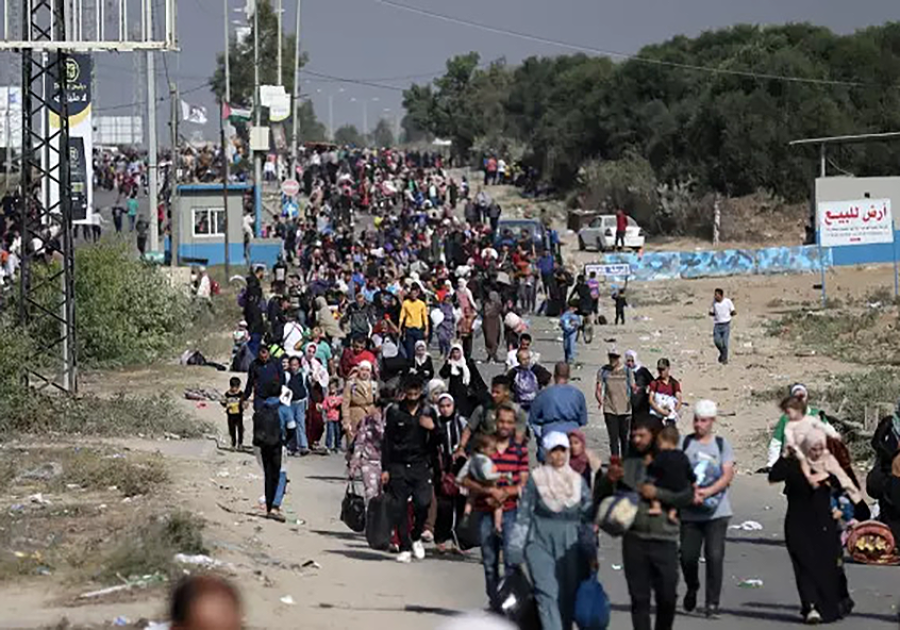
An alert issued by the Integrated Food Security Phase Classification (IPC) on 29 July 2025 has stated that ‘the worst-case scenario of Famine is currently playing out in the Gaza Strip’.
While The IPC did not make a formal declaration of famine, organisations such as The World Food Programme and Unicef say two famine thresholds - food consumption and acute malnutrition - have been breached in parts of Gaza.
Experts from the London School of Hygiene & Tropical Medicine (LSHTM) say evidence is converging on there now being a famine in Gaza which, unless an enormous surge of aid is delivered, will have devastating immediate and long-term impacts. These include children dying of common infections that their bodies are too weak to fight off after a prolonged period of malnourishment and acute malnutrition putting survivors at risk of long-term damage to their physical and mental health.
Professor Francesco Checchi of LSHTM, who led recent research estimating excess deaths in Gaza and has spent 25 years studying conflict situations, told The Guardian First Edition newsletter: “It isn’t necessarily the case that an entire population is declared to be in famine conditions. But in the case of Gaza, I think that’s what we’re seeing now.”
He explained the broad definition of famine being a situation where people have run out of any coping mechanisms to find food for themselves and their children:
“By coping mechanisms, I mean people sell off their assets… borrow money from somebody else, or ask for remittances from relatives overseas.” He explained that we can say famine has set in if “none of that is actually possible anymore”, telling The Guardian:
“So talking to people from charities on the ground that I know, even their staff who have money in their pocket quite literally cannot purchase any food because there is no food to be purchased in a market.
“I can show you an obvious demonstration of the fact that people in Gaza are literally starving: you have thousands and thousands of people queueing every day at the Gaza Humanitarian Foundation distribution site, even though it is almost certain on any given day that they will be fired upon. The fact they are going there anyway, even though they may not return, gives you a sense of how absolutely in need of food people are.”
Discussing how severe malnutrition leads to death, Professor Checchi said:
“Very rarely do people literally starve to death. It happens, but it’s relatively rare. Instead, people die of conditions that they would have survived from, such as common diarrhoea or common respiratory infections, that you and I would cope with very easily, but a malnourished body cannot cope with.”
“What I think is going to start happening inevitably, unless the situation changes radically in the next two to three weeks, is that there’s going to be a huge wave of children dying of common conditions and who otherwise wouldn’t have.”
The IPC report does not formally classify Gaza as being in a famine, stating that can only be determined by a thorough analysis that will be conducted "without delay". However, noting the difficulties involved in collecting the data needed to assess the situation, with aid workers unable to access many areas, Professor Checchi said:
“The kind of analysis that one could have done a year ago is no longer possible. I don’t think there is any real information that is missing in terms of declaring a famine on the grounds because of the convergence of multiple data and multiple contextual information. And I don’t think that governments such as the UK are unaware that what is happening is a famine.”
Commenting on the plan to use airdrops in Gaza, Professor Checchi said: “Airdrops are actually dangerous because they kill people”, highlighting that people often die by drowning or in the crush to try to reach food packages and called airdrops “ineffective and inefficient”. He cites a preprint study he co-authored showing that, during the first nine months of the war, less than 2% of the calories available to the population of Gaza came from airdrops or sea deliveries, despite massive and costly air and sea operations to supply food.
He said: “What needs to happen is very, very simple: a complete opening of the border crossings, and a complete restart of the traditional system of food distribution run by Unrwa, which has been running for decades now. They know what to do. They have the lists of people, they have the warehouses, they have everything in place to restart that system.
“If food began to flood in and people were able to access it, despite reaching famine levels, the situation could conceivably reverse quite quickly. Whereas if you leave that for another two weeks or three weeks, then I think it’s almost inevitable we’ll see extremely high levels of child mortality.”
Commenting on the impacts of starvation on survivors, Dr Marko Kerac of LSHTM, a paediatrician and public health doctor who has studied malnutrition and the long-term effects of malnutrition for 20 years, said:
“The immediate health impacts of starvation are the most devastating with a high risk of disease and death. Quite rightly, people focus most on those. However, what many don’t realise is that malnutrition also has long-term effects in later adult life. Early-life malnutrition impairs organs development and causes genes to switch off/on, increasing the risk of non-communicable diseases such as heart disease, diabetes and metabolic syndrome in later life. Adverse effects can even be seen across generations.”
“We know that during periods of extreme hunger the body begins to ‘eat itself’, breaking down stores of fat and protein in order to sustain itself. Children are especially at risk since their growing brains and bodies have high nutrient needs. But they also have fewer nutrient stores, plus immature immune systems which make them vulnerable to a vicious cycle of infection with consequent worsening malnutrition and in turn an even greater risk of infection.
“If you are malnourished as a child this can also stunt your physical growth and affect brain development, as well as increasing the risks of chronic conditions later on. The earlier in life you experience malnutrition the greater the risks to your long-term health.
“To avoid the worst health impacts from malnutrition early intervention is crucial. Any periods of undernutrition must be proactively managed so as to be as brief as possible. Effective treatments do exist but high-quality care is not just about regaining weight. Wider support is needed to help them to recover from the wider psychological as well as physical traumas of starvation.”
If you enjoyed this article and would like to build a career in global health, we offer a range of MSc programmes covering health and data, infectious and tropical diseases, population health, and public health and policy.
Available on campus or online, including flexible study that works around your work and home life, be part of a global community at the UK's no.1 public health university.