Expert Comment: Chikungunya spreads from Indian Ocean islands
28 July 2025 London School of Hygiene & Tropical Medicine London School of Hygiene & Tropical Medicine https://lshtm.ac.uk/themes/custom/lshtm/images/lshtm-logo-black.png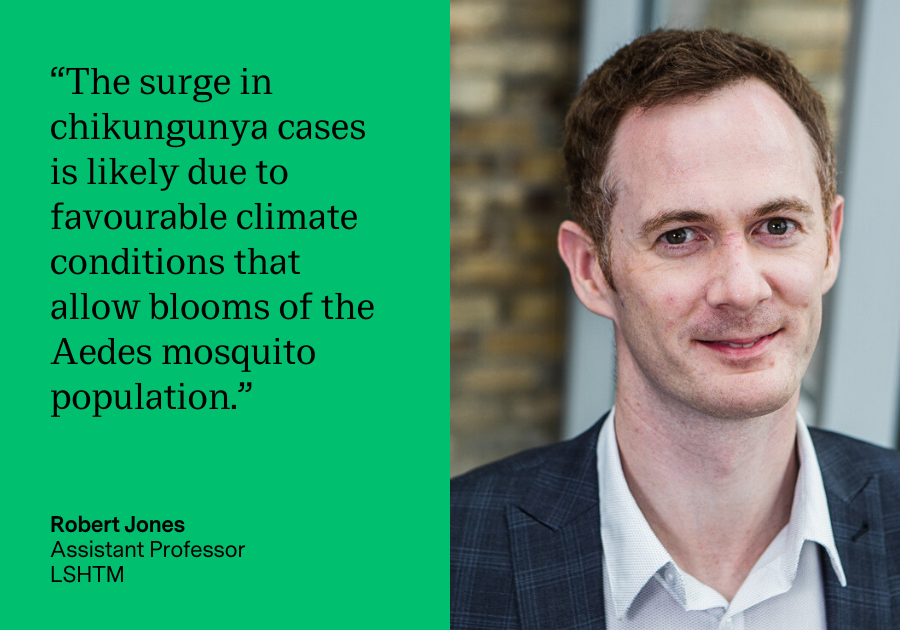
The surge in chikungunya cases began in early 2025, with major outbreaks in Indian Ocean islands including La Reunion, Mayotte and Mauritius. An estimated one-third of La Reunion's population has already been infected.
According to the World Health Organization, 5.6 billion people live in areas across 119 countries at risk from the virus, which is now spreading to countries such as Madagascar, Somalia and Kenya, and has shown epidemic transmission in Southeast Asia, including India.
There are also concerns about its spread within Europe with approximately 800 imported chikungunya cases in continental France since May 2025, as well as a recent case in Italy.
WHO experts have called for urgent actions to avoid a repeat of the 2004-2005 epidemic, which primarily impacted small island territories, affecting nearly half a million people, before spreading globally.
Chikungunya virus is spread by Aedes mosquitoes and causes symptoms including fever and severe joint pain. There is no specific antiviral treatment for the disease that, in rare cases, can be fatal. Key preventive measures include using insect repellent, wearing long-sleeved clothing and trousers, installing screens on windows and doors, and removing standing water from containers where mosquitoes breed.
Dr Robert Jones, Assistant Professor at the London School of Hygiene & Tropical Medicine (LSHTM), said:
“The surge in chikungunya cases is likely due to favourable climatic conditions that allow blooms of the Aedes mosquito population. These are aggressive, day-biting mosquitoes that thrive in warm, wet conditions. They live in close proximity to humans, which provide a blood source, and in domestic environments they find water tanks and discarded plastic containers that can provide suitable places for their larvae to develop.
“When small pools of water form, these mosquitoes can lay they eggs and in just 7-10 days adults will emerge. So, following the monsoon or heavy rains, we often see a lot more mosquitoes and this can be followed by a rise in mosquito-borne diseases.”
Dr Jones also highlighted the risks from the combination of climate change and transmission from people who don’t know they are infected, he said:
“Where there are large, immunologically-naïve populations the chikungunya virus can spread rapidly. Although we have seen elevated cases in the Indian Ocean and Southern China, infected people can carry the virus with them when they travel and this raises risks elsewhere.
“With global warming we have seen an expansion of the range of Aedes mosquitoes, meaning we find them in parts of the world that they didn’t previously exist. A lot of chikungunya cases are asymptomatic, so people may be infected but not know it. They might not have any symptoms but they can contribute to onward transmission.
“Other possible reasons for the surge in cases may be a lack of funding given for mosquito control activities, or maybe even a change in the genetics of the virus that has increased its capacity to infect Aedes.”
In 2023 there were 440 000 cases and over 350 deaths reported worldwide.
If you enjoyed this article and would like to build a career in global health, we offer a range of MSc programmes covering health and data, infectious and tropical diseases, population health, and public health and policy.
Available on campus or online, including flexible study that works around your work and home life, be part of a global community at the UK's no.1 public health university.