The AIDS pandemic isn’t over

Of the many paradoxes in public health, one is that success in controlling a disease leads to neglect and disinvestment, undermining that very success. The global AIDS response, one such success, is becoming a victim of our short-term memory and thinking, and the AIDS response is in danger of falling apart.
The initial response to AIDS – acquired immune deficiency syndrome, the disease associated with the human immunodeficiency virus (HIV) – was slow because of stigma, discrimination, and poverty, leading to a public health crisis, particularly in sub-Saharan Africa. The development of effective treatment in 1996 slowed progress of the disease and onward spread of the virus for the individual. Then, after 2000 international financing allowed the scale up of treatment, which has reduced new HIV infections and AIDS deaths, an unprecedented success.
International HIV funding became increasingly dominated by the United States leading most other countries to focus on other problems. Because of this reliance on the US, the cuts in US funding and dismantling of the agencies overseeing HIV programmes will have a disproportionate impact on global HIV. Disruption of HIV treatment and prevention will lead first to more AIDS deaths and then to increasing spread of the virus.
The HIV community bears some of the responsibility for undermining its own success with ill-conceived messaging and talk of ‘ending AIDS’. This message has contributed to the public and politicians seeing AIDS as something we can put behind us. The leadership of the Presidents Emergency Program for AIDS Relief (PEPFAR), to signal an end game to the US Congress, talked about an ‘AIDS transition’ when newly acquired HIV infections fell below deaths allowing HIV epidemics to fade away. This was epidemiologically flawed thinking. If infections fall below deaths HIV prevalence will decline, but only when interventions are maintained. Similarly, UNAIDS set targets to ‘end AIDS as a public health threat’ by 2030.
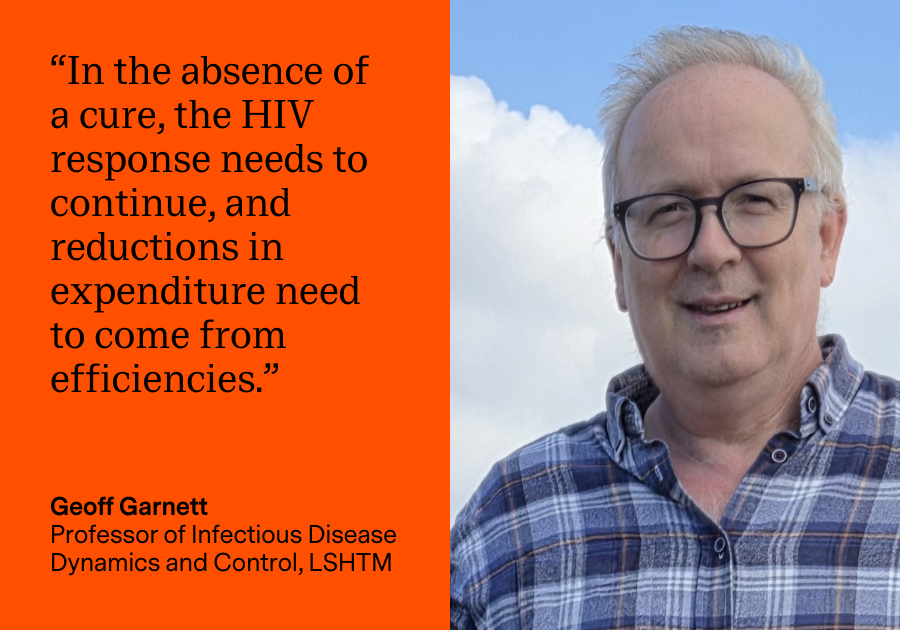
Ending AIDS was defined as a 90% reduction in new HIV infections and AIDS deaths compared to 2010, laudable but arbitrary goals. The targets included 38 million people still living with HIV and in need of treatment – hardly an end. In the absence of a cure, the HIV response needs to continue, and reductions in expenditure need to come from efficiencies.
AIDS is a slow plague with infections and epidemics playing out over decades. On average it takes over a decade for HIV acquisition to lead to AIDS, so HIV epidemics are orders of magnitudes slower than those for infections like flu and COVID-19 where progress to disease takes a matter of days.
The consequence of current financial and organisational shocks to the HIV response will take many years to resolve. Sadly, the UK has joined the US in reducing its support for the Global AIDS response with a reduction in a commitment to the Global Fund to Fight AIDS, Tuberculosis, and Malaria sending a terrible signal as the host of the replenishment. US international HIV funding was restored, but at a lower level and for a shorter time, and there are still problems distributing funds with the demise of USAID and reductions in US CDC, and the range of services allowed has been reduced.
In particular, the ending of support to programmes focused on the most vulnerable will likely undermine HIV control, and the withdrawal of funding for HIV surveillance will mean we won’t know what is happening. It will be slow and silent at first, but future generations will regret the careless and short-sighted abandonment of the HIV response.
If you enjoyed this article and would like to build a career in global health, we offer a range of MSc programmes covering health and data, infectious and tropical diseases, population health, and public health and policy.
Available on campus or online, including flexible study that works around your work and home life, be part of a global community at the UK's no.1 public health university.