Alumni Spotlight: Dr Meherunissa Hamid
19 October 2026 London School of Hygiene & Tropical Medicine London School of Hygiene & Tropical Medicine https://lshtm.ac.uk/themes/custom/lshtm/images/lshtm-logo-black.png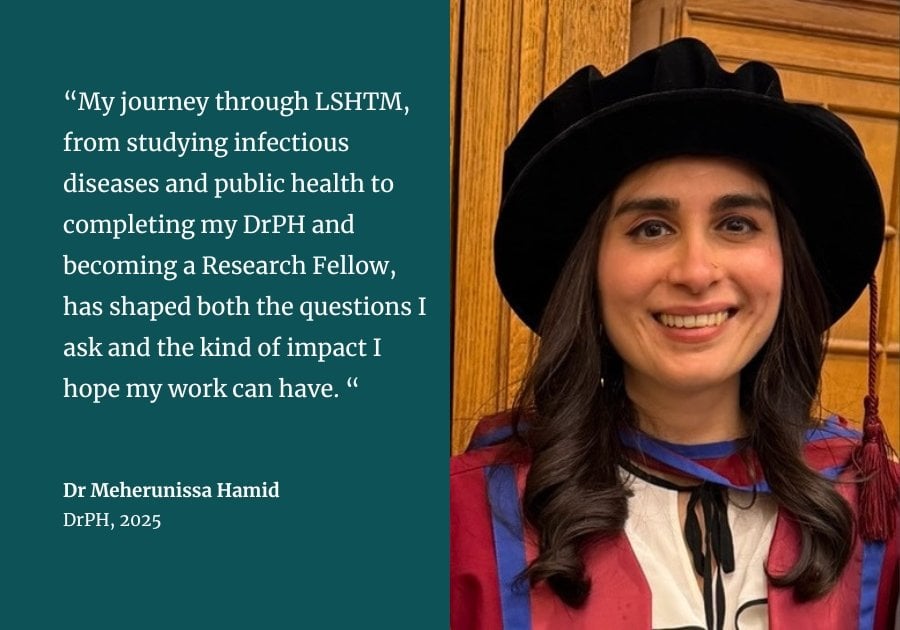
My first encounter with LSHTM was when I was still at school and beginning to search for undergraduate degree opportunities. After completing my BSc (Hons) in Biomedical Sciences at Newcastle University, I applied to the MSc in Molecular Biology of Infectious Diseases at LSHTM and was accepted. During this time, I worked in the lab, lived independently in London, made wonderful friends, and learned a great deal about myself. Later, my interests led me towards public health, and I returned to LSHTM once again for the MSc in Public Health in Developing Countries. That degree shaped me deeply. I had excellent mentors, made important connections, and remained closely attached to the School.
After completing the MSc, I returned home to Pakistan and worked in health services research. Over time, I became increasingly interested in the gap between policy, implementation, and lived experience of those on whom the policies were implemented. I saw how policies were often designed with good intentions, but without always reflecting the realities of the people most affected by them. That interest eventually shaped my application for the Doctorate of Public Health (DrPH) at LSHTM. My five-year DrPH journey began from that point, and I graduated in March 2026.
My DrPH research examined the working lives of women in domiciliary care (home care) in England, focusing on how gender, race and migration status shape their experiences. I found that many faced insecure employment, low pay, limited opportunities for progression and, for migrant and racialised women, additional pressures linked to immigration status and racism. These findings show how workforce policies can overlook the realities of those expected to deliver essential care, reinforcing inequalities rather than addressing them.
This research mattered to me because care work sits at the intersection of issues that concern me. For example, inequality, the distance between policy and practice, and the tendency for certain forms of labour to be undervalued or overlooked because of perceived hierarchies surrounding who performs particular kinds of work. I wanted to understand policy, in this case, through its consequences for women whose daily work sustains the care sector.
The significance of these findings lies in what they reveal about the relationship between policy and inequality. Policies intended to support the delivery of essential services can reinforce existing inequalities if they do not take account of gender, race, migration status and employment conditions. Improving care therefore requires more than increasing the number of workers. It also requires sustained attention to job security, fair pay, opportunities for progression, protection from discrimination and meaningful worker participation in decisions about the sector. I hope my findings can support conversations among policymakers, employers, researchers, and workers who have to build fairer and more sustainable care systems.
Although rooted in social care in England, this research has wider relevance. Women form a large part of many essential workforces in the UK and around the world, particularly in health, care, education and other professions where their labour is key but often undervalued. Addressing these inequalities requires policies that recognise women’s skills, improve working conditions and take their lived experiences seriously.
My journey through LSHTM, from studying infectious diseases and public health to completing my DrPH and becoming a Research Fellow, has shaped both the questions I ask and the kind of impact I hope my work can have. My research has reinforced that policy cannot be understood through written commitments alone. Its value depends on who is consulted during policy formulation, how it is implemented and experienced in people’s everyday lives. As I begin this next chapter, I hope to help bridge the gaps between research, policy and practice, ensuring that the experiences of women and other essential workers are not only documented, but taken seriously in the decisions that affect their working lives.