Alumni Spotlight: Ana Luiza Savi
7 September 2026 London School of Hygiene & Tropical Medicine London School of Hygiene & Tropical Medicine https://lshtm.ac.uk/themes/custom/lshtm/images/lshtm-logo-black.png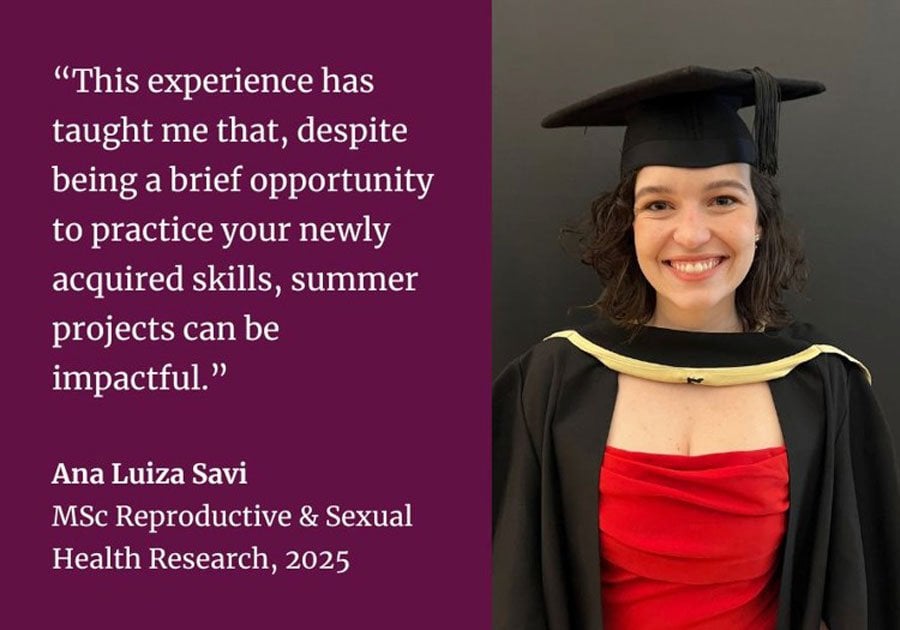
Could you tell us a little about yourself?
My name is Ana Luiza Savi (she/her), I am a Brazilian psychologist and sex therapist, and I recently graduated from the MSc Reproductive and Sexual Health Research at the LSHTM.
You bring together clinical psychology and feminist advocacy in your work. How have your experiences at LSHTM helped you integrate these different approaches in your research and professional practice?
Throughout my time in London, I had the opportunity to learn about and discuss reproductive choice, which is a matter that I carry very close to my heart. As an activist for abortion access in Brazil, I have personally witnessed how reproductive choices are mediated by power, wealth, racism, ableism, and other systemic issues that directly impact health outcomes for women and gender-diverse individuals. Inspired by these discussions, I had the opportunity to work with a pioneering family planning centre in Brazil to understand more about intrauterine device (IUD) use, insertion-related pain, and pain management options for my summer project.
Congratulations on your MSc research recently being published! Could you tell us about the journey from your summer project to publication, and what this experience has meant to you?
My journey from research proposal to publication took about a year and relied on a collaborative and trusting relationship between UK and Brazilian teams (Drs Rachel Scott, Judith Lieber, Luis Bahamondes, and Cássia Juliato). From the start, we explored common research interests, aligned expectations on workload and timelines, and discussed how to maximise local impact through publishing. At this early stage, determining the project's viability within a short timeframe and confirming supervisory capacity to support publication efforts were essential for moving forward.
During the data analysis and writing phases, our collaboration was responsible for ensuring the findings remained relevant, context-specific, and a reliable reflection of the real-world practices we were assessing. Among our results, we found that 81% of insertions were reported as moderately to severely painful, in contrast to the 5% prevalence estimated by national guidelines. With the invaluable support and guidance of my supervisors, I proceeded to determine the manuscript’s angle, map its limitations, and translate results into actionable recommendations.
I started working on the paper shortly after submission, when the topic was still fresh in my mind, and there were fewer competing projects happening. Still, it was useful to create a timeline and set a weekly writing schedule – even when I did not have the motivation to write, or I was not feeling very productive. Personally, prioritising discipline over performance was a good way to keep my writing consistent and feel less overwhelmed about doing something completely new. Looking back, keeping a close relationship with your supervisor and committing to a writing schedule that prioritises consistency over volume are probably the best pieces of advice I could give to anyone who would like to publish their dissertation.
This experience has taught me that, despite being a brief opportunity to practice your newly acquired skills, summer projects can be impactful. Since publishing, our paper has been picked up by over 10 news outlets in Brazil, and inspired hundreds of women to share their IUD insertion experiences online. Moving forward, I hope to keep working to bridge the gap between sexual and reproductive health programming and the lived experiences of contraceptive care.