Fighting cancer with evidence: William's story
13 February 2026 London School of Hygiene & Tropical Medicine London School of Hygiene & Tropical Medicine https://lshtm.ac.uk/themes/custom/lshtm/images/lshtm-logo-black.png
What is your big dream for public and global health?
My dream is for cancer to no longer be a leading cause of death, and ultimately to make it a curable disease. We need research to develop treatments and ensure they work, and the next challenge is how to get those treatments to the people who need them. There are significant inequities around the world. If I can do my part to help address some of these disparities, I think that would make it all worth it.
Why the London School of Hygiene & Tropical Medicine (LSHTM)?
I chose LSHTM mainly due to its reputation and long history in the field of public health research. Whilst completing my national public health training in Canada, I learned about John Snow and the history of public health and epidemiology as part of our epidemiology module, and that's how my interest in further studies in the UK began. When I started planning my MSc, it happened to be at the right point in my career and when the world was opening up again post-Covid. I decided I really wanted to take a more quantitative approach to my education and develop those core skills, and what better place than LSHTM, in the UK, the home where epidemiology essentially began.
What were you doing before your studies?
Before joining LSHTM, I was working for the Canadian federal government, as part of the Office of International Affairs under the health portfolio. I was a policy analyst supporting Canada's engagement with various health organisations like the WHO, the Pan American Health Organization and other entities, involved in day-to-day engagement and supporting ministers and deputy ministers during their dialogues. A definite highlight of my previous career was representing Canada at these meetings, speaking on Canada's behalf and delivering statements on a variety of topics.
What was your experience like as a student at LSHTM?
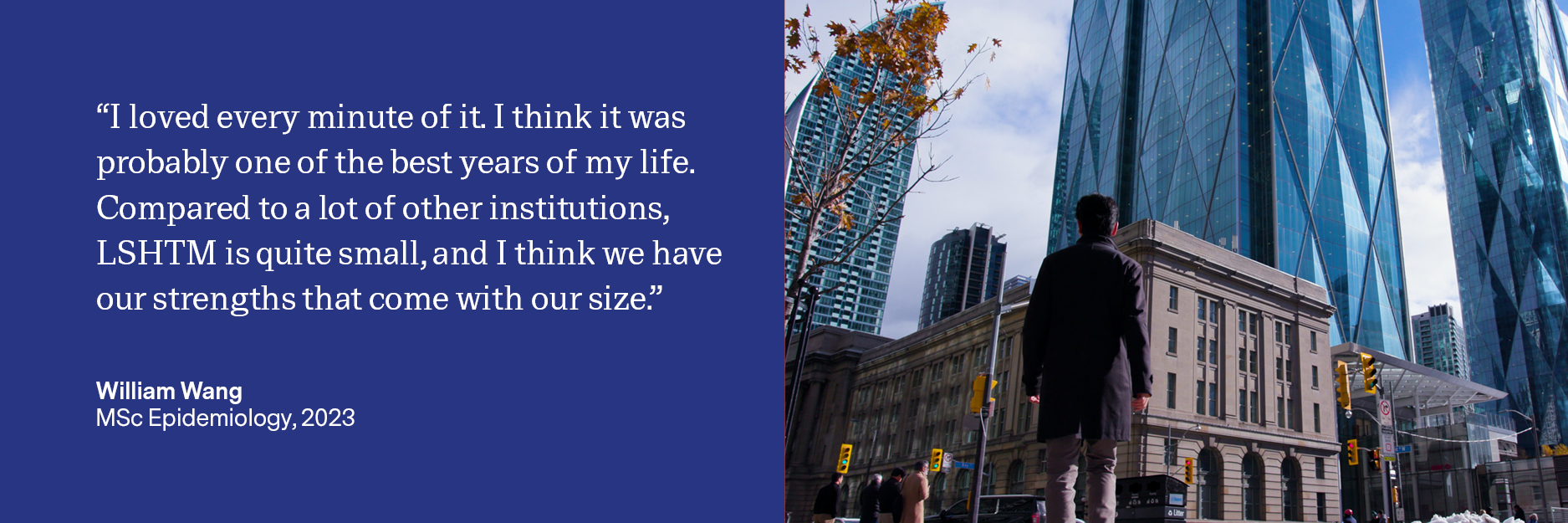
You're able to really connect with your fellow students and peers, but also reach out to professors and faculty on a very personal level. The overall environment at LSHTM was very supportive and collaborative. Looking back, I really enjoyed how diverse our cohort was too. We had students from all over the world, at all stages of life, with differing levels of experience, and that made the discussions in class so much more meaningful and engaging. You really do learn a lot.
Being in London is a great experience in itself. It's a great city and the school is so central. We could pop into the British Museum at lunch or walk a couple of minutes to explore a real range of different things. Having done my undergrad at a much smaller institution in a small Canadian city, this was a new experience for me, and I really enjoyed it.
What was your favourite memory as a student at LSHTM?
I think it was in the first half of the year, just after our exams, when we had our winter ball. It was an opportunity for students from all cohorts across the school to come together and celebrate our accomplishments from the first term. By then, people had gotten to know each other a little better, so it was a really fun event. It was a great time to celebrate together, especially as many of us had come from different parts of the world, were learning together and sometimes encountering difficulties along the way. Coming out of that and celebrating our achievements was a highlight for me.
Can you tell us about your summer research project and how you came to pick it?
My summer research was actually a project that I co-developed with my supervisor Dr Christopher Rentsch. I want to give him a big shout out because I think his support throughout the year was incredible. Even now, I still keep in touch with him and we still collaborate on some work here and there, but during the programme, he was very much both a sounding board academically, and also there for emotional support along the way.
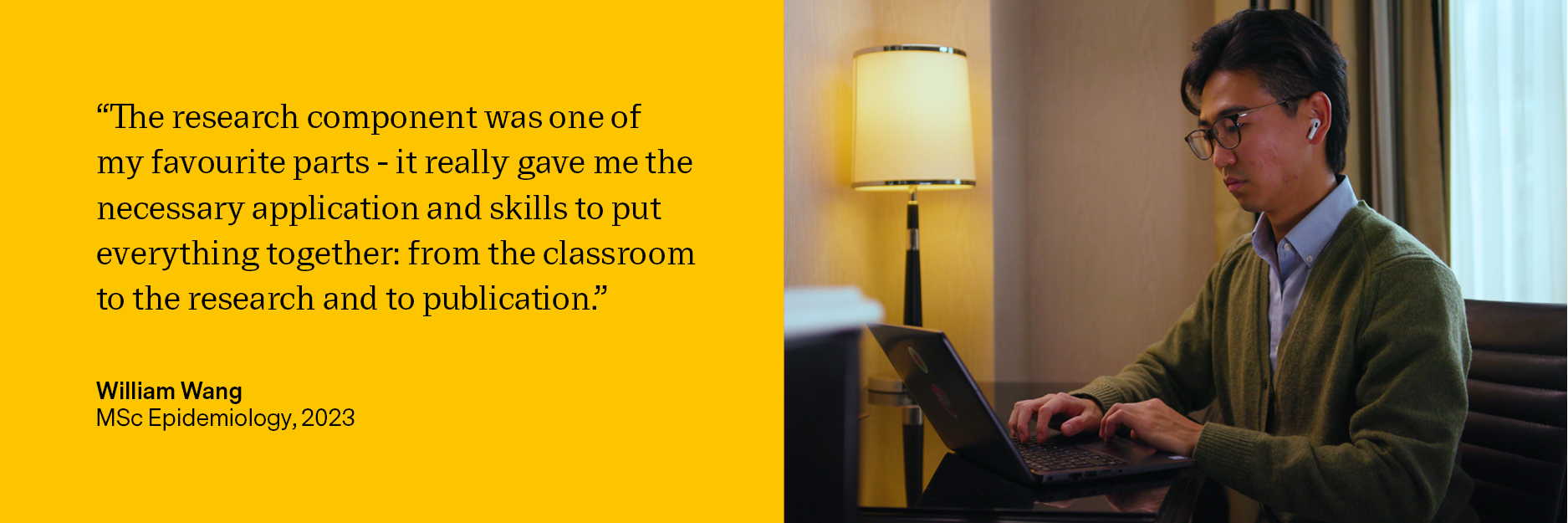
We worked on a project looking at the association between anticholinergic medications and the prevalence of pneumonia in a specific population in the US. Being able to work on this project was very much down to my supervisor's connections and the research he himself was doing. The supervisor-student relationship that LSHTM and the programme build is very unique. When I speak to my peers, many of us have very fond memories of this, especially those of us who didn't have an epidemiology background being paired with a leader in the field. A supervisor can support you not only in selecting a research project, but also in helping you understand core epidemiologic concepts. I think it has also helped a lot in getting me to where I am today in my career.
What did you do after your degree?
I finished my degree in September 2023 and was very fortunate to have been offered an internship position with Novartis, which came largely out of my summer research. At Novartis, I was a real world evidence analyst, and my summer project had involved a lot of real world data and methodologies, so that directly translated into the internship. They could see there was not just a theoretical understanding, but an actual application of it. When I graduated, I worked at Novartis for two months until the end of 2023, further expanding on my training and confirming that I wanted to work in the field of health outcomes research.
What happened after your internship and transitioning back to Canada?
When I finished my internship, I was trying to decide whether to stay in the UK and continue working with Novartis, or explore something closer to home. Being originally from Canada and having grown up here, all my family and friends are here too. So it was a little bit of a tough decision, but in the end I decided to come back to Canada and was very fortunate to find a similar position with AstraZeneca. I joined AstraZeneca in January 2024, working initially on the gastrointestinal side and on liver cancer throughout 2024. In 2025, I transitioned to immuno-oncology, supporting the small cell lung cancer side, and more recently into a role supporting non-small cell lung cancer in a very specific mutation population, which is where I am now.
What is your day to day like now?
My day-to-day involves a lot of meetings. For us, working in outcomes research, the ultimate goal is to generate evidence, whether it's to support the pre-launch or post-launch of different medications and different indications. This involves collaborating a lot with cross-functional partners across the organisation, whether it's colleagues from the medical affairs, the planning departments, the access departments, the commercial departments, and also working both at the global level, but also with different local markets. It involves a lot of strategising coming up with study designs to assess the efficacy and safety, or to understand how certain medications are performing in the real-world once they've been approved and out on the market for use. It's a very interesting job. You get to work with a lot of different people from different backgrounds and oftentimes work with a lot of clinicians as well, covering a lot of technical and clinical expertise. We do this all to understand how these drugs are working and how we can help our patients achieve better outcomes.
How did your degree and education at LSHTM help you in your career now?
My role right now is a very technical position that requires a strong epidemiology and research background, so without my MSc from LSHTM, I wouldn't have the necessary foundational skills to do what I do on a day-to-day basis. Reviewing protocols, study designs and interpreting results are all skills that were taught during the MSc and expanded upon during the summer project. And it's not only the technical skills, but the collaboration we experienced in the classroom, whether on projects, through discussions, or in showing professionalism with fellow peers. These are all skills that transfer directly into my day-to-day job. Being able to present findings and take criticism and feedback are all valuable skills I took from my time at the school. So looking back, if I hadn't done this MSc, I likely wouldn't have been able to work in the field of outcomes research and wouldn't be able to call myself an epidemiologist.
Any tips for future students at LSHTM?
- For any student going to LSHTM, I would suggest taking some risks. Whether it's reaching out to a professor whose research interests you, or taking a course that appeals to you but might not fit your prior background, you don't know if something suits you until you've tried it. For me, when I went to LSHTM, I knew I wanted to work in oncology research broadly, but I had no idea what real-world evidence was. So be open to new challenges. You never know what doors will open and what paths will come up.
- Take advantage of your time there too. You're only in London and at LSHTM for a year, so use that opportunity to make meaningful connections. I'm really grateful for my cohort. We had a really great group of people and many of us still stay in touch today. There are so many people from different walks of life at LSHTM, with different experiences and backgrounds, so you learn from each other, accept differences, and just enjoy the time there. Take advantage of the city. The year will go by too quickly and you'll miss it.
- LSHTM has a great student ambassador programme with lots of former and current students. These are really great resources for a prospective student - if you're interested in learning more about the day-to-day, reach out to an ambassador.
If you're even thinking of potentially applying, why not go for it!
- Learn more about MSc Epidemiology or Epidemiology by Distance Learning
- Contact our student and alumni ambassadors
- Application guidance for international students