There are continuing threats to human health encompassing not only traditional tropical diseases like malaria and dengue fever, but also the challenges thrown up by emerging diseases with pandemic potential, the practice of medicine in conflict and humanitarian settings and antimicrobial resistance.
We’ve designed this course to support physicians who focus on the practice of tropical medicine and international health in today’s world. You’ll examine the issues faced in practicing medicine in areas of conflict where resources are limited and explore the evidence base of tropical medicine and international health. We’ll also help you develop your decision-making and research skills, confidence, and competence so you can make a significant impact on global health.
Over one year (full time) or two years (split study), you’ll build on the foundation of how to diagnose, treat and prevent diseases that are threats to global health. Immersed in a thriving global community of like-minded professionals, you’ll complete modules tailored to your area of interest. You’ll be able to regularly interact with internationally recognised figures in global health. The strong professional networks you’ll build will continue well beyond the course.
What you will learn
- Understand the causes, pathogenesis, diagnosis and management of major diseases affecting tropical and developing countries
- Develop skills in diagnostic parasitology, microbiology and entomology, and knowledge of how to apply epidemiological principles
- Practise communicating medical principles at an appropriate level for patients, professionals, and other groups
- Grow your ability to analyse research findings for clinical and disease control and to critically evaluate their effects
- Discover how to select, apply and interpret statistical methods for analysing quantitative data
The aims and learning outcomes are detailed in the programme specification.
Term one focuses on the foundations of medical practice, building your understanding of global medicine. As part of this compulsory module, you’ll have an opportunity to take the Professional Diploma in Tropical Medicine and Hygiene (DTMH). If you’ve got an equivalent qualification already, we may be able to accredit the prior learning you’ve done and offer a January start.
You’ll be able to choose from a wide range of modules throughout the rest of the course, to suit your medical and professional aims. From conflict and health to water and sanitation and much more – the choice is yours. It might depend on whether you want to advance your skills in clinical research, learn epidemiological methods or explore disciplines that underpin global health.
Who is it for?
We’ve designed this course for professionals engaged in practicing medicine and focused on international health. General practitioners, hospital doctors and junior doctors from all specialities study with us. Perhaps you’re trying to decide how to specialise in tropical medicine and infectious diseases. Maybe you’re practising in a low- and middle-income country and want to upskill or increase your effectiveness and influence decision-making. You could also use the course as an opportunity to do clinical research.
Other students on the course are already engaged with or interested in humanitarian activities, migrant health, working in the NGO sector or with displaced populations.
Whatever your background, you’ll already hold a degree in medicine and be a registered medical practitioner with at least two years of experience working, anywhere, in the world, in clinical medicine.
With its immersive and stimulating environment, the course is also ideal for anyone looking to develop a sense of direction within medicine and debate big issues in global health for all with like-minded colleagues.
Past students have gone on to leadership roles in global health – in governments, non-governmental organisations and academic institutions. Some are leading clinical research in therapeutics and vaccinology and others are delivering health care in conflict settings or humanitarian crises. Some are NHS consultants or academics engaged in global health. But they’re all in touch with their classmates.
Professional Diploma in Tropical Medicine & Hygiene
All students on the MSc will take the Professional Diploma in Tropical Medicine & Hygiene (DTM&H). Students with a prior DTM&H, or holding 60 master's level credits from the DTM&H (East African Partnership) may apply for exemption from Term 1 via recognition of prior learning.
Duration
One year full-time or split-study over two years. Ways to study explained.
Andrew Nguyen
MSc Tropical Medicine & International Health
Paula Asensio Mathews
MSc Tropical Medicine & International Health
The below structure outlines the proposed modules for this programme. Programme and module specifications provide full details about the aims and objectives of each module, what you will study and how the module is assessed.
- Structure of the year
Term 1 (September-December) consists of teaching for the AB1 module, with the DTM&H examination in early December. Followed by the Winter break.
Term 2 (January-March) consists of MSc examinations, followed by a further ten weeks of teaching for C and D slot modules, plus a Reading Week* in the middle of the term. C modules are taught in five half-week blocks before Reading Week. D modules are taught in five half-week blocks after Reading Week. Followed by the Spring break.
Term 3 (April - September) consists of five weeks of teaching for E slot modules, taught in half-week blocks, and the project report.
*Reading Week is a week during term where no formal teaching takes place. It is a time for private study, preparing for assessments or attending study/computer skills workshops.
- Term 1
Students take one compulsory AB1 module:
- Tropical Medicine, Parasitology and Public Health
This module follows the course for the DTM&H. Term 1 consists entirely of the DTM&H lectures, seminars, laboratory practical and clinical sessions, and is examined through the DTM&H examination and resulting in the award of the Diploma and 60 Master's level credits at the end of Term 1.
- Terms 2 and 3
Students take a total of five study modules, one from each timetable slot (C1, C2, D1, D2, E). The list below shows recommended modules. Recognising that students have diverse backgrounds and experience, the programme director considers requests to take any module within LSHTM's portfolio, provided that this is appropriate for the student.
C1 slot
- Clinical Virology
- Malaria: From Science to Policy and Practice
- Maternal & Child Nutrition
- Practical Research Skills
C2 slot
- Conflict & Health
- Design & Analysis of Epidemiological Studies
- Diagnostic Bacteriology
- Qualitative Methodologies
D1 slot
- Applied Communicable Disease Control
- Control of Sexually Transmitted Infections
- Current Issues in Maternal & Perinatal Health
- Epidemiology of Non-Communicable Diseases
- Evaluation of Public Health Interventions
D2 slot
- Epidemiology of Infectious Diseases
- Ethics, Public Health & Human Rights
- Immunology of Parasitic Infection
- Mycology
E slot
- Applying Public Health Principles
- HIV
- Neglected Tropical Diseases
- Novel Drug Discovery & Antimicrobial Resistance
- Vaccine Immunology
- Project report
During the summer months (July - August), students complete a research project in a subject of their choice, for submission by early September. Projects may involve writing up and analysing work carried out before coming to LSHTM, a literature review, or a research study proposal. Some students gather data overseas or in the UK for analysis within the project. Such projects require early planning. Students undertaking projects overseas will require additional funding of up to £1,500 to cover costs involved. The majority of students who undertake projects abroad receive financial support for flights from LSHTM's trust funds set up for this purpose.
Please note: Should it be the case that you are unable to travel overseas or access laboratories in order to complete your project, you will be able to complete an alternative desk-based project allowing you to obtain your qualification within the original time frame. Alternatively, you will be able to defer your project to the following year.
Prize
The Frederick Murgatroyd Award is awarded each year for the best student of the year. Donated by Mrs Murgatroyd in memory of her husband, who held the Wellcome Chair of Clinical Tropical Medicine in 1950 and 1951.
Changes to the programme
LSHTM will seek to deliver this programme in accordance with the description set out on this programme page. However, there may be situations in which it is desirable or necessary for LSHTM to make changes in course provision, either before or after registration. For further information, please see our page on changes to courses.
| Fees 2026/27 | ||
|---|---|---|
| Home | Full-time | £14,930 |
| Part-time | £7,465 | |
| EU/Overseas | Full-time | £34,590 |
| Part-time | £17,295 | |
| Field Trip | £520 |
*Mobile users, scroll right to view fees
Sources of funding:
In order to be admitted to the MSc Tropical Medicine & International Health, an applicant must have a degree in medicine and be a registered medical practitioner. Preference will be given to candidates who have at least two years of experience working in clinical medicine (in any country) with recent professional experience in a relevant discipline.
English language requirements
If English is not your first language, you will need to meet these requirements: Band B.
Some applicants may be exempt if they have previously studied in English or meet other specified criteria. Please see our English language requirements for details.
It is possible to apply without English language test results however the results of a test may be listed as a condition of an offer of admission.
Access and widening participation
At LSHTM we are committed to ensuring that excellent students feel encouraged to apply for a course of study with us. We have introduced an innovative contextual admissions system that is designed to support those students who have faced the greatest barriers to their learning. More information on widening participation at LSHTM.
Applications should be made online and will only be considered once you have provided all required information and supporting documentation.
Please also read LSHTM's Admissions policies (pdf) prior to submitting your application.
You can apply for up to two master's programmes. Make sure to list them by order of preference as consideration will be given to your top choice first.
Please ensure you pay careful attention to the content of your personal statement, as we do not invite applicants to interview for this programme, so the clarity and relevance of the information you can provide is of considerable importance to us. We would like to know your experiences in the relevant field(s), your reasons for applying to our programme, what you hope to gain from the training we offer, and how you intend to use the knowledge and skills you acquired to further your career and contribute to improving health.
Application fee
A standard non-refundable application fee of £50 applies to all Master’s degree programmes and is payable upon application submission. The application fee also applies to PG Diplomas and PG Certificates where appropriate. Income generated from the application fee is shared between scholarships and the student hardship funds.
Application deadline
The final closing dates for all Master’s applications for entry in the 2026/27 academic year is:
- Sunday 26 July 2026 at 23:59 UK time for all students requiring a Student visa
- Monday 31 August 2026 at 23:59 UK time for all UK, Irish and non-Student visa students
Tuition fee deposit
All applicants must respond to their offer of admission within 28 days or their place will be released and the offer automatically declined. The deposit is deductible from tuition fees upon full registration with LSHTM. Applicants in receipt of a full scholarship will not be required to pay the deposit.
- Home students: £500 non-refundable deposit, payable within 28 days of the offer date
- Overseas students: £2,000 non-refundable deposit
- Offers made before 31 January 2026: deposit due by 1 March 2026
- Offers made from 1 February 2026 onwards: deposit due within 28 days of the offer date.
Do you need a visa?
Please visit our Visa & Immigration pages for advice and guidance.
Important notice for nationals/citizens of Afghanistan, Cameroon, Myanmar or Sudan: If you require a UK student visa, the government has introduced a “visa brake”. As a result, LSHTM is currently unable to sponsor student visas for applicants from these countries.
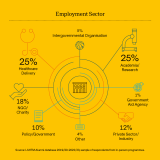
Graduates from this programme enter a diverse range of positions in public health, research, NGOs, health programmes, health services, government, policy and planning.
Employability
On average, 90% of our master's graduates from the 2019/20-2022/23 cohorts were in employment or undertaking further studies 15 months after graduation (Graduate Outcomes Surveys, 2020-2023).
Careers at LSHTM
In this video, LSHTM students share why they chose public health and reflect on their studies, student experience and future career goals.
Graduates from this programme go on to a wide variety of career paths including further research in epidemiology, parasite immunology; field research programmes or international organisations concerned with health care delivery in conflict settings or humanitarian crises, or return to academic or medical positions in low- and middle-income countries.
Below you will find just a few of the positions and organisations that our graduates from this course have entered:
- Example job titles
-
Accident and Emergency Health Worker
Analyst of Vector Control
Emergency Medicine Doctor
GP (General Practitioner)
Lecturer
Medical Director
Research Clinician AE-TBC
Associate Professor of Neurology
Dermatologist
Government Assistant
Specialist Registrar - Example organisations
-
Imperial College London
London School of Hygiene & Tropical Medicine
Médecins Sans Frontières
Medical Research Council Unit, The Gambia
Nagasaki University Hospital
Save the Children
Rabito Clinic
Hospital Management Board
NHS
LSHTM Alumni
LSHTM’s alumni community includes over 35,000 graduates across more than 190 countries. It offers a lifelong connection to LSHTM and to each other.
We are proud of our global alumni network, which includes many notable members, such as:
- Tedros Adhanom, the Director-General of the World Health Organization (WHO), who completed his MSc in Immunology of Infectious Diseases
- Karina Rando, the Minister of Public Health in Uruguay, studied MSc Public Health – Health Economics stream
- Christopher Whitty, Chief Medical Officer for England and Chief Medical Adviser to UK Government, studied MSc Epidemiology.
- Vanessa Bradford Kerry, founder of the non-profit Seed Global Health, director of the Program in Global Public Policy and Social Change at Harvard Medical School, and Special Envoy for Climate Change and Health for the World Health Organization (WHO), studied the MSc in Health Policy, Planning and Financing

- Career support - the LSHTM Careers Service provide a range of services from 1-1 appointments to events and workshops.
- Alumni blogs - did you know LSHTM has over 35,500 alumni in more than 190 countries.
- International alumni chapters - find an LSHTM network of alumni near you from our over 30 chapters.