Two new clinical trials conducted in Ethiopia have found that malaria treatments remain highly effective despite growing concerns about drug resistance, while also identifying a promising approach that could help reduce transmission and support malaria elimination efforts.
Malaria remains a major public health challenge in Ethiopia, where both Plasmodium falciparum and Plasmodium vivax circulate and transmission varies widely by geography and season. Although the country has made progress towards elimination, recent increases in cases, together with emerging drug resistance and parasites that can evade rapid diagnostic tests (RDTs), have raised concerns about the future effectiveness of current control strategies.
The studies, led by researchers from the Armauer Hansen Research Institute (AHRI) in Ethiopia and conducted in collaboration with partners including the London School of Hygiene & Tropical Medicine (LSHTM), Radboud University Medical Centre in the Netherlands, the US President’s Malaria Initiative, the US Centers for Disease Control and Prevention (CDC), USAID and Columbia University, were published in The Lancet Microbe.
Conducted in north-west Ethiopia, the trials evaluated treatments for both major malaria parasites circulating in the country: Plasmodium falciparum and Plasmodium vivax. Together, the studies provide the strongest evidence to date that current treatment strategies remain effective in a region facing emerging threats including drug-resistant parasites and parasites that can evade commonly used RDTs.
In the first study, researchers assessed the effectiveness of artemether–lumefantrine plus single low dose primaquine (SLDPQ), Ethiopia’s first-line treatment for uncomplicated P. falciparum malaria, and compared its performance with pyronaridine–artesunate plus SLDPQ. Both treatments achieved cure rates above 96%, with no early treatment failures and no serious adverse events reported. The findings are particularly encouraging because the study took place in an area where genetic markers associated with artemisinin resistance contribute to more than half of the circulating parasites.
The second trial focused on P. vivax, which accounts for more than a third of malaria cases in Ethiopia and presents unique challenges for control and elimination. Researchers found that both chloroquine and pyronaridine–artesunate each combined with 14 day primaquine for radical cure achieved efficacy rates above 95%, demonstrating that the first line treatment (chloroquine) regimens remain highly effective for treating uncomplicated infection while the alternative ACT demonstrated high efficacy, providing a strong evidence for future unified treatment of the two species.
Beyond clinical cure, the researchers also investigated how quickly treatment could stop malaria from being transmitted from people to mosquitoes. In a dedicated transmission study, participants who received pyronaridine–artesunate together with primaquine were no longer able to infect mosquitoes within 24 hours of treatment. This rapid interruption of transmission suggests the regimen could play an important role in reducing the spread of malaria within communities.
The findings add to growing evidence supporting pyronaridine–artesunate as a versatile treatment option for both P. falciparum and P. vivax. In areas where the two species circulate together, a unified treatment strategy could simplify case management, strengthen health system efficiency and contribute to malaria elimination efforts.
The studies also highlight the need for continued vigilance. Researchers identified a high prevalence of genetic changes in P. falciparum associated with reduced susceptibility to artemisinin and with false-negative results from some RDTs. Although these changes have not yet undermined treatment effectiveness, their increasing prevalence underscores the importance of continued surveillance to ensure that current tools remain effective.
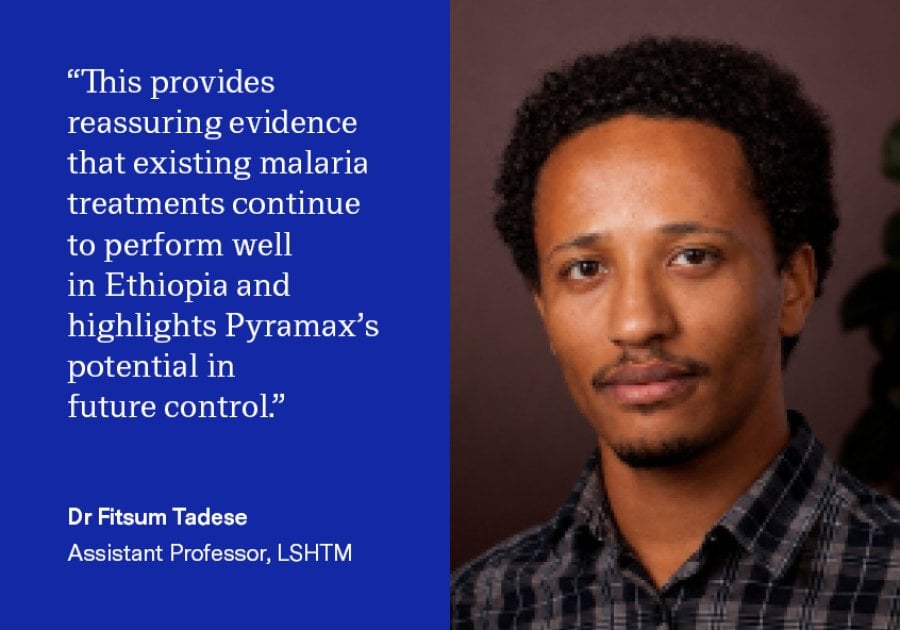
Dr Fitsum Tadese, Assistant Professor at LSHTM said: “Taken together, our findings provide reassuring evidence that existing malaria treatments continue to perform well in Ethiopia, while highlighting the potential of pyronaridine–artesunate to support future malaria control and elimination efforts through its strong efficacy and rapid transmission-blocking effects.”
The research was funded by the US President’s Malaria Initiative, the Wellcome Trust and other international partners supporting malaria research and elimination efforts in Ethiopia.
Publications
Bezabih MK; Sisay S; Behaksera SW; Ramjith J; Teka H; Girma S et al. Efficacy of chloroquine plus low-dose primaquine and pyronaridine–artesunate plus low-dose primaquine against Plasmodium vivax malaria in adults and transmission to mosquitoes in Ethiopia: a phase 2/3, observer-masked, randomised, parallel-group trial. The Lancet Microbe (2026).
Bezabih M, Misganaw T, Ejigu L et al.Evaluation of the effectiveness of artemether–lumefantrine and artesunate–pyronaridine each combined with single low-dose primaquine in adults with Plasmodium falciparum infection in Ethiopia: a phase 2/3, observer-masked, randomised, parallel-group trial. The Lancet Microbe (2026)
If you enjoyed this article and would like to build a career in global health, we offer a range of MSc programmes covering health and data, infectious and tropical diseases, population health, and public health and policy.
Available on campus or online, including flexible study that works around your work and home life, be part of a global community at the UK's no.1 public health university.