
The first study to assess malaria treatment effectiveness in Djibouti, published in Open Forum Infectious Diseases, has found that the country's frontline antimalarial drug continues to cure almost all infections, providing reassuring evidence for national malaria control efforts at a time of growing regional concern about resistance.
The study, led by researchers from Djibouti, Ethiopia and the London School of Hygiene & Tropical Medicine (LSHTM), is the first therapeutic efficacy study (TES) ever conducted in the country. Therapeutic efficacy studies are considered the gold standard for assessing whether malaria medicines remain effective and are a key tool for identifying emerging drug resistance before it becomes a major public health problem.
Researchers followed 88 patients with uncomplicated Plasmodium falciparum malaria who received artemether-lumefantrine, Djibouti's first-line treatment. Among patients who completed follow-up, the drug achieved a cure rate of 98.6%, with only one confirmed treatment failure.
The findings are particularly significant because Djibouti sits at the centre of a region facing multiple malaria threats. The country has experienced a resurgence in malaria cases over the past decade, fuelled in part by the spread of Anopheles stephensi, an invasive mosquito species that is rapidly expanding across the Horn of Africa. At the same time, neighbouring countries have reported the emergence of genetic mutations associated with resistance to artemisinin-based treatments.
While the study confirmed that artemether-lumefantrine remains highly effective, it also revealed several challenges that could undermine future malaria control efforts.
Researchers found that commonly used HRP2-based rapid diagnostic tests detected only 37.5% of malaria infections. Genetic analysis showed this poor performance was linked to widespread deletions in parasite genes targeted by the tests. By contrast, pLDH-based rapid tests identified every infection detected during the study. The findings reinforce Djibouti's decision to replace HRP2-based tests and highlight the growing challenge of diagnostic evasion in the region.
The researchers also identified a genetic mutation associated with partial artemisinin resistance in one parasite sample. Although the mutation was rare, its detection is notable given Djibouti's role as a major transport and migration hub connecting countries across the Horn of Africa, where resistance markers have already been reported.
Another important finding was that some patients continued to carry gametocytes – the parasite stage responsible for transmission from humans to mosquitoes – for up to three weeks after treatment. In some cases, gametocytes remained present even after the parasites responsible for causing illness had been cleared, raising concerns that transmission could continue despite successful treatment.
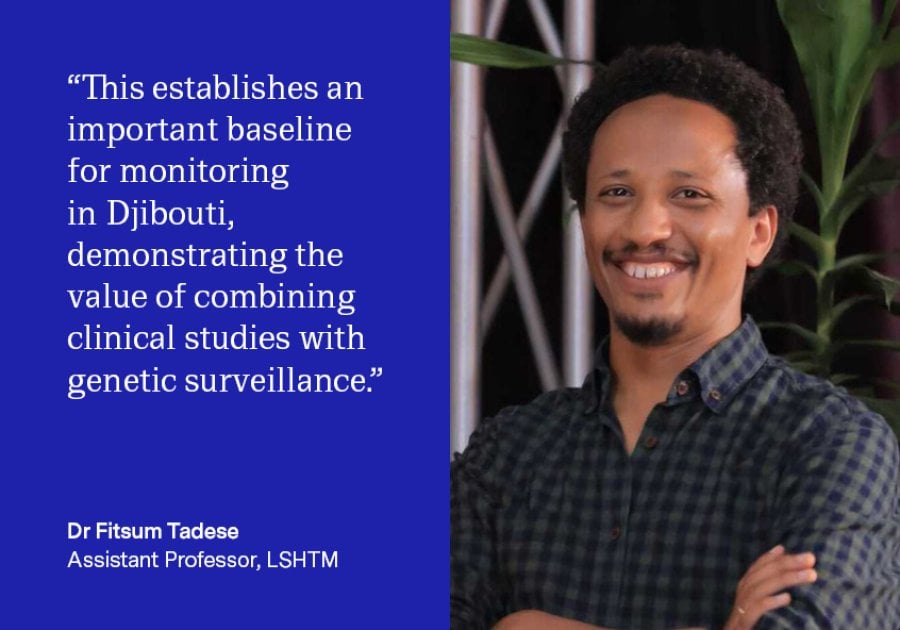
Dr Fitsum Tadesse, Assistant Professor at LSHTM and last author of the paper, said: “The study establishes an important baseline for future monitoring in Djibouti and demonstrates the value of combining clinical studies with advanced genetic surveillance. Continued monitoring of drug effectiveness, parasite genetics and diagnostic performance will be essential to protecting recent gains against malaria and preventing the spread of resistant parasites across the region.”
The study was conducted through a collaboration between the Djibouti Ministry of Health, the Armauer Hansen Research Institute, LSHTM, the University of California San Francisco and other international partners working to strengthen malaria surveillance through a Gates Foundation-supported project, HAMMS (Horn of Africa Malaria Molecular Surveillance).
Publication
Behaksra SW et al. First TES in Djibouti: A Critical Milestone Amid Rising Regional Threats. Open Forum Infectious Diseases (2026). DOI: https://doi.org/10.1093/ofid/ofag324
If you enjoyed this article and would like to build a career in global health, we offer a range of MSc programmes covering health and data, infectious and tropical diseases, population health, and public health and policy.
Available on campus or online, including flexible study that works around your work and home life, be part of a global community at the UK's no.1 public health university.