
Researchers from the London School of Hygiene & Tropical Medicine have led one of the largest-ever genetic studies of the malaria parasite Plasmodium falciparum, uncovering region-specific patterns of adaptation and drug resistance that could help strengthen global malaria surveillance efforts.
Published in Nature Communications, the study analysed more than 17,500 parasite samples collected from 39 countries, combining large-scale whole-genome sequencing with advanced population genetic analysis to better understand how malaria parasites evolve and spread.
The international research team identified distinct regional patterns of parasite adaptation, including genetic signatures linked to antimalarial drug resistance. The findings provide new insight into how resistance emerges and spreads in different parts of the world, particularly in Southeast Asia, South America, and the Horn of Africa.
The researchers found strong evidence of localised selection pressure around several known drug-resistance genes, including pfcrt and pfkelch13, as well as signals in additional genes that may contribute to future artemisinin resistance, including Kelch13 interaction candidate genes. Samples from Vietnam showed particularly high genetic relatedness, with all analysed isolates carrying the artemisinin-resistance mutation C580Y.
The study also included newly sequenced parasite genomes from Brazil, which revealed increased genetic relatedness around resistance-associated regions, suggesting ongoing local drug selection pressures.
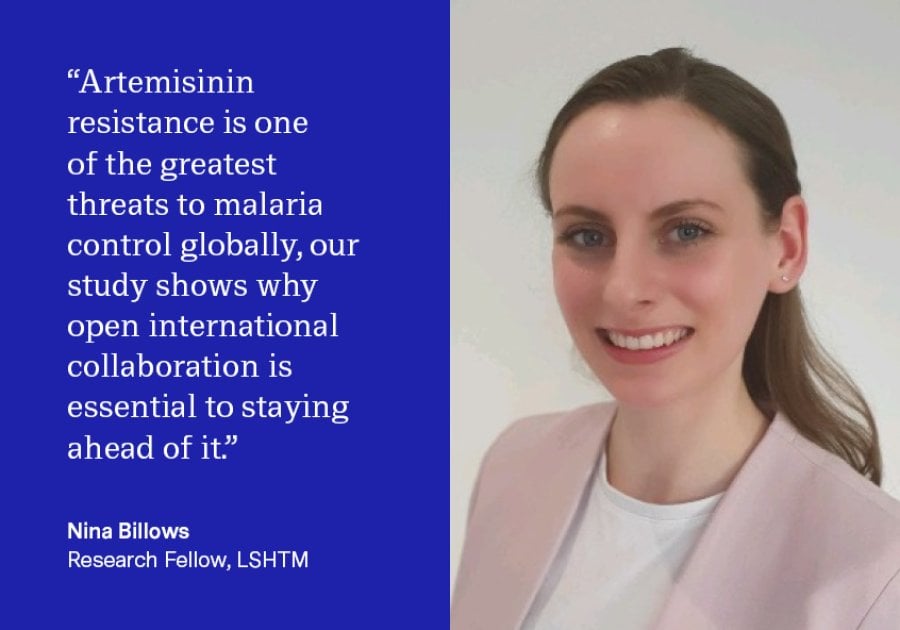
Nina Billows, Research Fellow at LSHTM and first author of the paper, said: "I'm incredibly grateful to our collaborators in Brazil, Vietnam, and Kenya, as well as to the wider research community whose publicly deposited genomic data made this work possible. Analysing data at this scale is what allows us to pick up the subtle genetic signals that mark the early stages of drug resistance. Artemisinin resistance is one of the greatest threats to malaria control globally, and studies like this one show exactly why open, international collaboration is so essential to staying ahead of it."
The authors say the findings demonstrate the growing value of genomic surveillance for tracking malaria evolution and anticipating emerging resistance threats before they spread more widely.
Dr Leen Vanheer, Research fellow at LSHTM and co-author of the paper, said: "Analysing the entire genome of Plasmodium falciparum isolates exposes the selective pressures antimalarials exert on the parasite and can uncover new molecular markers of drug resistance, which we can then use to track how resistance spreads globally. This study identifies such signatures of selection in genes that could play a role in artemisinin resistance.”
Malaria remains one of the world’s leading infectious disease threats, causing an estimated 610,000 deaths annually, primarily among children in sub-Saharan Africa. As resistance to current treatments continues to emerge, understanding the genetic diversity and evolutionary dynamics of malaria parasites is becoming increasingly important for global control and elimination strategies.
The study was led by researchers from LSHTM in collaboration with partners in Brazil, Kenya, and Vietnam.
Publication
Billows, N., Dombrowski, J.G., Thorpe, J. et al. Global-scale population genetic analysis of Plasmodium falciparum identifies region-specific patterns of malaria parasite adaptation. Nature Communications (2026). DOI: https://doi.org/10.1038/s41467-026-73006-2
If you enjoyed this article and would like to build a career in global health, we offer a range of MSc programmes covering health and data, infectious and tropical diseases, population health, and public health and policy.
Available on campus or online, including flexible study that works around your work and home life, be part of a global community at the UK's no.1 public health university.