
Research led by Scientists from the London School of Hygiene & Tropical Medicine and Mahidol University have found that the malaria parasite Plasmodium knowlesi can adapt to infect human red blood cells that lack surface proteins previously believed to be essential for infection.
The study, published in Blood, shows that the parasite can develop an alternative way to enter these cells. Understanding these alternative invasion pathways could help scientists identify new targets for malaria vaccines or treatments, as well as improve understanding of how malaria parasites evolve.
The discovery challenges long-standing assumptions about how malaria parasites infect humans and provides new insights into their adaptability. Malaria parasites cause disease by invading red blood cells, where they grow and multiply. To enter these cells, the parasite must bind to specific protein receptors on the surface of the red blood cell.
For P. vivax and P. knowlesi, this invasion has long been thought to depend on a specific interaction between two proteins. The parasite produces a protein on its cell surface, the Duffy Binding Protein (DBP), which attaches to a receptor on human red blood cells known as the Duffy Antigen Receptor for Chemokines (DARC).
This interaction allows the parasite to remain close to the red blood cell surface, facilitating the subsequent steps of invasion into the cell.
However, some people have genetic mutations that prevent the Duffy receptor from being expressed on their red blood cells. These individuals have a phenotype known as Duffy-negative, meaning their red blood cells lack the DARC receptor.
For many years, people with Duffy-negative blood were thought to be naturally protected from infection by parasites such as P. vivax and P. knowlesi because the parasite could not enter their red blood cells.
Over the past decade, however, increasing numbers of P. vivax infections have been reported in Duffy-negative individuals, raising questions on the essentiality of the DARC-DBP interaction in P. vivax and P. knowlesi infections. Understanding how P. vivax infections happen in Duffy-negative individuals has been difficult because P. vivax cannot easily be maintained in long-term laboratory culture.
To investigate whether malaria parasites can adapt to infect Duffy-negative cells, researchers used P. knowlesi, a closely related malaria species that can be grown in laboratory conditions.
Collaborators at Mahidol University in Thailand exposed P. knowlesi parasites to Duffy-negative red blood cells continuously for six months.
During this time, the parasites gradually adapted and eventually developed the ability to grow in Duffy-negative blood cells, demonstrating for the first time that P. knowlesi can invade these cells without relying on the DARC receptor.
The researchers demonstrate that under continued exposure to Duffy-negative blood, P. knowlesi parasites underwent genome alterations, hypothesising that these genome modifications allowed for the ability of these parasites to infect Duffy-negative blood. These findings allow us to further investigate the biology of malaria infections in Duffy-negative individuals, and to understand the processes behind how malaria parasites adapt in different environments.
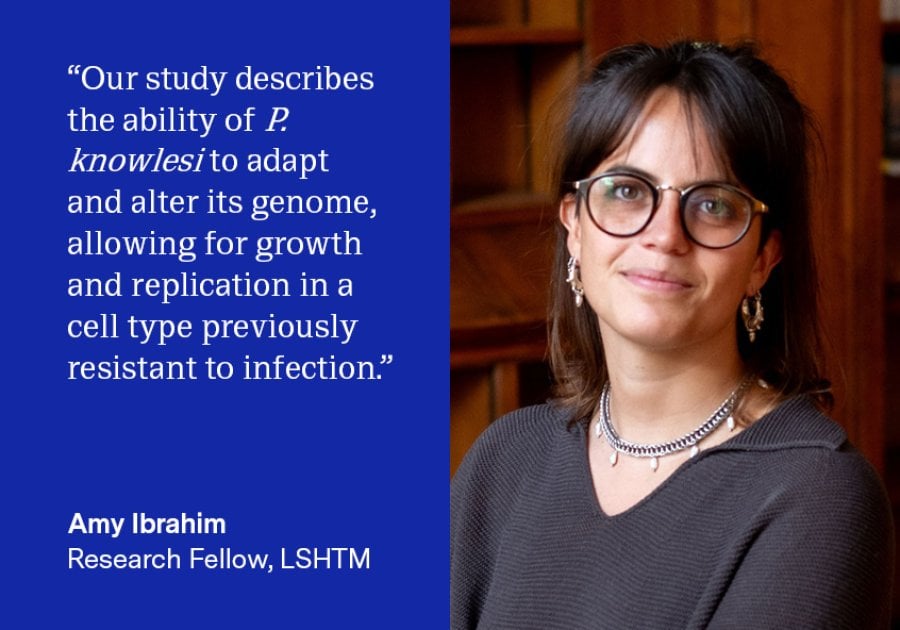
Amy Ibrahim, Research Fellow at LSHTM said: "Our study describes the ability of P. knowlesi to adapt and alter its genome, allowing for growth and replication in a cell type previously resistant to infection.
“Whilst a useful finding for investigating malaria infections in Duffy-negative individuals, this study demonstrates the remarkable adaptability of Plasmodium parasites in response to their environment. “
Publication
Zinga, MM; Ibrahim, A; Mohring, F; Chainarin, S; Jonsdottir, TK; Ngernna, S; Amabilino-Perez, B J; Pholcharee, T; Turkiewicz, A; Campino, S; Clark TG, Miao, J; cui, L; Roobsoong, W; Sattabongkot, J; Moon, RW; Nguitragool, W; “Plasmodium knowlesi can adapt to infect Duffy-negative Erythrocytes”. (2026) Blood DOI: 10.1182/blood.2025029557 (In Press)
If you enjoyed this article and would like to build a career in global health, we offer a range of MSc programmes covering health and data, infectious and tropical diseases, population health, and public health and policy.
Available on campus or online, including flexible study that works around your work and home life, be part of a global community at the UK's no.1 public health university.