The World Malaria Report 2025 estimates 272 million malaria cases and around 608,000 deaths in the most recent reporting year. These figures remain far higher than the levels targeted under the Global Technical Strategy for 2025. Current incidence is around 60 cases per 1,000 population at risk, and the mortality rate remains close to 14 deaths per 100,000 population at risk. The African region continues to experience the overwhelming majority of the global burden.
The report also shows that elimination is possible when strong surveillance and sustained investment are in place. Several countries have recently been certified malaria-free, including Cabo Verde and Egypt in 2024, and Georgia, Suriname and Timor-Leste in 2025. These examples demonstrate that progress is achievable even in challenging environments, although gains remain fragile without decisive action on the biological threats that undermine existing tools.
This year’s report places particular emphasis on the spread of resistance. Four countries now have confirmed partial artemisinin resistance: Eritrea, Rwanda, Uganda and the United Republic of Tanzania. A further four — Ethiopia, Namibia, Sudan and Zambia — show suspected resistance where validated mutations exceed 5 per cent. In Uganda, the prevalence of wild-type Kelch13 parasites has fallen sharply since 2016, with multiple resistant lineages emerging and expanding. Since 2019, five of 66 studies of artemether-lumefantrine in Africa have shown treatment failure rates above 10 per cent. Although ACTs remain broadly effective, these signs indicate increasing pressure on first-line therapies.
The diagnostic landscape is also becoming more complex. New data show pfhrp2 or pfhrp3 gene deletions in 34 endemic countries, with six reporting prevalences above 15 per cent. Between 2024 and 2025, 16 new studies were added to the global database, including reports from Cameroon, Côte d’Ivoire, Ethiopia, Ghana, Mozambique, South Africa, Uganda and the United Republic of Tanzania. In South Africa, pfhrp2 and pfhrp3 deletions were found in nearly all discordant samples tested. In several parts of the Horn of Africa, parasites now carry both Kelch13 resistance markers and pfhrp2 or pfhrp3 deletions, making them harder to treat and harder to detect.
Resistance in mosquitoes is also widespread. Of the 58 countries reporting insecticide susceptibility data over the past five years, resistance to at least one insecticide was detected in 48 countries. Pyrethroid resistance remains the most common, confirmed in 48 of the 53 countries that monitored it. Resistance to carbamates, neonicotinoids and organophosphates is also expanding, placing additional pressure on vector control programmes.
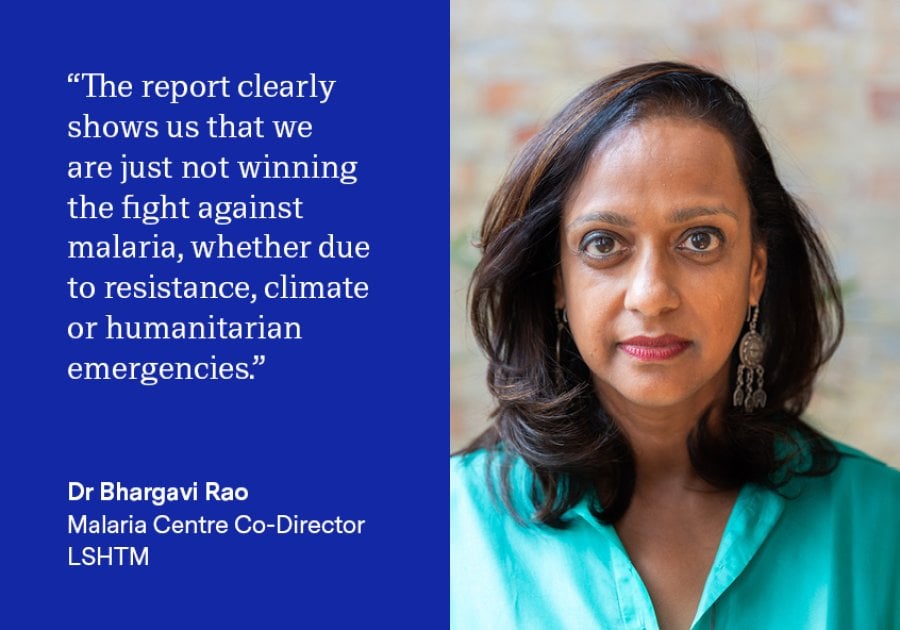
Dr Bhargavi Rao, Clinical Associate Professor and Co-Director of the Malaria Centres at the London School of Hygiene and Tropical Medicine (LSHTM), said: “The report clearly shows us that we are just not winning the fight against malaria, whether due to resistance, climate or humanitarian emergencies. The cuts to international aid are going to make it even harder to address this growing risk to millions of children around the world. We desperately need NGOs, governments and research institutions to collaborate more effectively to ensure new innovations target the threats undermining progress, but importantly, that existing tools are also made accessible to those most in need.”
Professor of Parasitology at LSHTM, Colin Sutherland, said: “The warning signs of emerging threats are now impossible to ignore, including drug resistance, diagnostic resistance and insecticide resistance. Without a concerted response, these could create real vulnerability for malaria control in Africa, exacerbating recent stagnation in case numbers and mortality. We are involved with partners all around the world, and particularly with our fellow scientists on the African continent, in efforts to widen the set of tools that countries can use to combat malaria.
“This informal global alliance is working together to strengthen the active monitoring of parasite drug susceptibility and insecticide effectiveness against mosquitoes, to introduce new diagnostic approaches and to expand access to multiple first-line therapies. These endeavours are designed to equip programmes to respond quickly when current tools are seen to be losing effectiveness.”
If you enjoyed this article and would like to build a career in global health, we offer a range of MSc programmes covering health and data, infectious and tropical diseases, population health, and public health and policy.
Available on campus or online, including flexible study that works around your work and home life, be part of a global community at the UK's no.1 public health university.