The World Health Organization (WHO) has released an updated Field Manual on Malaria Control in Emergencies, providing practical guidance for health workers and humanitarian actors responding to crises. The manual, launched in 2025, replaces WHO’s 2013 handbook and consolidates global expertise and field-tested strategies for managing malaria in some of the world’s most fragile settings as well as outbreaks of malaria during emergencies such as floods or other climatic events.
The manual also highlights the ongoing role of research and innovation, ensuring that users have access to the most up-to-date guidance.
The release comes amid an unprecedented surge in conflict and climate crises. By the end of 2023, a record 117 million people were displaced worldwide, including nearly 80 million living in 43 malaria-endemic countries. Displaced populations often face heightened vulnerability to malaria, with overcrowded living conditions, disrupted health systems, and little access to preventive tools or treatment.
The updated field manual draws on experiences from more than 24 countries and offers practical tools to mount swift and effective malaria responses. It includes sections on epidemiology and risk assessment, diagnostics and case management, vector control, chemoprevention, risk communication and community engagement, and surveillance and operational research.
WHO stressed that the manual is more than a technical resource, it is a call to action to strengthen collaboration, uphold the right to health, and ensure no one is left behind even in the most difficult of circumstances. Emphasising that malaria, if left unchecked in emergencies, often becomes a leading cause of death, particularly in regions with moderate to high transmission.
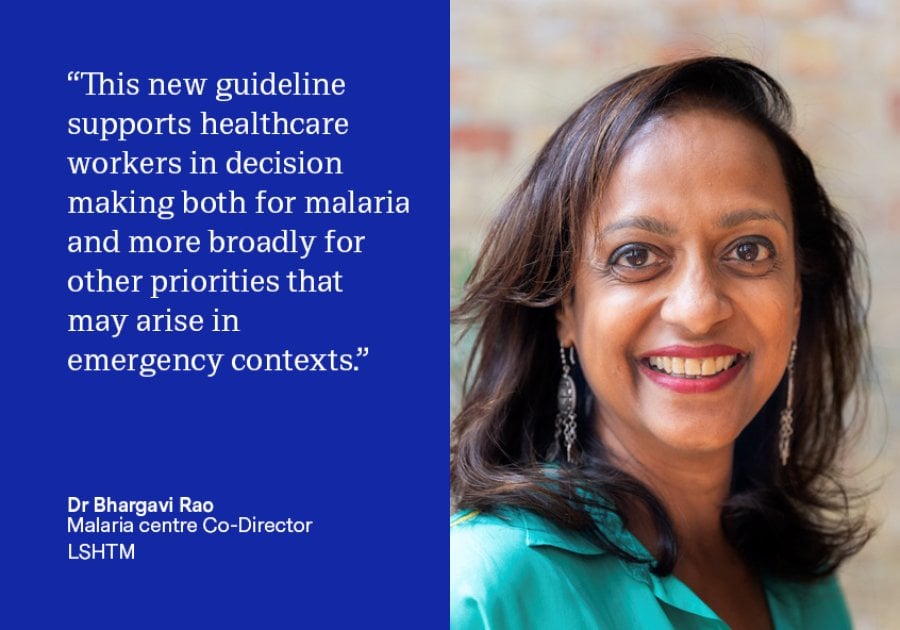
Clinical Associate Professor, Dr Bhargavi Rao is the Co-Director of the Malaria Centre at LSHTM and a member of the Health in Humanitarian Crises Centre. Dr Rao co-led the development and is co-Programme Director for the new Health in Humanitarian Crises masters programme at LSHTM.
Dr Rao, Co-author of this field manual, highlights the significance of the manual for frontline workers and the need to integrate malaria control into broader emergency response.
She said: “As we see from the rises in malaria cases seen in Ethiopia to outbreaks in Pakistan, we urgently need to understand how to best tailor our responses to the needs of the context beyond standard malaria control. This may involve considering different vector behaviours, expanded age groups to target or mass distribution strategies to ensure those most vulnerable are protected and to minimise mortality and morbidity in that specific scenario. Prioritisation in crisis situations is critical and this new guideline supports healthcare workers in decision-making both for malaria and more broadly for other priorities that may arise in emergency contexts.”
The handbook includes suggestions for further reading, useful tools and resources, and links to current information, making it an essential tool for humanitarian actors, health workers, and decision-makers operating in emergency settings.
The publication was developed through extensive consultation with experts, agencies, and field practitioners, and supported by funding from the Bill & Melinda Gates Foundation.
The full manual is available on WHO’s publications site: Malaria control in emergencies: Field manual
If you enjoyed this article and would like to build a career in global health, we offer a range of MSc programmes covering health and data, infectious and tropical diseases, population health, and public health and policy.
Available on campus or online, including flexible study that works around your work and home life, be part of a global community at the UK's no.1 public health university.