
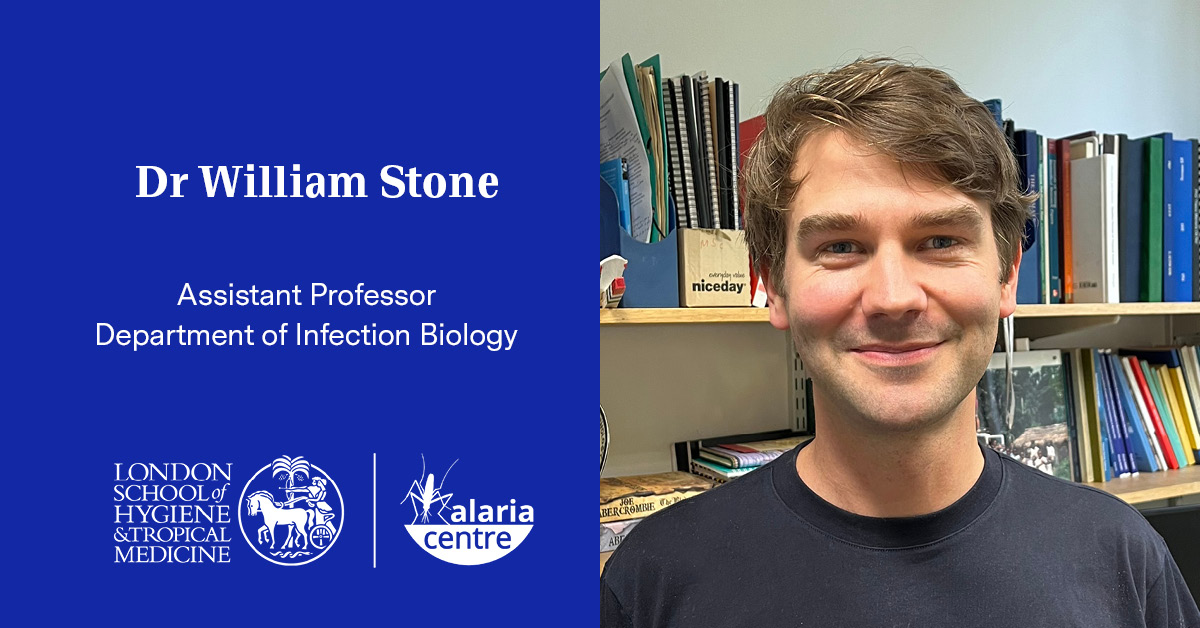
Tell us about your role at LSHTM.
I’m an Assistant Professor in the Department of Infection Biology.
My work is grounded in an understanding of the human ‘infectious reservoir’ of malaria. At its most basic, this is the pool of people in endemic populations that produce parasites that are infectious to mosquitoes, but there’s another layer of complexity when we consider who contributes to transmission - shaped by population demographics, immune status, control coverage, and human behaviour. Understanding this stuff becomes important if you think about whether our interventions are adequately tailored to deplete the reservoir and achieve transmission reduction.
This holistic understanding of transmission underpins my primary research interests – which are working to develop and test tools that specifically target transmission and using these frameworks to dig deeper into the immune mechanisms that naturally stop some people transmitting. I teach basic immunology and bio-stats, mostly to lab-based students.
Describe your role in 3 words?
Too. Desk. Based.
Tell us about your latest research publication or projects.
Over the last five years or so I’ve built some great relationships with a research team in Mali, at the University of Bamako. Working closely with Almahamoudou Mahamar, we’ve produced some (I think) great work; showing for the first time that tafenoquine, a longer lasting version of primaquine, is very effective in blocking transmission from humans to mosquitoes; demonstrating that gametocytes, which are insensitive to most therapeutic antimalarials, do not contribute to post-treatment HRP2 antigenemia – an important consideration for RDT performance (with my first PhD student Tate Oulton); and investigating genomic networks in humans and mosquitoes (with my second PhD Student, Leen Vanheer).
Right now, we are testing a malaria transmission-blocking monoclonal antibody in an endemic population for the first time ever – and the results are looking very promising! Unfortunately, the transmission season got away from us a bit last year, so the trial paused and will start up again in the wet season this year. My salary won’t though…the perils of fixed term contracts (LSHTM has the highest % of staff on these contracts of any university in the UK). This is a pretty stressful situation, and one I’m sure many people can relate to. While I wait on the outcome of three or four grant applications, I have to try not to let this uncertainty affect me too much. I’m lucky - I don’t have kids or dependents. Many people in my position do, so it’s easy to see why there is such attrition of staff at this career stage.
How would you describe the current situation in malaria and global health?
Really, really bad? For the billions of people living with the daily threat of infectious diseases, and for the global health researchers working to combat them. I think we’ve yet to really feel the full force of the US funding cuts. It will be a domino effect that will impact not just lives and jobs but also things like student intake at LSHTM.
Just recently, I worked for two months with colleagues in Uganda on a highly competitive funding call. That effort is now in jeopardy - not because of the science, but because cuts to overseas NIH funding have undermined the surveillance infrastructure we were depending on. It’s really disheartening.
The current U.S. government’s stance on global health is regressive and short-sighted. How much damage can one government do in 3.5 more years? Probably quite a lot.
If you had to change one thing in the research world, what would that be and why?
To become a successful academic, the model seems to have been about separating yourself from the pack. Leading from the front. This means, I suspect, that certain personality types are more likely to succeed. If I could change one thing it would be that good work, team-work, and hard work are better rewarded.
What has been the most rewarding aspect of your career so far, and how do you see it influencing the future of your field?
I helped develop a RT-qPCR assay that’s now widely used to quantify male and female gametocytes – that was quite cool. One of the genes involved didn’t have a name, so I gave it one. I’m not sure that’s how it works but, it’s on PlasmoDB so I guess it must be! Other high points involve getting my review on the front cover of Trends in Parasitology; helping to organise a pan-African mosquito feeding assay workshop in Yaounde, Cameroon; and hearing that I had got a Wellcome trust fellowship to work on transmission-blocking immunity.
It can be difficult to see how your work makes a big difference to the wider community and to public health. As my work has become more applied – testing drugs and monoclonals in Africa, designing larger trials to try to convince national malaria control programs to adopt new transmission focused intervention strategies – it has felt more influential. But these projects involve a lot of people and my role in them is quite central. With (potential) influence comes responsibility…that can be scary!
Who is your biggest inspiration in the science world?
Like many people I suspect I am here because of David Attenborough. I went to Bristol Uni because I knew the BBC Natural History unit was there. It took a while for me to realise that not all the best animals were fluffy. There’s a parasite that makes ants climb blades of grass and bite down, so they’ll be eaten by sheep - their definitive host. Much cooler than pandas.
Still, I love him. I remember seeing Planet Earth when it was on TV for the first time. The bit where the camera goes over the edge of Angel falls in Venezuela: I think I cried a little bit.
Interesting Dave fact and great collective noun: He used to keep a conspiracy of Pygmy Lemurs in his house!
What do you do for fun?
I hope one day to be able to serve a tennis ball in a way that imparts some level of respect in my opponent, but I suspect this will take many more years. A perfect (non-work) day would involve Yorkshire tea and eggs benedict. Then bread baking, a walk in the countryside, getting lovingly tackled to ground by a pack of dogs who all demand scratches, and spontaneously finding all my friends in a great pub. Then back home to cook an ambitious but successful dinner and play a complicated board game.