
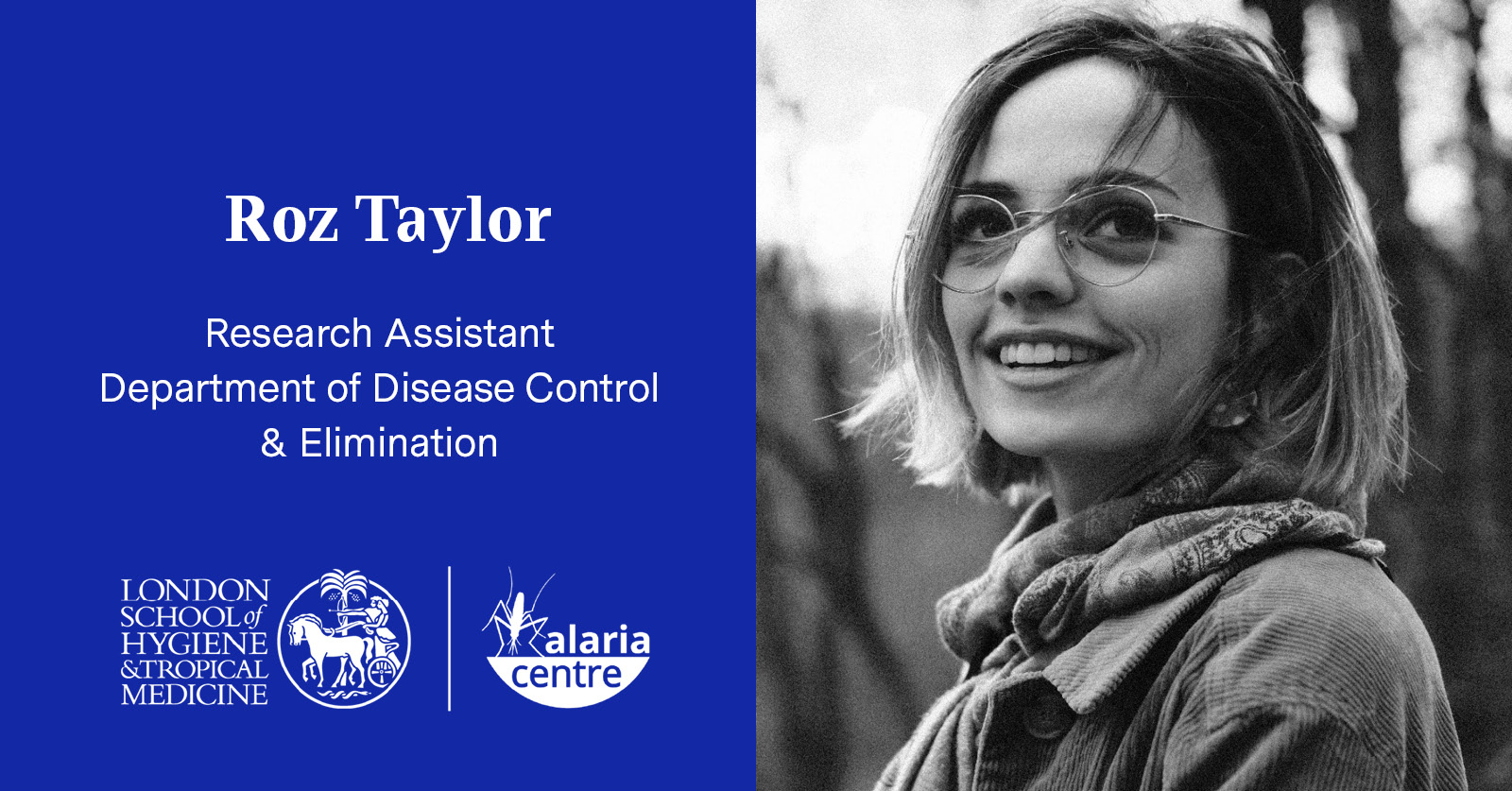
What is your role at LSHTM?
I’m a Research Assistant in the RAFT (Resilience Against Future Threats through vector control) Consortium.
Could you share some insights into your current project?
I am currently working on several things related to Anopheles stephensi, a malaria vector that has historically been found in large parts of South Asia and the Middle East and Arabian Peninsula. However, this mosquito was detected for the first time in Africa in 2012 in Djibouti. Since then, it has been reported in a further 7 countries and has been implicated in an urban outbreak in Ethiopia.
The key concern is that An. stephensi is very different from the primary vectors in Africa. It can breed in man-made water sources, like plastic containers, tanks, wells and construction pits, and tolerate salinity, pollution and high temperatures. This allows it to breed in places where An. gambiae and An. funestus do not. For example, An. stephensi thrives in highly urbanised environments in India, and is found across the Thar desert. This invasive vector also feeds and rests both indoors and outdoors.
As a result, An. stephensi threatens to spread malaria in places that have previously been low risk, like city centres. It also presents challenges for control programmes, which are designed around the native malaria vectors. The strategic implications that now face us aren’t too clear yet – but it is clear that we will have to rethink some of our assumptions of malaria control and that this new threat requires rapid additional funds. RAFT is involved with several brilliant research teams that are trying to better understand the spread of An. stephensi, and we are working to put it on the agenda, through recent and upcoming events, informative materials and publications.
How did you initially embark on your journey in malaria research?
In my undergraduate degree, I did several modules on disease ecology, parasitology and malaria. I was really interested in malaria research and proposed my project with the Reece Lab at the University of Edinburgh, looking at relationships between parasite synchronicity and patient characteristics from historical data. I was given a small grant to continue with this work for a few months after my BSc and then I decided to apply to study One Health at the LSHTM. I knew I was already interested in malaria and so it felt like a natural progression to gravitate towards it, and I did my project with Isabel Byrne and Marta Moreno, on environmental risk factors for dry season persistence of Anopheles vectors in Burkina Faso.
Could you describe the work environment at the Malaria Centre?
The Malaria Centre is a great community. The Centre retreat is really fun and helped me to understand how much everyone collaborates, and the diversity of contexts each Research group works in. You get to know people at the Centre through your work more generally too, and everyone is committed to doing top-quality research in a variety of areas and disciplines – I think this is what makes the Centre so valuable as a source of support and knowledge-sharing.
You live in London now working at the LSHTM, where were you before this?
Before my current job, I completed an MSc in One Health at the LSHTM and Royal Veterinary College, so I have lived in London for a while. Before that I did my MSc at the University of Edinburgh. I was there for four years and I still think it is one of the most beautiful cities I’ve been to – you’ve got the seaside (which people forget to visit), the hills and parks, and the old architecture to explore. There are some brilliant malaria researchers there too.
What were your childhood aspirations?
For years when I was little I really wanted to be a volcanologist, I’m not sure what the inspiration was!
What's the most enjoyable aspect of working with your team?
I really care about the work I do, and the people I work with. I’ve met some really amazing researchers and am learning so much – as well as making a tonne of friends. The opportunity to publish work that I am passionate about and that feels important is really exciting too.
Beyond work, what are your hobbies and interests?
It’s not cool, but I love reading – I read 48 books in 2023 so I’ve set myself a high bar for this year. I started going to salsa lessons so wish me luck for that, and I’ve been learning Italian for a while now. Oh, I love food too and still partway through trying every bakery in London that I’ve been recommended.
What do you find yourself doing when you're not working?
I spend a lot of time with my friends, reading, exercising and falling off my bike due to clumsiness.
What’s next?
I want to continue getting more experience but I also really want to do a PhD so I'm hoping for that. I'm really interested in environmental resilience and in mosquito-borne disease ecology.
Is there a personal mantra or philosophy that guides your life?
Oh that’s tough. I don’t really have one. Hats off to those that had an immediate answer.
Any words of wisdom or inspiration for your fellow Centre members?
I’m really grateful to have great supportive colleagues, and I would say it’s never weird to tell someone you like their work, or want to learn more, or would like to hear about any opportunities they have for you.