
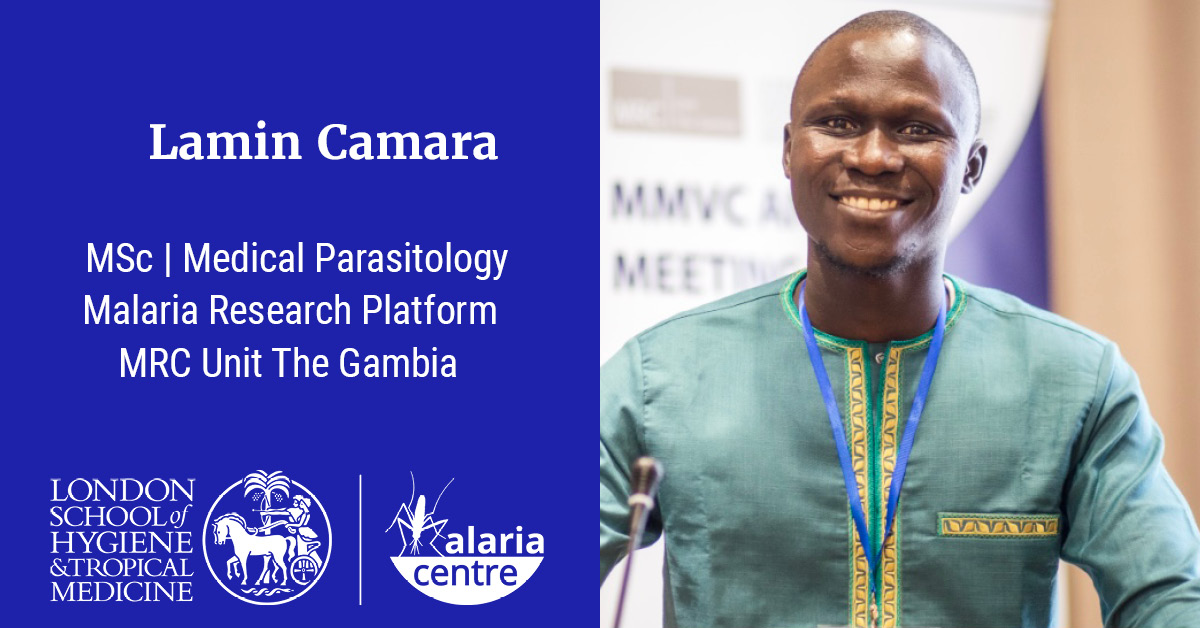
What is your role at MRCG?
I serve as a Higher Scientific Officer at MRCG, overseeing the Luminex Immunoassay platform for detecting malarial antibodies. Additionally, I lead the development and implementation of various molecular diagnostic techniques to track malaria infection in The Gambia. Under Dr. Mamadou Ousmane Ndiath's supervision, I've coordinated notable projects like MATAMAL, PamCovid, and SeroCovid.
Tell us a bit about a project that you are currently working on?
I'm currently involved in two exciting projects: Vac086 and SERVAL. Vac086 and SERVAL evaluate the effectiveness of new malaria vaccines, RH5.2-VLP and R21. Vac086 is a clinical trial designed for controlled settings, while SERVAL is a larger-scale mass vaccination study. I lead molecular diagnostics for these projects, providing preliminary data analysis.
When and how did you start working on malaria?
I began my journey in malaria research as a Laboratory Technician in May 2011 under the malaria research platform. Initially focusing on investigating the impact of scale-up control measures on malaria prevalence in the Upper River Region of The Gambia, led by Dr. Margaret Pinder. Over time, I've contributed to various malaria projects, including the Program Grant, Sniffer Dog study, and the INDIE 1b study.
What did you want to be when you were growing up?
Growing up, I was torn between pursuing a career as a petrochemical engineer or attending medical school. However, working at MRCG at LSHTM transformed my aspirations. Witnessing the significant burden of infectious diseases like malaria in The Gambia firsthand ignited my passion for biomedical science. I realized research could be a powerful tool to develop solutions and alleviate the suffering of vulnerable communities.
‘When I’m not working, I am…’
When I'm not working, you'll find me at the gym, watching football, or spending time with friends and family.
What’s the best piece of advice you’ve ever been given?
"Trust the process."