
Malaria centre member | Joquina Jones
What is your role at LSHTM?
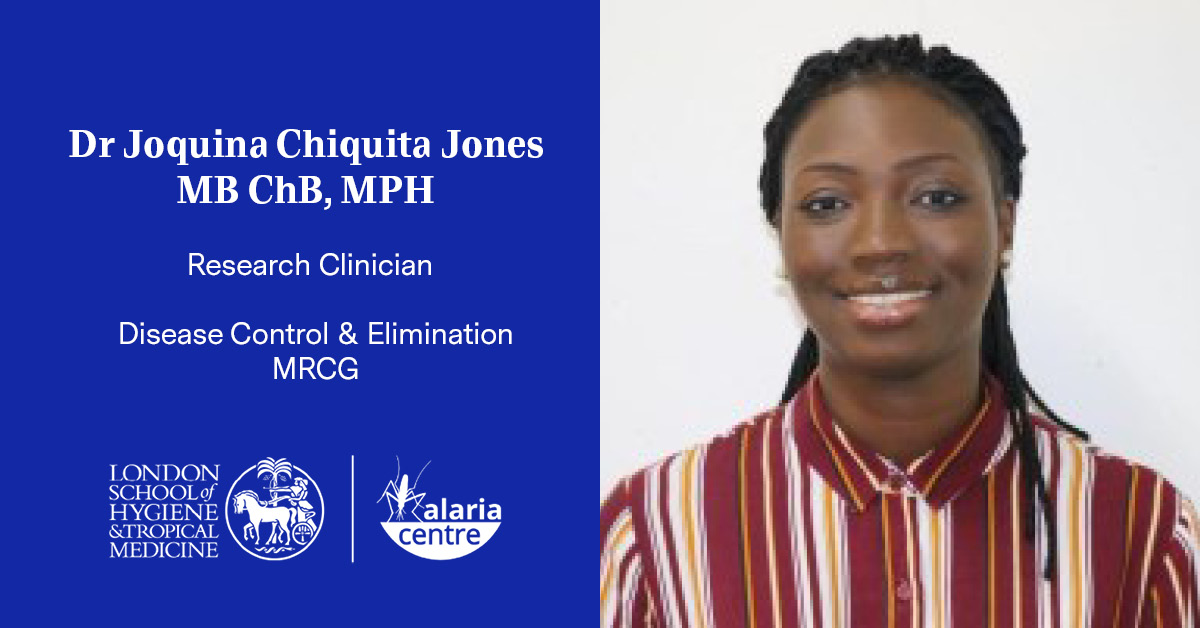
I am a Research Clinician with the Malaria Vaccine Trial under the Department of Disease Control and Elimination at LSHTM. My primary role involves conducting clinical trials focused on implementing and evaluating malaria vaccines. This includes participant recruitment, ensuring compliance, monitoring vaccine administration, and following up with participants to assess vaccine safety and immune responses. I work closely with a multidisciplinary team to collect, analyse, and interpret data, contributing to publications and reports that disseminate our findings to the broader scientific community. My work also extends to community engagement and education, helping build trust and understanding about the importance and impact of malaria vaccine research among local populations. As a research clinician at LSHTM, my role is crucial in advancing our understanding of malaria vaccines and contributing to global efforts to reduce the burden of malaria in Sub-Saharan Africa and around the world.
Tell us a bit about your current project.
My current project is a phase 1b clinical trial focusing on a multistage Plasmodium falciparum malaria vaccine. The primary aim of this study is to assess the safety and immunogenicity of two vaccine candidates: the blood-stage vaccine RH5.2 virus-like particle (VLP) in Matrix-M, and the pre-erythrocytic stage vaccine candidate R21 in Matrix-M. We are evaluating these vaccines both individually and in combination. Our study targets both adults and infants in The Gambia, a region where malaria is a significant public health concern. The rationale behind combining these two vaccines is to provide broader and more effective protection against malaria by targeting different stages of the parasite’s life cycle. Our goal is to determine whether these vaccines alone or in combination are safe and can provide a robust immune response that could significantly reduce the burden of malaria. The findings from this study could pave the way for more effective malaria vaccination strategies and bring us closer to controlling and eventually eradicating this devastating disease.
Why did you choose to work in malaria research?
My journey into malaria research began with my extensive experience as a medical doctor, where I treated and managed numerous patients suffering from malaria. I saw first-hand the recurrent and severe impact of malaria on individuals and communities, particularly on pregnant women and children. When an opportunity presented itself for me to participate in research with the potential to make a difference, I seized it. With a strong commitment to making an impact, my choice was easy. Choosing to work in malaria research allowed me to combine my clinical expertise and public health background to contribute to innovative solutions and make a meaningful difference in the lives of Gambians and the world at large. These contributions extend from exploring novel drug therapies and vaccine development to improving vector control strategies and enhancing diagnostic tools, areas in which our team at LSHTM is already leading. I am confident that through this phase 1b malaria vaccine trial, we have the potential to save countless lives and contribute to the global effort to control and eventually eradicate malaria.
What were your childhood aspirations?
As a child, I always aspired to be a medical doctor. This was largely influenced by my family of medical personnel who were passionate about making a difference in the world by helping others. My attraction to the medical field was a natural one, nurtured by my family, who charted the path for me to become a doctor. My dad, also in the medical field, often used medical terms in conversations with my mum, which kept us guessing and intrigued. This aspiration has become a reality for me.
Who do you idolize and why?
Rather than idolising a single person, I have been continually inspired by a diverse group of mentors and leaders in health research. Each of these individuals has significantly contributed to advancing our understanding of diseases and improving health outcomes, shaping my career and aspirations. Throughout my journey, I have had the privilege of working with and learning from many dedicated professionals. Early in my career, I was mentored by a clinician who tirelessly worked on the front lines of emergency care, whose expertise and compassion deeply influenced my approach to patient care. Later, at MRCG at LSHTM, I was inspired by researchers who developed groundbreaking strategies for disease control and prevention. Collectively, these leaders have provided me with invaluable insights, guidance, and inspiration, helping me navigate my path in infectious disease research. Their collective wisdom and passion for improving health outcomes remind me daily of the importance and impact of our work.
Beyond work, what are your hobbies and interests?
Beyond my work in malaria research, I have a deep passion for dancing, traveling within the sub-region, and reading motivational books. These hobbies and interests not only provide a break from my routine but also offer fresh perspectives and inspiration that enrich my life and keep me balanced, allowing me to approach my work with renewed energy and enthusiasm.