
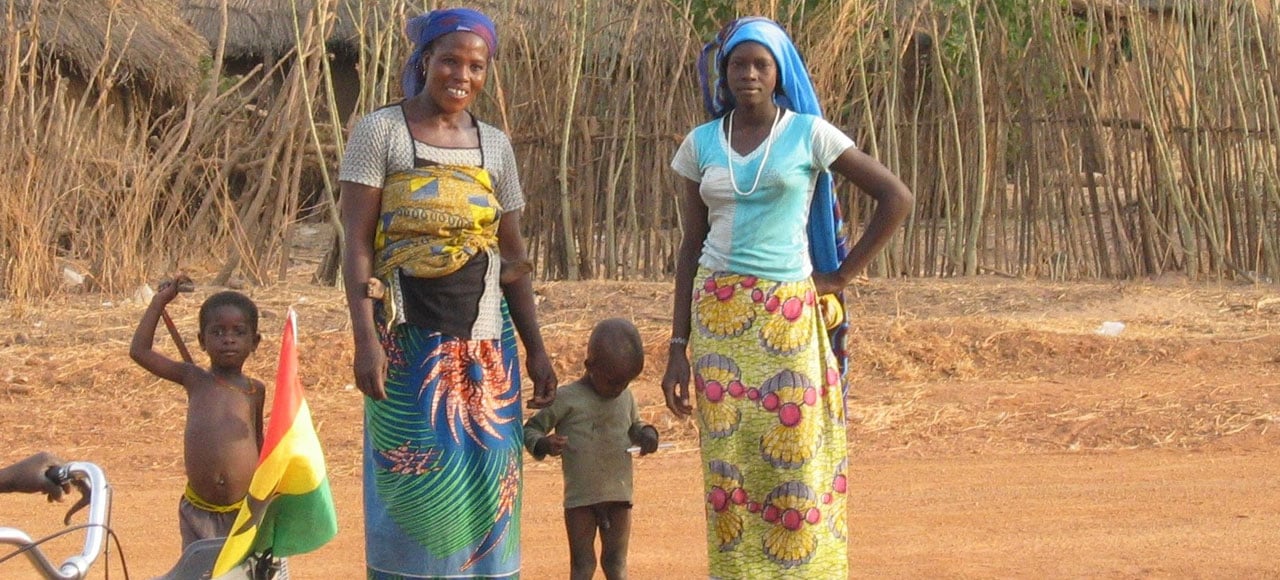
An inter-disciplinary research project using longitudinal datasets and on-the-ground co-production to understand impacts of climate change on mental health outcomes in women, adolescents and children, and map the consequences for the future provision of mental health services in low and middle income settings.
Climate/MentalHealth is a collaboration between the London School of Hygiene and Tropical Medicine and the University of Ghana led by Dr Shay Soremekun, Professor Philip Tabong, and Dr Benedict Weobong. The project has been funded by the Medical Research Foundation.
Climate/MentalHealth is partnering with the LSHTM Centre for Climate Change and Planetary Health, the Kintampo Health Research Centre and local grassroots organisations in Ghana to develop research and action priorities, engage in bi-directional capacity strengthening, and co-design potential climate change-related mitigation strategies to improve mental health outcomes.
In contrast to an extensive and growing body of research on the impacts of climate change on physical health, the potential impacts on mental health have been much less well studied. The burden of poor mental health is however one of the major challenges facing our global community, causing one fifth of all disability-adjusted life years.
Effects of heatwaves, floods, storms, famine and other hazards can have devastating and long-lasting consequences for land ownership, disease, conflict, food security and pollution - and directly or indirectly impact wellbeing and health. It's estimated mental health impacts of such events will be particularly acute in low and middle income settings where high temperatures, reliance on subsistence farming, poor health and sanitation may worsen consequences. Already at higher risk of poor mental health or with vulnerable livelihoods, women, children and adolescents (WCA) are amongst key groups expected to be disproportionately impacted.

As a result, a recent, clear consensus has emerged amongst international bodies and governments of the urgent need for empirical research to address key evidence and policy gaps in this area.
The Climate/MentalHealth Project will meet this challenge by conducting an ambitious and inter-disciplinary programme of research on climate change and mental health.
We will review current evidence and gaps of the impacts of climate change on WCA mental health outcomes to set future research objectives. The study's core purpose however is to identify and leverage longitudinal datasets from low and middle income settings with relevant WCA data on our outcomes of interest, and use quantitative and causal methods to estimate impacts of a range of extreme climate indicators on mental health. The outputs will inform a final activity, an on-the-ground situational and policy analysis (case study) in Ghana. This analysis will assess current policy and primary health system readiness for provision of mental health support services to vulnerable groups in the context of increasing risk of climate-related hazards, and co-produce potential mitigating strategies.
Further details of each work package is found on the 'Research' tab.
Meet our research team on the ‘Who are we’ tab.

Cherie
Part
Research Fellow in Medical Statistics

Elaine
Flores Ramos
Research Fellow in Planetary Health

Shay
Soremekun
Assistant Professor
Benedict Weobong
Principal Investigator
Clinton Frempong
Research Fellow in the Department of Social and Behavioural Sciences
Philip Tabong
Associate Professor in the Department of Social and Behavioural Sciences
- RP1: Overview of reviews on climate change and mental health
The conduct and direction of research packages 2 and 3 below will be informed by outputs of a review of the current evidence of the impacts of climate change on mental health outcomes in women, children and adolescents. The number of review articles on climate and mental health have multiplied substantially within the last 5 years. Given significant heterogeneity in quality, scope and geographical coverage of reviews, we will take an ‘overview of reviews’ approach to address the following questions and identify research gaps: 1a) Which geographical regions are covered by current evidence? 1b) What types of climate-related hazards and mental health outcomes have been previously defined/studied? 1c) What evidence exists for impacts of climate-related hazards on mental health outcomes, in i) women, or ii) children/adolescents < aged 18 years? 1d) What are the putative mechanisms by which climate impacts on mental health outcomes in the above groups?
- RP2: Secondary analysis of climate indicator-linked longitudinal data on mental health outcomes
We will identify relevant georeferenced, longitudinal mental health datasets to estimate the impacts of climate change-related hazards on mental health outcomes in women adolescents and children in low and middle income settings. Georeferencing (latitude and longitude) will be available at household or similar level, in order to allow for linkage to climate data from weather stations and satellite programmes.
We will assess the impacts of extreme heat, humidity, rainfall and catastrophic events where possible (floods, drought, etc). The analysis will take a chronological approach, and use multilevel regression models relevant for longitudinal data with random terms to account for geographic clustering and panel data, and including appropriate spline/cosine terms for seasonality. Outcomes will include any mental health and wellbeing indicators collected either by self-report instruments or clinician assessment and available in the selected longitudinal databases.
- RP3: Situational analysis of mental health services and future intervention planning - Ghana
We will conduct a situational analysis of the availability of primary care and community-based mental health services provision in the Bono East Region of Ghana by extending the scope of the Programme for Improving Mental Health Care framework (‘PRIME+’). This assessment will include the perspectives of key frontline actors - community providers, alternative services including churches/traditional healers, frontline primary care staff, and the experiences and needs of people with lived experience of poor mental health. We will introduce framing to highlight risks and implications of extreme climate-related events for mental health and health services, and to explore the acceptability of potential climate change-related mitigation strategies to inform the development of future interventions.