Expert comment: What leaders must do to tackle the climate and health crisis in Europe
18 May 2026 London School of Hygiene & Tropical Medicine London School of Hygiene & Tropical Medicine https://lshtm.ac.uk/themes/custom/lshtm/images/lshtm-logo-black.png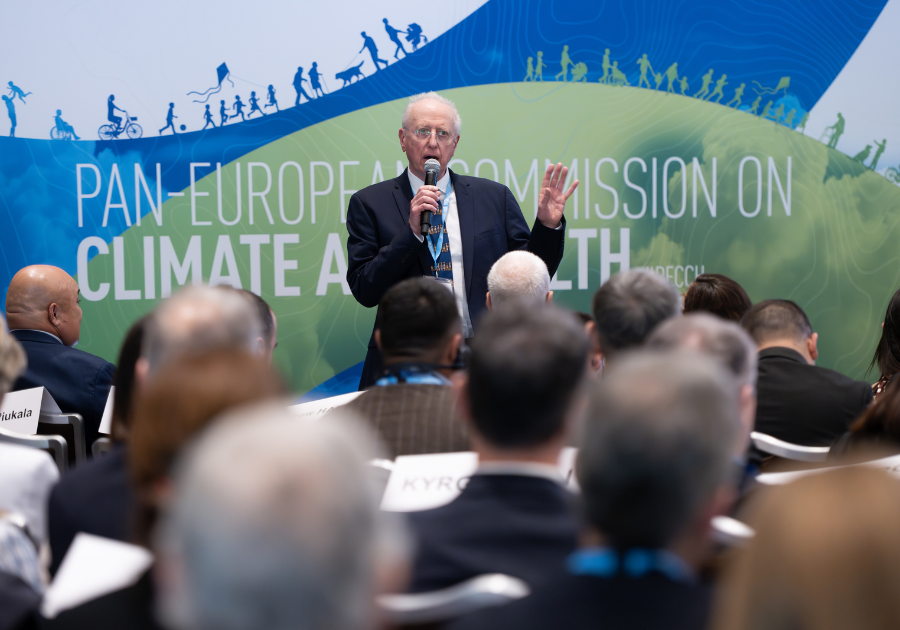
London School of Hygiene & Tropical Medicine (LSHTM) experts involved in a new report from the Pan-European Commission on Climate and Health (PECCH) are discussing its findings during the 2026 World Health Assembly in Geneva this week – including a call for the World Health Organization (WHO) to declare climate change a public health emergency of international concern.
This is one of the recommendations in the Call to Action report, released on 17 May 2026, that urges heads of governments, ministers, health authorities, cities, funders and the WHO to scale up climate and health action.
The European region is the fastest heating region in the world, with temperatures rising twice as fast as the global average. The health impacts of extreme heat are already hitting the region hard. Evidence from LSHTM researchers last year suggests almost 70% of the 24,000 estimated heat-related deaths in the summer of 2025 in 854 European cities were attributable to climate change.
The Commission is the first independent regional initiative of its kind on climate change and health, comprising diverse experts from science, public health, policy making, and civil society. Sir Andy Haines, Professor of Environmental Change and Public Health at LSHTM, is Chief Scientific Adviser to the Commission.
Professor Andy Haines said: “Climate change is impacting health across the WHO European region and globally, and the response is not matching the scale of the threat. Business as usual will cost lives and increase risks to health from extreme heat, floods, air pollution, infectious disease, and food insecurity. The Commission’s Call to Action provides evidence-based recommendations that decision makers from government, public health, funding and the WHO can implement now to accelerate climate action for a healthier, more sustainable future.”
The PECCH, chaired by H.E. Katrín Jakobsdóttir, former Prime Minister of Iceland, was established in June 2025 in the context of increasing threats from climate change to the pan-European region and the need to put health at the centre of climate action.
Climate change is causing extreme weather events such as wildfires and floods, contributing to the changing spread of infectious diseases such as dengue and chikungunya, threatening food security, and increasing health burdens from non-communicable diseases. Air pollution caused by the burning of fossil fuels, the main driver of climate change, is linked to an estimated 600,000 premature deaths annually across the WHO European region. Despite growing evidence of the health harms of climate change and the health benefits of action in Europe and globally, political attention on climate change is wavering, leaders are facing competing priorities, and misinformation is damaging public trust.
The Commission’s Call to Action comes at a crucial moment. Energy prices are volatile, supply chains are under strain, and geopolitical shocks are highlighting the need to transition away from fossil fuel dependency for health, security, and economic stability. With many countries scaling back climate commitments, the PECCH report shows how the pan-European region can lead the way in pushing forward the climate and health agenda and showing the benefits it can bring to societies and economies.
The PECCH Call to Action provides a comprehensive set of 17 actionable recommendations. As well as calling for the formal declaration of climate change as a global public health emergency, the Commission also recommends the creation of a climate-health regional information hub. This would provide countries with access to trusted resources for evidence-informed policies, advocacy, and communications - aligning with existing efforts led by LSHTM to address harmful health misinformation, operationalised by the Health Information Integrity Network.
The Commission report also calls on urban and regional networks to formalise climate change and health in their mandates for cities, and for the WHO to monitor and evaluate progress. Engagement with cities and city networks is a core focus of work led by LSHTM and partners as part of the Pathfinder Initiative research programme on the health benefits of climate action.
Other LSHTM experts also commented on the report’s recommendations and what needs to happen next.
Professor Heidi Larson, Professor of Anthropology – Risk and Decision Science at LSHTM, (not part of the Commission), said: “The Commission’s recommendation to launch a climate-health information hub is a welcome opportunity to scale up efforts to tackle climate misinformation in the WHO European region and beyond. For the initiative to be successful, the WHO and partners must first and foremost address the issue of public trust. Important lessons can be learnt from other fields such as addressing public concerns around vaccines.”
Dr Iris Blom, researcher at LSHTM and Scientific Writer for the PECCH, said: “Climate action needs to be implemented across all sectors to protect and promote health. At the same time, the health sector contributes 4-5% of global greenhouse emissions and has a key role to play. Climate resilience and environmental sustainability should be embedded in everyday health system practice to drive progress.”
Dr Lorna Benton, Research Fellow at LSHTM (and contributor to the Commission), said: “We have more than enough evidence to implement climate mitigation and adaptation actions that bring benefits to health. But better evaluation of implemented actions is needed to understand what works, and to hold governments and decision makers accountable.”
In a comment published in The Lancet on 19 May following the release of the Call to Action, Andy Haines and H.E.Katrín Jakobsdóttir note challenges that must be considered in the implementation of the Commission’s recommendations. These include diversity of political systems across the region; geopolitical instability and increases in military expenditure diverting vital resources and political attention away from climate action; the impact of spiralling fuel costs from the Iran war on implementing fossil fuel subsidy reform; and financial constraints faced by the WHO and UN system.
LSHTM experts will discuss the PECCH report’s recommendations at a technical launch event in Geneva on 19 May, hosted by the PECCH and the Pathfinder Initiative (led by LSHTM) on the sidelines of the World Health Assembly.
If you enjoyed this article and would like to build a career in global health, we offer a range of MSc programmes covering health and data, infectious and tropical diseases, population health, and public health and policy.
Available on campus or online, including flexible study that works around your work and home life, be part of a global community at the UK's no.1 public health university.