CORRAL Study Stakeholders and Investigators Meet to Advance Childhood TB Diagnosis
20 February 2026 London School of Hygiene & Tropical Medicine London School of Hygiene & Tropical Medicine https://lshtm.ac.uk/themes/custom/lshtm/images/lshtm-logo-black.png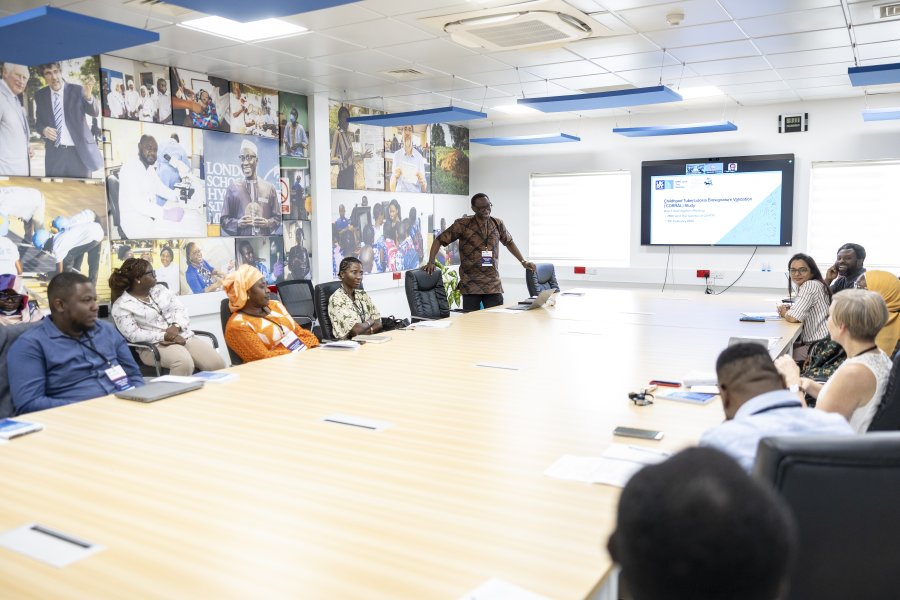
The CORRAL study aims to validate a novel three-marker host protein biosignature for diagnosing childhood tuberculosis (TB). The project is being implemented in collaboration with the LSHTM, University of Liverpool, Stellenbosch University, and Charité Universitätsmedizin Berlin, as well as the Foundation for Innovative New Diagnostics (FIND) with funding from a UKRI/MRC Development Pathway Funding Scheme (DPFS) grant.
Speaking at the opening ceremony, Professor Toyin Togun, Co-Director of the TB Centre at LSHTM and Senior Scientist at MRCG, underscored the urgency of improving paediatric TB diagnosis.
“Diagnosis of TB in children is particularly challenging. Therefore, this project presents an opportunity to develop a new diagnostic test suitable for use in children. This meeting will enable us to assess progress made in year-1 of the project and jointly develop strategies toward the next steps.”
“Childhood TB research has consistently been one of the Unit’s major focus areas,” noted Professor Umberto D'Alessandro, Unit Director of MRCG at LSHTM. He reaffirmed the MRCG at LSHTM’s commitment to improving child health through high-quality research that informs global policy while delivering measurable benefits to communities in The Gambia and beyond.
Diagnosing TB in children remains a major challenge due to the difficulty of obtaining sputum samples and the typically low levels of bacteria present in paediatric cases. As a result, many children particularly in Africa remain undiagnosed or are diagnosed late. The World Health Organization has identified the development of non-sputum, biomarker-based diagnostic tests for childhood TB as a global research priority.
The meeting was attended by co-investigators including Professor Beate Kampmann from the Charité–Berlin, Professor Novel Chegou from Stellenbosch University, and Dr Schadrac Agbla from the University of Liverpool. Dr Alex Anderson from the LSHTMalso joined remotely, providing technical guidance on technology transfer.
Previous research conducted in The Gambia led to the discovery of a promising three-marker protein biosignature using small blood samples from HIV-uninfected children. The biosignature accurately distinguished children with TB including those missed by conventional microbiological tests from those with other respiratory diseases, regardless of age or nutritional status.
The current phase of the project focuses on validating and refining this biosignature using well-characterised, bio-banked samples from independent paediatric cohorts in Mali, Nigeria, Tanzania, and The Gambia. Researchers will assess its ability to differentiate TB disease from other respiratory conditions in both HIV-infected and HIV-uninfected children across diverse epidemiological settings.
Successful validation will pave the way for developing a simplified, non-sputum-based diagnostic tool ideally a point-of-care test using micro-ELISA platforms supported by microfluidic technology.
The CORRAL stakeholders’ meeting reflects MRCG at LSHTM’s continued efforts to advance scientific innovation, strengthen health systems, and reduce the burden of infectious diseases across Africa.
If you enjoyed this article and would like to build a career in global health, we offer a range of MSc programmes covering health and data, infectious and tropical diseases, population health, and public health and policy.
Available on campus or online, including flexible study that works around your work and home life, be part of a global community at the UK's no.1 public health university.