Closing the global AMR surveillance gap
2 March 2026 London School of Hygiene & Tropical Medicine London School of Hygiene & Tropical Medicine https://lshtm.ac.uk/themes/custom/lshtm/images/lshtm-logo-black.png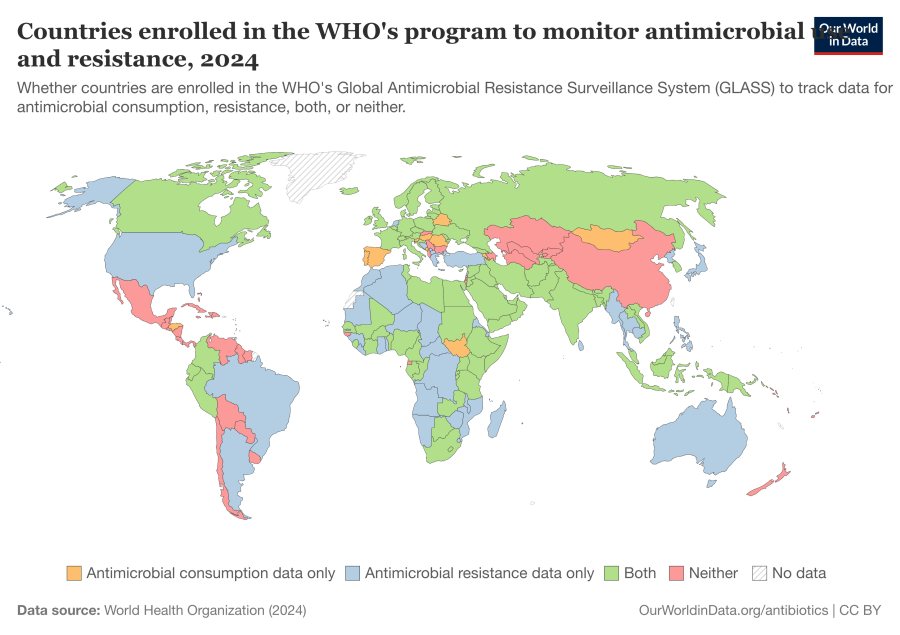
By 2050, antimicrobial resistance is projected to kill ten million people a year. That number, cited in almost every AMR policy document written in the last decade, has become so familiar it risks losing its power to shock. But buried within it is a more uncomfortable truth that gets far less attention. We do not actually know where most of those deaths are happening right now, because the surveillance systems that would tell us simply do not exist in the places that need them most.
The WHO's 2025 Global Antimicrobial Resistance and Use Surveillance System report makes this starkly clear. The highest resistance burdens are concentrated in sub-Saharan Africa and South-East Asia, yet these are precisely the regions most underrepresented in global surveillance data. In East Africa alone, assessments of the pathogen genomics landscape have found that bioinformatics capacity gaps, inadequate laboratory infrastructure, and a chronic shortage of trained personnel mean that resistance trends are effectively invisible at the national level. We are trying to navigate one of the most complex global health crises of our time with a map that is mostly blank.
This is not a new observation. But what is new, and genuinely exciting, is the pace at which it is changing.
Initiatives like SeqAfrica, supported by the Fleming Fund, have in just four years generated nearly 30,000 pathogen genomes across 21 African countries, establishing regional sequencing hubs and building a generation of African bioinformaticians. Africa CDC's Pathogen Genomics Initiative, now in its second phase, has set a bold target: equip all 55 National Public Health Institutes on the continent with operational next-generation sequencing capacity. PulseNet Africa, the continent's enteric disease genomic surveillance network, is expanding its reach into settings where outbreak response has historically depended on clinical intuition rather than genomic data.
These are not small achievements. But they remain insufficient, and they share a common limitation. They are largely built around centralised, infrastructure-heavy sequencing platforms that require samples to travel, sometimes across borders, before analysis can begin. In a cholera outbreak in a remote district, or an emerging ESBL cluster in a district hospital, the week lost waiting for sequencing results is not a technical inconvenience. It is a clinical and public health catastrophe.
This is where the field stands at an inflection point. Oxford Nanopore Technology's portable sequencing devices are small enough to fit in a backpack, require little more than a laptop and a power source to run, and are capable of real-time analysis in the field. They have matured from an interesting proof of concept to a genuinely viable surveillance tool. We are now running clinical metagenomics directly on slaughterhouse effluents in field settings in The Gambia. We are employing sequencing to characterise environmental resistance reservoirs in communities across West Africa. We are generating data that, until recently, simply could not exist outside of a well-resourced reference laboratory.
The bioinformatics infrastructure has also caught up. By exploiting the methylation signals embedded in raw nanopore sequencing data, we can accurately identify clinically relevant AMR determinants and attribute them, along with their plasmid vectors, to their pathogenic hosts directly from complex clinical samples, without prior culture. Machine learning tools trained on high-income country resistance data are being validated and adapted for African pathogen populations. Workflows that once required weeks of computational expertise can now run in near real time on a laptop. The barrier is no longer primarily technological. It is structural, political, and financial.
What the AMR field now needs is not another report documenting the surveillance gap. It needs sustained investment in the people and institutions doing this work on the ground: the microbiologists in The Gambia, Kenya, and Zimbabwe who are building reference collections, the bioinformaticians training their successors, and the public health officials trying to translate genomic data into policy without a clear framework for doing so. It needs a genuine commitment to producing AMR knowledge in the settings where AMR kills, not just about them.
The blank spaces on the global AMR map are not a technical problem. They reflect where we have chosen to look, and where we have not. Changing that is both a scientific imperative and a matter of equity.
If you enjoyed this article and would like to build a career in global health, we offer a range of MSc programmes covering health and data, infectious and tropical diseases, population health, and public health and policy.
Available on campus or online, including flexible study that works around your work and home life, be part of a global community at the UK's no.1 public health university.