Strengthening national preparedness for zoonotic diseases
19 September 2025 London School of Hygiene & Tropical Medicine London School of Hygiene & Tropical Medicine https://lshtm.ac.uk/themes/custom/lshtm/images/lshtm-logo-black.png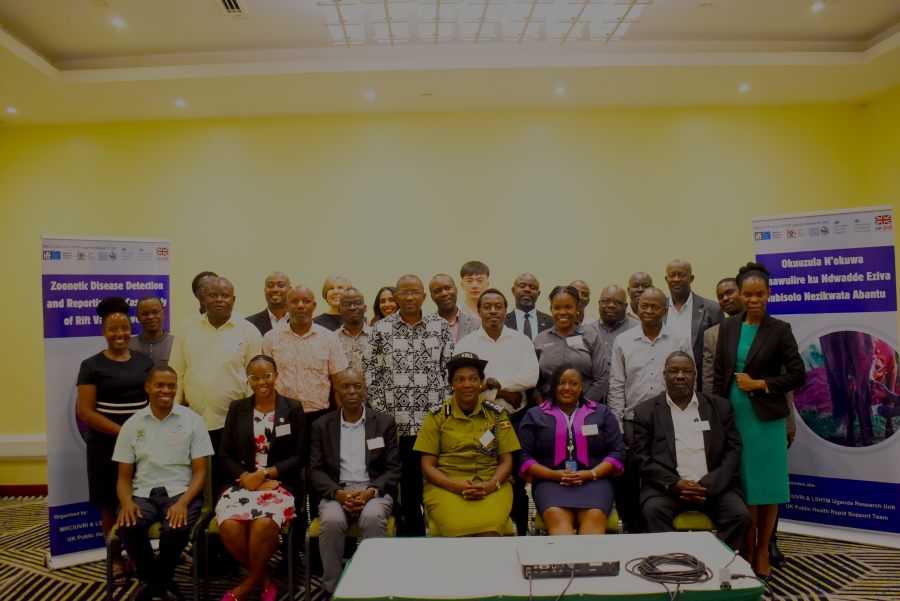
In collaboration with the UK Public Health Rapid Support Team (UK-PHRST), the MRC/UVRI and LSHTM Uganda Research Unit convened a series of stakeholder workshops to disseminate findings from and co-create recommendations based on the Zoonotic Disease Detection and Reporting (ZOODER) study. This participatory, qualitative research aims at identifying gaps and solutions to zoonotic disease detection and reporting in Uganda, with a case study on Rift Valley Fever (RVF) in Kalungu District. The events, held across community, district, and national levels, brought together livestock keepers, animal and human health workers, local leaders, district and national officials, and policymakers with an aim to co-create suggestions and ensure that evidence from the research informs stronger systems for surveillance and reporting of zoonotic diseases, which threatens both livelihoods and public health.
A collaborative, community-driven study
Since January 2025, the research study team engaged more than 130 participants in Kalungu District through interviews, focus groups, and ethnographic fieldwork. The study indicates that livestock keepers and animal health workers, often the first to notice signs of illness in livestock, struggle with barriers that limit timely detection and reporting of zoonotic threats, which may pose greater risks to public health and lead to economic losses. Many livestock keepers were familiar with diseases like brucellosis and anthrax but had limited knowledge of RVF. Others feared reporting sick animals due to potential quarantine or income loss, sometimes opting to sell animals quietly instead.
Despite these challenges, the research revealed strong community readiness to adopt preventive practices such as boiling milk, vaccinating animals, and improving kraal hygiene - provided that supportive structures are in place. Frontline health and veterinary workers expressed the need for introductory or refresher training, necessary diagnostic resources, and improved coordination across human and animal health systems.
Dr. Yang Zhao, UK-PHRST social scientist, LSHTM Assistant Professor and Co - Principal Investigator of the ZOODER study noted,
“These workshops have provided invaluable local insights into Rift Valley Fever and other zoonotic diseases to inform national strategies on zoonotic disease detection and reporting. Working with communities, we can better prevent outbreaks and safeguard lives and livelihoods.”
Turning evidence into action
The dissemination workshops were designed not only to share findings but to co-create solutions with stakeholders. During the community workshop in the Lwabenge subcounty of Kalungu District on 9 September 2025, livestock keepers and community leaders validated the research results and proposed context-specific actions such as strengthening multi-platform awareness campaigns across radio, social media, and printed materials, and clarifying safe and accessible channels for reporting sick animals. At the district workshop in Masaka on 10 September 2025, district health and veterinary officers worked with community representatives to align these insights with district health priorities and produced a joint workplan to improve surveillance, feedback, and response systems.
The national event in Kampala on 12 September 2025 drew representatives from the Ministry of Health, the Ministry of Agriculture, Animal Industry and Fisheries, the Ministry of Water and Environment, research institutions, and international partners. Discussions centered on integrating local realities into policy frameworks, ensuring sustainable funding for zoonotic disease surveillance, and building stronger laboratory and diagnostic capacity across Uganda.
Dr. Nambusi Kyegombe, Head of Social Determinants of Health at the Unit and Co-Principal Investigator of the ZOODER study, emphasized the ethical importance of returning findings to the people who generated them.
“Our commitment is to ensure this research does not end in reports but supports practical solutions that emerge from, and are led by, communities. When communities are partners with co-ownership of the process and outcomes, we can co-create solutions that fit local realities, can be scaled nationally, and can be sustained over time"
The ZOODER dissemination process illustrates how ethical, participatory research can move from observation in the kraal to action in the capital. By engaging communities as co-creators of knowledge, validating findings transparently, and ensuring recommendations feed directly into district and national planning, the project has laid the groundwork for meaningful change. The next steps will be to take forward the recommendations co-developed at the community, district and national level and to work with stakeholders to explore how they can be embedded into existing health and veterinary systems. With this foundation, livestock keepers could gain greater awareness of disease risks and safe practices, frontline workers would receive clearer support structures, and policymakers would be able to draw on a strong evidence base to strengthen Uganda’s preparedness for zoonotic threats.
About ZOODER
The ZOODER study aims to understand why gaps in zoonotic disease detection and reporting occur and endure, by examining the engagement, role, knowledge, and capacity of first responders to zoonotic animal disease, including livestock keepers and animal health practitioners. The study explores decision-making processes among livestock keepers when seeking care for themselves and their animals, the conditions and symptoms that trigger veterinary care, and how households prioritize different species or individual animals for treatment. It further examines how gender dynamics and other socio-cultural factors such as spirituality may shape these decisions, as well as the capacity and practices of animal health practitioners in detecting and reporting zoonotic diseases. The study is located within the Unit’s Social Determinants of Health research.
Learn more about the Unit’s research.
About the Implementing partners
The Medical Research Council/Uganda Virus Institute/ London School of Hygiene & Tropical Medicine (MRC/UVRI & LSHTM) Uganda Research Unit.
The MRC/UVRI & LSHTM Uganda Research Unit is an internationally recognised centre of excellence for research and training established in 1988 to improve the understanding and control of the HIV epidemic in Uganda and globally, following a request from the Uganda Government to the United Kingdom (UK) Government. In response to the changing public health landscape, Unit work has broadened beyond HIV to include other infections, neglected, endemic, emerging and re-emerging infections and non-communicable diseases (NCDs). Its mission is to conduct high-quality research that adds knowledge and leads to improved control of infectious and non-communicable diseases in Uganda, Africa and globally, through translation of scientific findings into policy and practice, and rigorous research capacity building.
The UK-Public Health Rapid Support Team (UK-PHRST)
UK-PHRST is a key international partner in epidemic disease response. We partner with low- and-middle income countries to respond to infectious disease outbreaks before they develop into global health emergencies. We work closely with international organisations, partner country governments and non-governmental organisations to:
- Rapidly investigate and respond to disease outbreaks at their source in LMICs eligible for UK Official Development Assistance, with the aim of stopping a public health threat from becoming a broader health emergency.
- Conduct research to generate an evidence base for best practice in epidemic preparedness and response.
- Strengthen capacity for improved national response to disease outbreaks in LMICs.
We are an innovative partnership between the UK Health Security Agency and the London School of Hygiene & Tropical Medicine, funded with UK aid by the UK Department of Health and Social Care. The views expressed in this publication are those of the author and not necessarily those of the Department of Health and Social Care.
If you enjoyed this article and would like to build a career in global health, we offer a range of MSc programmes covering health and data, infectious and tropical diseases, population health, and public health and policy.
Available on campus or online, including flexible study that works around your work and home life, be part of a global community at the UK's no.1 public health university.