From rural New Zealand to London: Rebecca’s part-time MSc Climate Change & Planetary Health journey at LSHTM
4 September 2025 London School of Hygiene & Tropical Medicine London School of Hygiene & Tropical Medicine https://lshtm.ac.uk/themes/custom/lshtm/images/lshtm-logo-black.png
I first came across LSHTM when I was 17, sitting in biology class in Kāpiti, New Zealand. I was looking for a place where I could study zoonotic diseases. It wasn’t until my final semester of my undergraduate degree, while on exchange at the University of Sheffield, that this idea became a reality, after I applied for the MSc Climate Change and Planetary Health (CCPH) at LSHTM.
About me
I began my academic journey at the University of Auckland in New Zealand, studying a dual degree in Microbiology and Population Health. During a module on environmental public health, my tutor talked about the vector-control work she had done in Vanuatu. Inspired, this led me to apply for a health protection internship at our port city of Tauranga, where I conducted the summer exotic mosquito surveillance and researched the potential impact of transitional facilities on vector mosquito breeding. This only grew my interest in zoonotic diseases and how we can educate and engage the public during our surveillance and response to emerging threats.
Why LSHTM?
Once I moved to Sheffield in January 2024 for my semester exchange, and later to Liverpool in June for my research work on UK vector mosquito surveillance, I knew I was ready to begin my postgraduate studies. I chose LSHTM for its global focus and emphasis on building skills in epidemiology, modelling, interactive learning, community enabling research, and effective communication of public health information.
Why part-time?
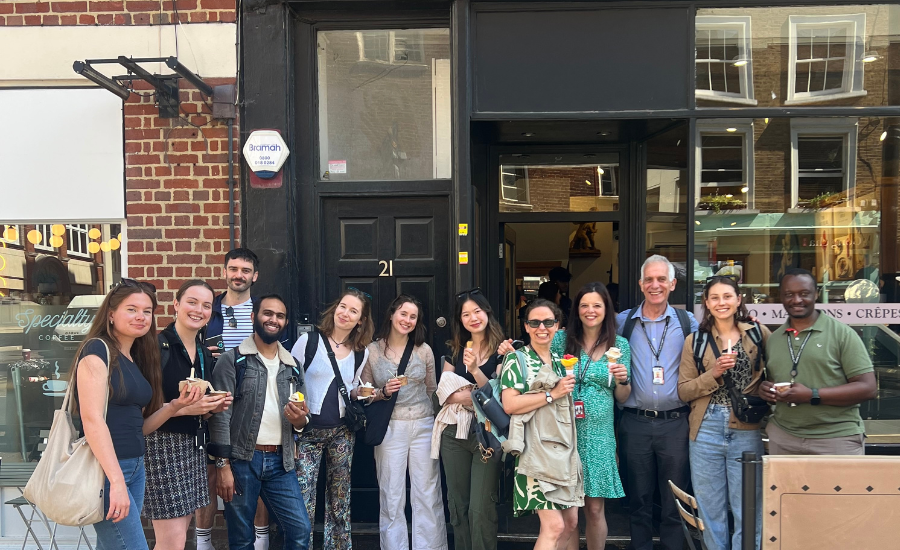
Before starting my MSc in September 2024, I was working as a research assistant and wanted the flexibility to continue my work remotely. With the capacity to work part-time, I knew I could also help fund my studies and living in London. At first, I was apprehensive about studying part-time as I thought it might negatively impact my social experience at LSHTM and the quality of my learning. However, I quickly realised that, with several students diligently completing the MSc alongside other commitments, it was not about the length of time I was on campus, but how I engaged with people while I was at LSHTM. With our smaller CCPH cohort, high module contact hours, interactive teaching, and plenty of events, I have found ample time to build strong relationships with my peers and mentors. I have made lifelong connections with my fellow CCPH colleagues and within my LSHTM network, many of which have shown me the value of not only being knowledgeable but also having a strong passion and drive for change.
I have felt very supported as a part-time student.
The programme directors were present to discuss module choices before and early into the degree, and the organisation of course events considered the schedules of our part-time cohort, both online and in-person. Being part-time has allowed me to further my research experience and work part-time in a range of roles, from continuing my work with the University of Liverpool to reviewing work with the National Collaborating Centre for Environmental Health in Canada, and also with student ambassador duties, hospitality work, and experience with the UK Health Security Agency. Studying part-time has not limited my experience at LSHTM; in fact, it has, in many ways, provided me with the space to focus more intentionally on my research and career path.

Why CCPH, though?
I have been asked this question by several prospective LSHTM students, and my answer is, first and foremost, because of my passion for the environment and for understanding the intrinsic link it has with people's health. I chose CCPH because I was interested in learning more about how climate change affects health, and how to co-develop solutions with affected communities. I was drawn to planetary health for its ability to see that for us to better human health, we cannot compromise the health of our natural systems. I know I want to be an advocate for planetary health, and CCPH has not only introduced me to career paths where this is possible, but also a community of people who share many of the same passions and drive.
Addressing climate change requires a cross-disciplinary approach. I have seen how no one person or discipline can solve planetary health challenges, and that it requires diversity in perspective and skill to design and implement effective interventions. I have been introduced to new areas of health research in heat stress, air pollution, biodiversity, sustainable food systems and infectious diseases, and learned skills in statistical analysis and modelling, evaluating research, co-developing community-based interventions, and presenting. Learning with and from fellow MSc candidates and experts working in planetary health, with experience across academia, policy, medicine, government, consultancy, geography, ecology, and from a vast number of countries and contexts.
My summer project
I will be working to address the need for surveillance of Vibrio bacteria in coastal waters across Europe, and to improve public awareness of how to keep safe as waters warm with climate change. My project will strengthen my skills in environmental predictive spatial modelling and in effective public health communication.
I was first introduced to the emerging threat of Vibrio bacteria in coastal environments during the CCPH module ‘Fundamentals of Planetary Health’, where we collaborated to address a planetary health challenge. It just so happens that my topic was waterborne diseases in Stockholm, and this led me to later reach out to Jaime Martinez-Urtaza, a Senior Professor from the Autonomous University of Barcelona and leader of frontier research in Vibrio disease dynamics.
Final thoughts
Planetary health action is becoming more urgent in all regions of the world. If you are interested in global health, sustainable systems thinking, and the health impacts of climate change, I encourage you to explore the MSc Climate Change and Planetary Health.
- Contact our student ambassadors.
- Discover ways of study at LSHTM.
- Find out more about MSc Climate Change & Planetary Health (in person) or MSc Climate Change & Planetary Health online.
- More from CCPH students: Advocating for planetary health - Shahab's reflection on COP28