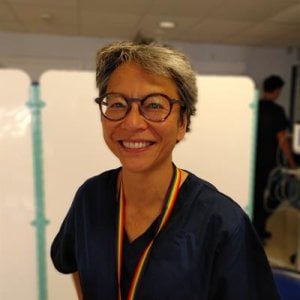
Professor Shunmay Yeung
Professor of Infectious Disease and Global Health
United Kingdom
Shunmay Yeung is a paediatrician specialising in infectious disease and global child health with a background in health economics and implementations research. Her research interests include malaria, the diagnosis and management of acute febrile illness in children, climate change and planetary health. She is a visiting professor at Nagasaki Univeristy, Japan and Imperial College, London; and a visiting researcher at the University of Tokyo.
Affiliations
Centres
Teaching
Shunmay teaches on the Nagasaki DTM&H. She was until recently, Chair of the LSHTM DTM&H exam board and co-lead the child health module. She was the MSc Module Organiser of the Practical Skills for Clinical Research (face to face) module and of the Distance learning module on Communicable Disease Control. She has taught on a number of other MSc modules and undergrduate courses both at LSHTM and at other univeristies within the UK and overseas.. She is an enthusiastic clinical teacher, supervisor and mentor of trainee doctors and medical students at St Mary's Hospital.
Research
She is a PI and leads work packages in DIAMONDS an ambitious research consoritum funded by the European Union Horizon 2020, and co-ordinated by Prof Mike Levin of Imperial College. DIAMONDS involves 28 institutions in 14 countries in Europe, the Gambia, Nepal and Taiwan, and aims to develop and pilot a new test for diagnosing bacterial, viral and other inflammatory diseases. The work packages she leads aim to bridge the gap between the development of the new diagnostics and their optimal utilisation by health workers in both high, and low and middle income settings. Her approach involves complementary approaches, utilising her clinical background and applying it to qualitative research and cost-effectiveness modelling. Shunmay is also the lead paediatrician for the UKAID funded FIEBRE consortium - a multi-country study which aims to describe the aetiology of fever in adults and children in Laos, Malawi, Mozambique and Zimbabwe. She is co-PI on three projects in Indonesia: DUALIS and MENJAGA - MRC funded projects aimed at improving antenatal testing of syphillis, HIV and hepatitis B; and PINTAR an Australian government funded project aimed at reducing unnecessary use of antibiotics in the private pharmacies.
Recently she has becocming increasingly involved in research related to Climate Change. She is a co-investigator on the Children, Climate and Cities project and was Co-Chair of the Royal College of Paediatrics and Child Health Climate Change Working Group Research workstream.
Her PhD was on antimalarial drug resistance and drug policy and was undertaken in Southeast Asia, under the supervision of Professors Sir Nicholas White and Dame Anne Mills, with funding from the Wellcome Trust. It employed economic and epidemiological modeling and field studies on the access to malaria diagnosis and treatment. In collaboration with the Cambodian national malaria control programme (CNM), she lead PACES (Proactive Case Detection and Community Participation for the elimination of drug resistant malaria study) in Cambodia, as part of the Tracking Resistance to Artemisinins Collaborations (TRAC and TRAC2), large programmes of research funded by UKAID and led by the Mahidol-Oxford Research Unit. In her most recent project, she worked with the CNM and a local implementing partner (Health and Social Development) to develop, implement and evaluate G6PD testing and radical cure for P. vivax malaria in Cambodia.
An active clinician, Shunmay works as an honorary consultant in Paediatric Infectious Disease at St Mary's Imperial College Hospital, London. In the past she worked as a government medical officer in Hlabisa district hospital in rural KwaZulu/Natal in South Africa and was deployed as a clinical advisor to Sierra Leone with Save the Children in order to help in the set up of the Kerrytown Ebola Treatment Centre in 2014. She subsequently returned to Sierra Leone to supervise research on the management and outcome of children admitted to Ebola Holding Units during the crisis.
She was Deputy Director of the ACT Consortium and the Co-ordinating Investigator for the Artemisinin Resistance Confirmation, Characterization and Containment (ARC3) consortium, both funded by the Bill and Melinda Gates Foundation. She has worked for World Health Organisation in Geneva as as a Medical Officer in the Global Malaria Programme and is on the board of the Angkor Hospital for Children in Cambodia, and sits on a number of expert committees and advisory boards.
Shunmay is currently supervising three PhD students and a number of clinical academic trainees.
Selected Publications