Unit research provides new evidence supporting a single-dose Rift Valley fever vaccine
6 March 2026 London School of Hygiene & Tropical Medicine London School of Hygiene & Tropical Medicine https://lshtm.ac.uk/themes/custom/lshtm/images/lshtm-logo-black.png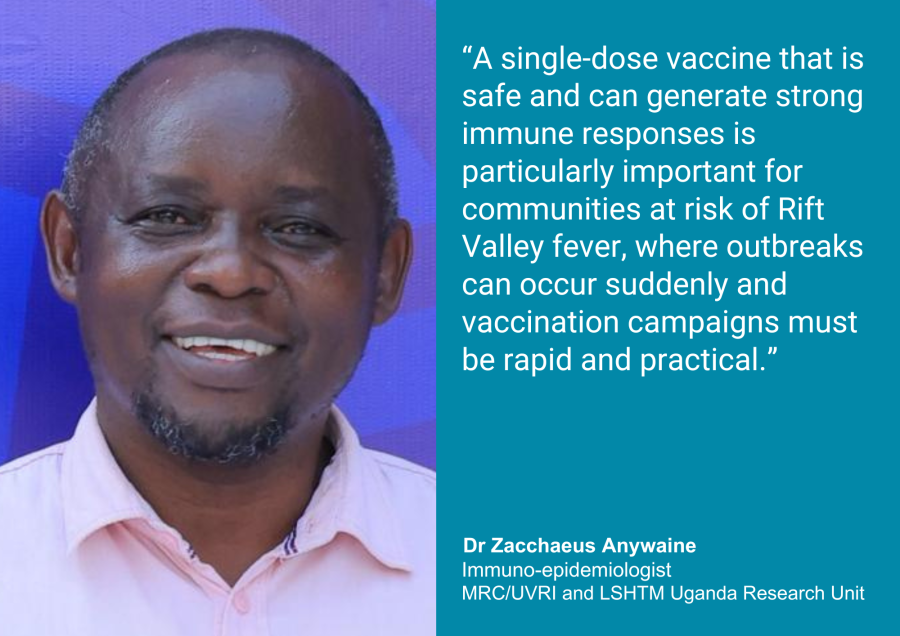
The phase 1 study, published in The Lancet Infectious Diseases Journal, was led by researchers at the MRC/UVRI and LSHTM Uganda Research Unit and evaluated the safety and immunogenicity of the ChAdOx1 RVF vaccine, a viral-vector vaccine designed to stimulate the immune system against the Rift Valley fever virus.
Rift Valley fever is a mosquito-borne disease that primarily infects livestock but can also cause disease in humans following contact with infected animal tissues or from infected mosquitoes. Outbreaks in East Africa cause significant economic losses and pose serious risks to communities that live and work closely with animals. Despite this threat, no vaccine is currently licensed for human use, making the development of safe and effective vaccines a global priority.
The ChAdOx1 RVF vaccine trial enrolled 30 healthy adults aged 18–50 in Masaka, Southwestern Uganda, an area where Rift Valley fever has previously been reported. Participants were enrolled into three groups of increasing vaccine dose levels, and each received a single dose of the vaccine in the arm. The vaccine was found to be safe and well tolerated, with most side effects being mild or moderate, including injection-site pain, fatigue, and mild fever. No serious adverse events were reported.
Importantly, a single dose generated healthy immune responses. By day 28, all participants had developed neutralising antibodies against the virus, which remained detectable three months after vaccination. The vaccine also stimulated strong T-cell responses, indicating the activation of multiple arms of the immune system. The highest dose produced the most sustained immune responses without increasing side effects, suggesting that a single-dose regimen could provide a practical vaccination strategy for high-risk populations, including pastoralist communities and livestock workers who face regular exposure to the virus.
Dr Zacchaeus Anywaine, Principal Investigator of the study and an immuno-epidemiologist at the MRC Uganda Unit, said the findings highlight the promise of the vaccine candidate.
“A single-dose vaccine that is safe and can generate strong immune responses is particularly important for communities at risk of Rift Valley fever, where outbreaks can occur suddenly and vaccination campaigns must be rapid and practical,” he stated.
The study also demonstrates how early-phase vaccine trials can be successfully implemented in rural settings where zoonotic diseases are most likely to emerge. Researchers worked closely with community leaders and local institutions to develop the messages that explained the study to potential participants, address questions, and support recruitment. This engagement helped ensure informed participation and strong follow-up throughout the trial. The experience provides a practical model for conducting complex vaccine studies in regions where emerging infectious diseases are most likely to occur.
Professor Pontiano Kaleebu, Chief Investigator of the study and Head of viral pathogen research at the MRC Uganda Unit, stated that the work highlights the importance of conducting vaccine research in the regions most affected by emerging diseases. He said,
“Conducting early-phase vaccine trials in endemic settings is critical for accelerating the development of vaccines against emerging infections. This study demonstrates the capability of African research institutions to lead high-quality clinical trials that address diseases of regional and global importance.”
While the findings are encouraging, further studies will be needed to evaluate the vaccine in larger populations and to assess how long protection may last. If future trials confirm these results, the ChAdOx1 RVF vaccine could become an important tool for preventing outbreaks of Rift Valley fever in both humans and animals, supporting a One Health approach to controlling the disease.
Publication details:
Journal: The Lancet Infectious Diseases
DOI: 10.1016/S1473-3099(25)00565-1
Study design: Randomised, placebo-controlled clinical trial
Participants: 30 healthy adults aged 18–50
Trial registration: NCT04672824
If you enjoyed this article and would like to build a career in global health, we offer a range of MSc programmes covering health and data, infectious and tropical diseases, population health, and public health and policy.
Available on campus or online, including flexible study that works around your work and home life, be part of a global community at the UK's no.1 public health university.