Sustaining gender-based violence coordination in emergencies amid a shifting humanitarian landscape
12 March 2026 London School of Hygiene & Tropical Medicine London School of Hygiene & Tropical Medicine https://lshtm.ac.uk/themes/custom/lshtm/images/lshtm-logo-black.png
Gender-based violence (GBV) continues to be one of the most pervasive but underfunded issues in humanitarian and public health emergencies. Despite policy commitments and increased global attention to addressing GBV over the past two decades, global funding cuts and the 2025 Humanitarian Reset – a set of reforms being implemented to streamline coordination and strengthen accountability – now threaten to reverse years of progress.
GBV is both a public health and human rights crisis, affecting 1 in 3 women globally. Emergencies exacerbate GBV risks by disrupting health systems, social protection, and justice mechanisms. Data on GBV in emergencies is limited and likely underestimates the true scale. Still, evidence shows rising sexual and intimate partner violence (IPV) and reduced access to services during crises. In Ukraine, police reports of IPV increased by 40% in early 2023 compared to 2022, with conflict-related sexual violence continuing.
Effective GBV coordination ensures that comprehensive services are available for survivors, including health, mental health, justice and legal support and that prevention and risk mitigation measures are embedded across all responses. Reforms being proposed under the Humanitarian Reset threaten to reduce visibility, technical prioritisation, and dedicated expertise for GBV.
Against this evolving landscape, our recently published study consolidates global evidence and practitioner insights on GBV coordination in emergencies. The findings highlight both immediate risks and long-term opportunities to sustain and strengthen GBV coordination. Using a three-phase qualitative approach—evidence synthesis, a Lebanon case study, and a 2025 global consultation with GBV experts—we synthesised seven practical and strategic recommendations (see below).
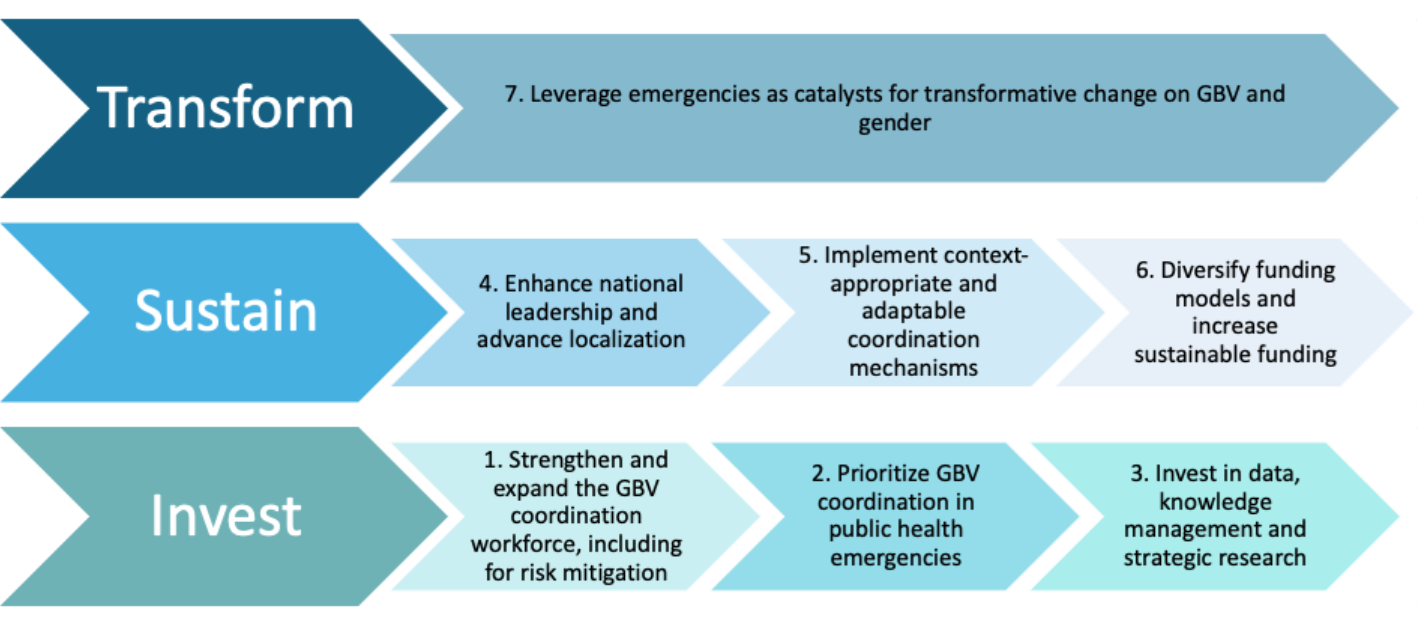
1. Invest in skilled coordination leadership
Governments, donors, and agencies must invest in developing and retaining skilled GBV coordinators—building their capacity, ensuring role continuity across emergencies, and embedding GBV risk mitigation across all emergencies.
2. Systematically integrate GBV coordination in public health emergencies
During COVID-19, resources shifted to outbreak control, reducing essential GBV services and converting women-led safe spaces into isolation centres. Health emergency frameworks must embed GBV response and prevention as a core component, ensuring that systems are equipped to address GBV.
3. Invest in data, knowledge management and strategic research
Reliable, timely data is critical for effective GBV coordination and evidence-based action. Strengthening data systems and resourcing a strategic research agenda are essential alongside improved monitoring and evaluation.
4. Enhance national and local leadership
Governments and women-led organisations should be at the forefront of coordination, supported—not overshadowed—by international actors. This calls for a deliberate shift to nationally-owned systems, backed by long-term capacity strengthening, mutually beneficial partnerships, and funding that empowers local leadership.
“Robust coordination mechanisms empower local actors and enable more effective advocacy for gender equality and GBV prevention.” –GBV Coordinator
5. Implement context-appropriate coordination
While global frameworks provide a foundation, effective GBV coordination should be tailored to the specific political, cultural, and social contexts, with sub-national coordination that engages affected communities.
6. Diversify and stabilise funding
Effective GBV coordination requires reliable and flexible funding. The humanitarian community must diversify funding sources, secure multi-year financing, and explore innovative partnerships to sustain GBV coordination.
“High-level advocacy is critical—particularly for securing co-funding from national governments. . . it requires engagement at the leadership levels.” –GBV Coordinator
7. Leverage emergencies for transformative change
While emergencies exacerbate GBV, they also offer opportunities for transformation. Effective GBV coordination can be a catalyst to embed prevention and response into national systems and promote long-term gender equality legal and social reform.
“Based on my experience in Lebanon. . . I have witnessed how emergency situations can drive progress in gender norms and women's rights [e.g. 2016 abolished the Penal Code Article 522, "rape law"] when strong coordination mechanisms and local organizations are in place.” –GBV Coordinator
In today’s volatile funding and policy climate, safeguarding GBV coordination is not optional. Rather than treating its erosion as an inevitable by-product of funding cuts and reforms, we advocate for maintaining a dedicated GBV focus within humanitarian systems. We urge policymakers, donors, and practitioners to protect and strengthen GBV coordination, support enabling policies and funding mechanisms, and elevate the leadership of feminist organisations. Ultimately, effective GBV coordination is a commitment to human rights, gender equality, and more resilient societies.
Dr Philomena Raftery, LSHTM Doctorate of Public Health graduate (2023)
Dr Jennifer Palmer, Associate Professor, LSHTM
If you enjoyed this article and would like to build a career in global health, we offer a range of MSc programmes covering health and data, infectious and tropical diseases, population health, and public health and policy.
Available on campus or online, including flexible study that works around your work and home life, be part of a global community at the UK's no.1 public health university.