Safe and dignified burials: Reducing Ebola transmission
22 May 2026 London School of Hygiene & Tropical Medicine London School of Hygiene & Tropical Medicine https://lshtm.ac.uk/themes/custom/lshtm/images/lshtm-logo-black.png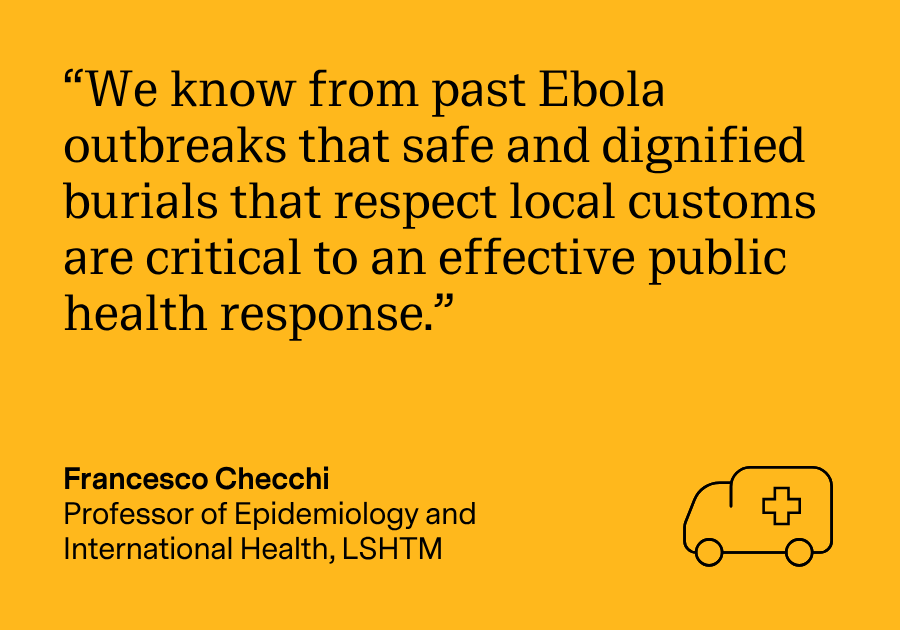
As an outbreak of Ebola caused by Bundibugyo virus spreads across the Democratic Republic of the Congo (DRC) and reaches Uganda, the public health community is rapidly mobilising their response to the difficult situation.
A study led by LSHTM, the International Federation of Red Cross and Red Crescent Societies and the Congolese Red Cross, published in the Lancet Global Health, analysed the previous large epidemic in nearby areas of the DRC in 2018-20 in which over 2,000 people died. They found that scaling up safe and dignified burials of deceased Ebola cases resulted in substantial reductions in transmission.
Francesco Checchi, Professor of Epidemiology and International Health at LSHTM and the study lead, said: “This intervention can potentially tip the epidemic’s trajectory towards extinction. We recommend that this feasible, culturally appropriate intervention should be prioritised by response actors.”
It is known that people remain infectious after death from Ebola, and a large amount of the transmission of the virus comes from unsafe preparation of bodies and funeral practices.
The study used a propensity score analysis to look at data collected across 21 health zones covering up to 92% of probable or confirmed cases of the last outbreak in the DRC. It found that large-scale efforts to support safe and dignified burials likely contributed to the decrease of transmission.
Safe and dignified burials adhere as closely as possible to local funerary customs and practices, while modifying the aspects that are medically unsafe, such as family members washing the body or keeping the body at home rather than in mortuaries or hospitals.
Approaching burials this way, rather than imposing strict responses that feel medicalised and militaristic, allows people to grieve and bury their loved ones in safe but acceptable ways, contributing to a likelihood in uptake of the practice.
In light of the current situation, Francesco further reflected on what we have learned about this crucial public health response to Ebola outbreaks, and how we can apply these lessons in the DRC now to help curtail the spread of the disease.
The research was funded by Elrha’s Research for Health in Humanitarian Crises (R2HC) Programme. R2HC was funded by the UK Foreign, Commonwealth and Development Office (FCDO) and the UK National Institute for Health Research (NIHR).
- Watch the presentation in English
- Watch the presentation in French
If you enjoyed this article and would like to build a career in global health, we offer a range of MSc programmes covering health and data, infectious and tropical diseases, population health, and public health and policy.
Available on campus or online, including flexible study that works around your work and home life, be part of a global community at the UK's no.1 public health university.