Researcher spotlight: Luthfi Azizatunnisa'
4 February 2026 London School of Hygiene & Tropical Medicine London School of Hygiene & Tropical Medicine https://lshtm.ac.uk/themes/custom/lshtm/images/lshtm-logo-black.png
Tell us about your career journey.
Back in 2008, I started my undergraduate degree in medicine. I was not disabled back then, but in my final year, I had an accident and broke my neck. It was a cervical spinal cord injury that left me tetraplegic. From my chest down, I cannot sit upright without support and my hand grips are weak.
Because of that, I took a break for three years. I could sit in my wheelchair and I returned to college, but my university was not accessible and there were no learning adjustments, so I struggled to keep up. For example, I had to climb up to second floor classrooms because the buildings did not have lifts, and my mum would help me every day. During that time, I questioned whether I could still pursue a medical degree.
In Indonesia, medical training involves four years of undergraduate study, followed by two years of clinical rotation. I completed my degree, but in order to practise as a medical professional, the system requires everyone to carry out all aspects of the profession, like delivering babies and performing Cardiopulmonary Resuscitation (CPR). I realised how physically demanding this was, and that I probably could not continue in that role, so I had to choose another path. Even now, the system is much the same, with no reasonable adjustments in place.
After graduating, I applied for a Master’s in Public Health funded by Tropical Disease Research (TDR), a WHO programme for research and training focused on tropical disease and implementation research. I worked on tuberculosis, and my master’s thesis was on tuberculosis screening in prisons. I then joined the Centre for Tropical Medicine at the University of Gadjah Mada in Yogyakarta as a Research Assistant, where I still work. I later became a lecturer, teaching the Master of Public Health and undergraduate medicine cohorts.
I switched my focus from tropical diseases to disability because I have lived experience of disability; I have seen and come up against the inequity in health services for people with disabilities. There is very limited evidence on how healthcare and insurance systems meet the needs of people with disabilities in Indonesia. Seeing this gap inspired me to pursue a PhD in disability and health, to generate evidence that could inform better policies and services.
Your PhD explores access to healthcare for people with disabilities in Indonesia, specifically through health insurance. Can you explain why this is such an important area of focus?
Financial barriers are a major challenge for people with disabilities. It is about who will cover the health expenses of people who often have higher healthcare needs and expenditure, while also being more likely to live in poverty.
Indonesia has the biggest single-payer health insurance in the world, called Jaminan Kesehatan Nasional (JKN), or the National Health Insurance. It now covers more than 98% of the population, over 270 million people. The coverage in terms of breadth is massive, but I wanted to study the depth; how well it covers the needs of people with disabilities.
This is my fourth year, and I have initial findings, which were published in The Lancet Regional Health Southeast Asia and recently in SSM – Health Systems. The main thing to note is that coverage does not mean access. Based on the national socioeconomic survey, around 30% of people with disabilities still don't have health insurance.
There are several barriers to enrolling in and using JKN. Some people with disabilities do not have a national ID, which means they cannot enrol at all, and stigma can lead families to hide or overprotect them. Physical and informational barriers are common. Many do not know about online options, and the mobile app is not accessible for people with vision impairment, including those who use screen readers.
Even when people are enrolled, they do not always seek care using the health insurance because they may not know whether their membership status is active. In rural areas, health facilities are less available, so many travel long distances to reach JKN-covered services and often choose closer facilities and pay out-of-pocket instead.
Having insurance doesn’t always mean that needs are met. Only a small number of assistive technologies are included, and items like wheelchairs are not covered. Where support is available, the financial protection is limited. For example, hearing aids can cost around 20 million Indonesian Rupiah (approximately £870), but insurance only covers a small fraction. Rehabilitation services such as speech therapy cease after age seven, and many lifelong needs are not covered. Since the eligibility for subsidised coverage focuses mainly on poverty, it often fails to account for the extra costs of disability, leaving many excluded from government support.
As you near the end of your PhD, what impacts do you hope your work will have?
That is also my concern! I realised my PhD is only the beginning and I plan to build on it with follow-up research. I want this study to have impact, but Indonesia is big, and health insurance is always about money and how the government allocates it. Changing national priorities is difficult.
At first, I was very stressed because I saw the reality in the field. I met people with disabilities in very poor conditions, struggling to access healthcare and even daily living. Recently, when I spoke to the Indonesian Minister of Health at a meeting in London, it became clear to me that disability inclusion is seen as additional, not essential, in the government’s priorities. That was frustrating.
Now, I want to focus on strengthening the evidence. The evidence in Indonesia is still limited, and that is probably why this is not a priority. My role, for now, is to build the evidence base, and then, hopefully, do more advocacy after that.
What is your favourite thing about studying at LSHTM and living in London?
When I moved to London three years ago, it was my first time in the UK. I find it much easier to go anywhere by myself and I like that I can do my daily living independently.
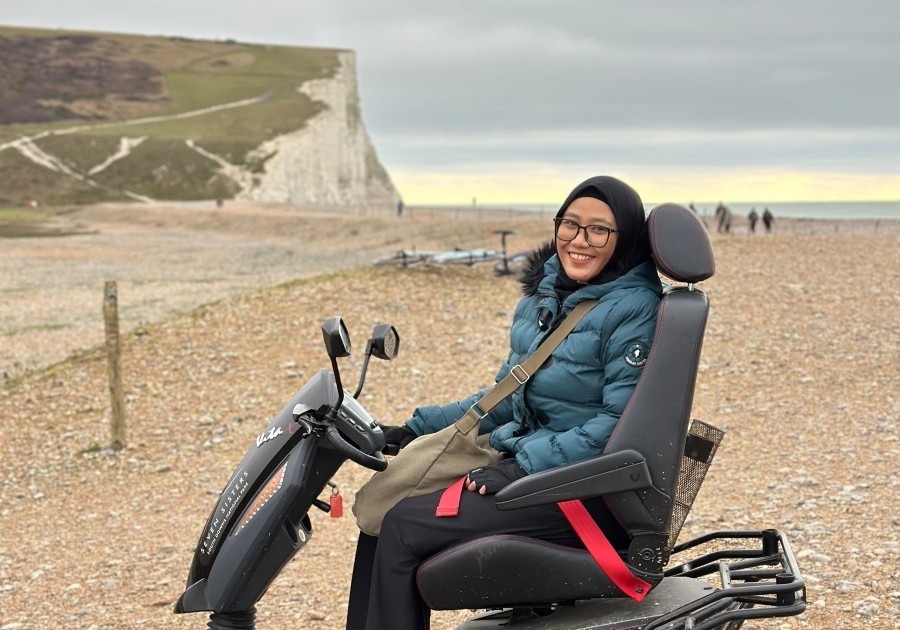
It’s great that so many places here are accessible. I remember going to the Seven Sisters cliffs in south-east England and using a scooter to go all the way down to the beach. I thought I could only reach the visitor centre, but I was able to go further!
I like the research environment at LSHTM. At ICED, I am part of a team working on disability, which I am passionate about. I feel very welcome, and it is encouraging to be around people who share that focus. We have meetings where everyone updates what they are working on, and it feels collaborative because we sit together and exchange ideas. Here, people are interested in disability research and focused on having an impact.
What do you like to do in your free time?
I play an instrument called angklung. It is a traditional bamboo instrument from Indonesia. The instrument is simple – you just shake it and it produces a single note. So each person in a group plays one note at the right time to create a melody.
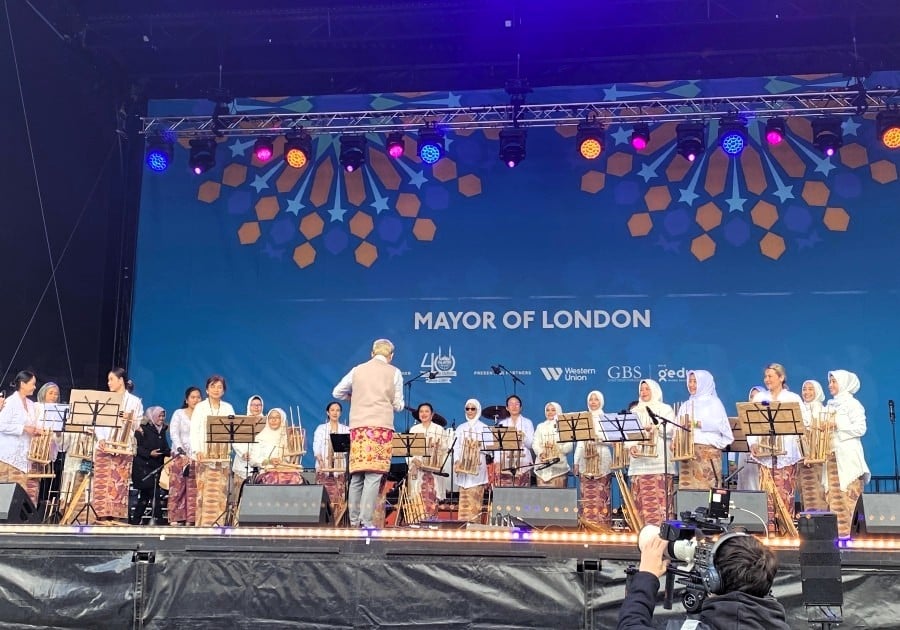
I always want to engage in music, even though I am literally tone deaf! Back in high school, I played bass and guitar in an all-girl band. Now, since my hands are weak and I cannot play them anymore, I wanted to find something I could still do here in London, so I joined a group of Indonesian ladies playing traditional music.
We rehearse regularly and perform at events. The biggest one is Eid on the Square, organised by the Mayor of London. We also performed at Battersea Power Station at an annual Southeast Asian festival called CelebrASIA.
I’m also part of a choir with other Indonesian students and diaspora, and we recently performed at a charity concert, Songs for Sumatra, to raise funds for people affected by massive floods and landslides in Aceh, North Sumatra and West Sumatra.
If you enjoyed this article and would like to build a career in global health, we offer a range of MSc programmes covering health and data, infectious and tropical diseases, population health, and public health and policy.
Available on campus or online, including flexible study that works around your work and home life, be part of a global community at the UK's no.1 public health university.