Leading the fight against Antimicrobial Resistance in Ghana
11 February 2026 London School of Hygiene & Tropical Medicine London School of Hygiene & Tropical Medicine https://lshtm.ac.uk/themes/custom/lshtm/images/lshtm-logo-black.png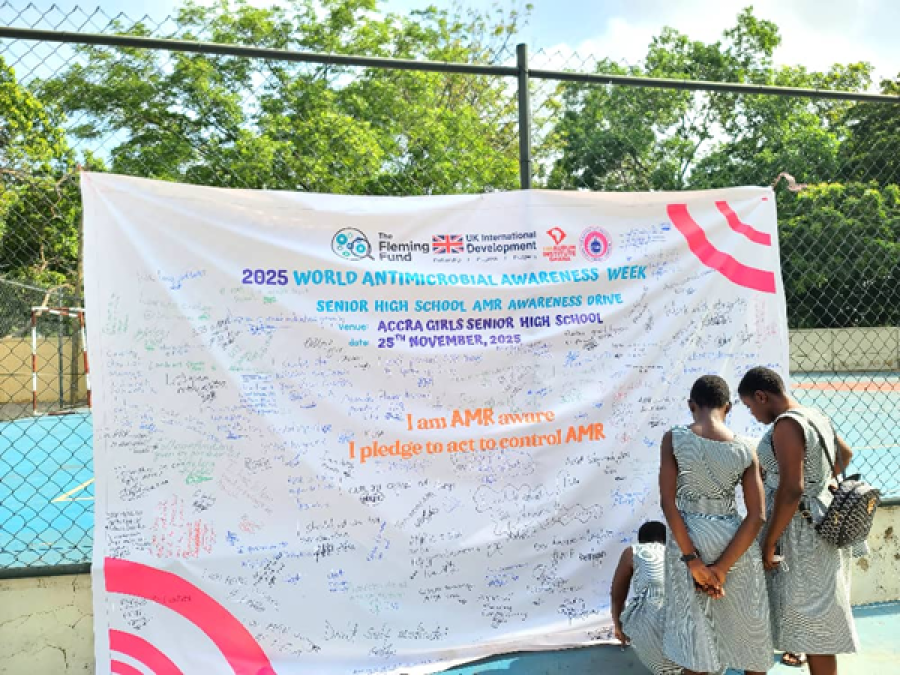
On the International Day of Women and Girls in Science, we celebrate women whose scientific leadership is transforming communities and strengthening global health. One such leader is Ms Regina Ama Banu, a Phase 2 Environmental Laboratory Fellow with the Fleming Fund at the Council for Scientific and Industrial Research – Water Research Institute (CSIR-WRI) in Accra, Ghana, whose work is advancing awareness and action on antimicrobial resistance (AMR).
During World Antimicrobial Awareness Week, Regina led the organisation of the first AMR awareness seminar within her institute, bringing together more than 100 staff members and interns. The event marked an important step in strengthening institutional understanding of AMR and demonstrated the powerful role early-career women scientists can play in driving change within research environments.
Building on this success, Regina expanded the initiative beyond CSIR-WRI to reach students at Accra Girls’ Senior High School. By engaging directly with a girls’ science class, she created space not only to share knowledge about AMR, but also to inspire young women to see themselves as future scientists and community advocates for responsible antimicrobial use.
Working closely with her Head of Division, Dr Mark Osa Akrong, Regina brought together female scientists from across eight CSIR-WRI divisions to serve as STEM role models. She coordinated hands-on learning activities, educational materials, and a student pledge wall, ensuring the outreach combined scientific learning with mentorship and empowerment.
The session, held on 25 November 2025, featured motivational talks from women scientists, interactive presentations, and a quiz competition designed to deepen understanding of AMR. The impact was clear: the proportion of students demonstrating strong knowledge of AMR increased from 71% before the training to 95% afterwards.
Students’ thoughtful questions about antibiotics, vaccines, resistance, and safe medicine use reflected both curiosity and confidence—evidence of the lasting influence of Regina’s leadership and the visibility of women scientists guiding the next generation.
Reflecting on International Women and Girls in Science, Regina said: “Each time I bathe, I am reminded that hundreds of other women out there still lack access to safe water for such basic use. For obvious reasons, women and children need water the most. This concern drives me as a water scientist to contribute my quota by ensuring that water testing is done promptly and results are delivered on time at the CSIR Water Research Microbiology lab in Accra, Ghana. Though my role feels indirect, I know that in a small but meaningful way, it contributes towards the delivery of safe water.”
She added: “Do not abandon the science. Continue to nurse that little idea you have now, that area of interest, as it holds the power to make the world a better place when nurtured and gradually transformed into an invention. You are the next Albert Einstein whose light will illuminate future generations. Congratulations in advance. “
Her work illustrates how women in science are not only advancing research, but also translating knowledge into community action, education, and behavioural change. By connecting mentorship, public engagement, and scientific expertise, Regina Ama Banu exemplifies the spirit of the International Day of Women and Girls in Science and the vital role women play in confronting global health challenges such as antimicrobial resistance.
If you enjoyed this article and would like to build a career in global health, we offer a range of MSc programmes covering health and data, infectious and tropical diseases, population health, and public health and policy.
Available on campus or online, including flexible study that works around your work and home life, be part of a global community at the UK's no.1 public health university.