Expert comment: 134 million people living with recent Mycobacterium tuberculosis infection
11 May 2026 London School of Hygiene & Tropical Medicine London School of Hygiene & Tropical Medicine https://lshtm.ac.uk/themes/custom/lshtm/images/lshtm-logo-black.png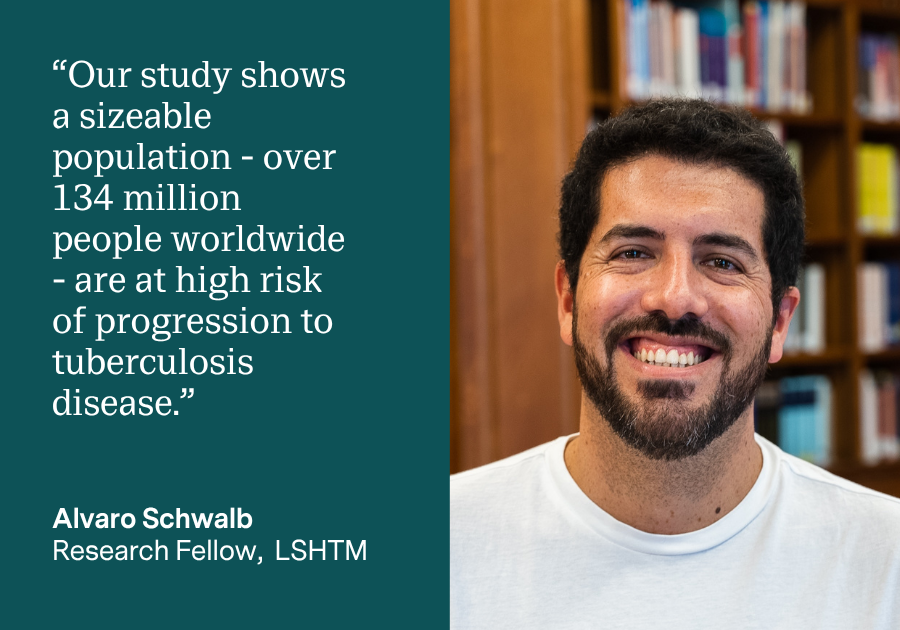
A new mathematical modelling study led by researchers at the London School of Hygiene & Tropical Medicine estimates that approximately 134 million people worldwide were living with a recent Mycobacterium tuberculosis (Mtb) infection in 2022, representing 1.7% of the global population.
Published in PLOS Medicine, the results found that, in terms of total infections, 289 million people (3.7% of the world’s population) were harbouring a viable Mtb infection. Among those recently infected, 16 million (12%) were children under 15 years of age.
The authors constructed country-specific annual risk of infection trajectories for 171 countries from 1950 to 2022. These trajectories were adjusted to account for the systemic underestimation of risk of infection estimates and self-clearance of infection.
Alvaro Schwalb, Research Fellow at LSHTM, said: “Our findings reveal a sizable population recently infected with Mycobacterium tuberculosis. The recency of infection supposes a substantial risk of progression to tuberculosis (TB) disease.”
“Similar to many patterns we observe in TB research, the burden was unequally distributed in the Global South. Nearly 87% of recent infections concentrated in the WHO regions of South-East Asia, the Western Pacific, and Africa.”
On the novel methods of the paper, Alvaro Schwalb said: “A key contribution of the study is the distinction between viable infection and tuberculous immunoreactivity from tests such as TST and IGRAs. Previous global estimates of latent TB infection (one-quarter of the global population) focused entirely on estimates of immunoreactivity and assumed lifelong infection with Mtb.”
“This research follows the current novel paradigm of the spectrum of TB disease and accounts for the dynamic nature of Mtb infection by incorporating the fact that most infected individuals clear their infection without treatment.”
On the wider impact of their findings, Alvaro Schwalb said: “Focusing on recent viable Mtb infection sets a medically actionable target, one which can guide policymakers in targeting an upper bound of the population who may benefit from TB preventive therapy.
“By distinguishing viable infections against tuberculous immunoreactivity, we can provide more accurate estimates for public health efforts tackling TB.”
Limitations: The authors note uncertainties regarding the self-clearance rates used in the model. While evidence supports self-clearance, empirical data on its magnitude, timing, and associated factors are limited.
Read the full paper: Schwalb A et al. Estimating the global burden of viable Mycobacterium tuberculosis infection: A mathematical modelling study. PLOS Medicine, 2026.
If you enjoyed this article and would like to build a career in global health, we offer a range of MSc programmes covering health and data, infectious and tropical diseases, population health, and public health and policy.
Available on campus or online, including flexible study that works around your work and home life, be part of a global community at the UK's no.1 public health university.