Brexit continues to damage UK cancer services as few fixes only partial
23 June 2026 London School of Hygiene & Tropical Medicine London School of Hygiene & Tropical Medicine https://lshtm.ac.uk/themes/custom/lshtm/images/lshtm-logo-black.png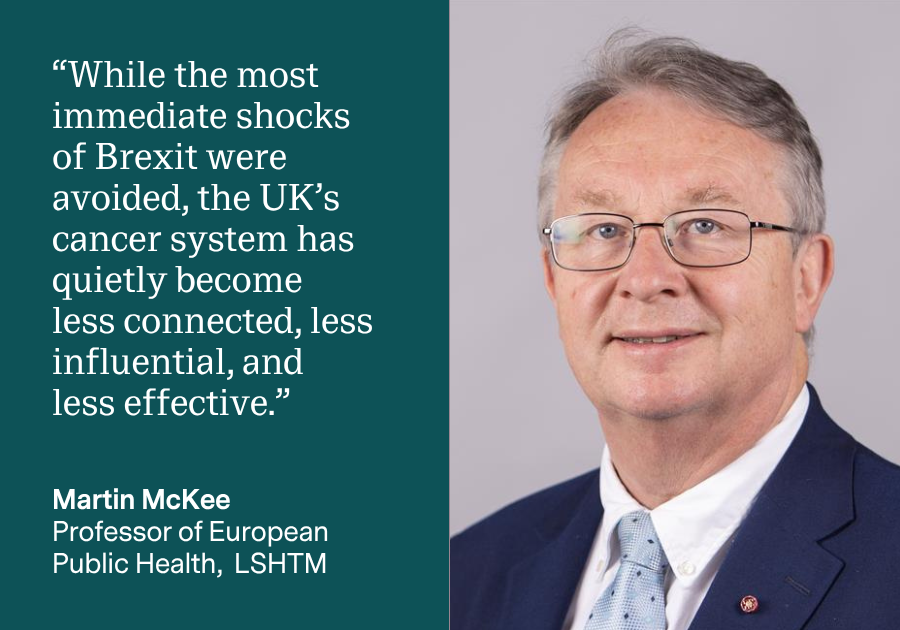
A new analysis co-authored by a researcher at the London School of Hygiene & Tropical Medicine reports that, a decade after the UK voted to leave the European Union, Brexit continues to exert a “chronic, system-wide” impact on the UK’s ability to prevent, research, and treat cancer.
Published in The Lancet Oncology for the tenth anniversary of the Brexit referendum, the paper describes how, while immediate disruptions have largely been contained, the UK cancer system now operates with reduced scale, increased friction, and weakened international integration, with consequences for patients, clinicians, and researchers.
The UK was able to establish new scientific and regulatory systems and, due to careful contingency planning, succeeded in minimising the immediate risks Brexit posed to the supply of medicines, research funding and regulatory continuity. Though this measures prevent short-term crises, they have not restored previous levels of access, efficiency, or influence.
Instead, the authors argue that the UK cancer system has been weakened structurally by exclusion from European networks. The UK continues to experience cumulative and ongoing losses, rather than one-off shocks experienced immediately after Brexit.
Funding for research has felt the greatest impact. Although UK researchers rejoined EU funding programmes in 2024, they now play a more peripheral role in major collaborations, with fewer leadership positions and more administrative barriers. Multinational clinical trials have also become more complex and costly. All of this has reduced opportunities for researchers and slowed scientific work.
The authors also argue that the UK’s access to medicine is now more fragile as it remains outside of key EU programmes for managing medicine shortages. The UK also remains a less attractive place for launching new cancer drugs, as the separate UK and EU regulatory systems have increased duplication and costs. Workforce pressures from reduced mobility with the EU have been offset with recruitment from outside Europe, but the authors note that loss of free movement still hinders collaborations and recruiting specialist staff.
While the UK retained most EU regulations, the authors remain concerned that reduce capacity could weaken protections against carcinogens and environmental risks in the longer-term. This illustrates the authors’ key argument: that Brexit should no longer be viewed as a one-time shock to the health system, but rather as an ongoing process of attrition.
Martin McKee, Professor of European Public Health at LSHTM, said: “The UK avoided the most immediate shocks of Brexit in cancer care, but that should not be mistaken for success. The system has quietly become less connected, less influential, and less effective.
“These negative impacts are continuously being felt by the UK’s cancer systems, as withdrawal from EU systems is producing chronic, not temporary, effects on health systems, just as it is doing with the economy. Policymakers must understand this fact in order to successfully tackle the issues our systems face.
“These changes are subtle but significant, and they matter for patients. They will feel the changes through potential delays in new treatments reaching the UK, and greater strain on health services already under pressure.”
The authors highlight that future improvements depend on closer UK–EU cooperation, particularly in medicines regulation, clinical trials, data sharing and surveillance, and workforce mobility. Restoring the UK’s former position would require much deeper integration with European systems, including rejoining shared legal and regulatory frameworks.
McKee M & Dayan M. Unpicking the UK's cancer response after Brexit: what broke, what was patched up, and what still matters. The Lancet Oncology, 2026. DOI: 10.1016/S1470-2045(26)00306-2
If you enjoyed this article and would like to build a career in global health, we offer a range of MSc programmes covering health and data, infectious and tropical diseases, population health, and public health and policy.
Available on campus or online, including flexible study that works around your work and home life, be part of a global community at the UK's no.1 public health university.