Unit researchers and partners lay groundwork for protection of African-led research and innovation
9 October 2025 London School of Hygiene & Tropical Medicine London School of Hygiene & Tropical Medicine https://lshtm.ac.uk/themes/custom/lshtm/images/lshtm-logo-black.png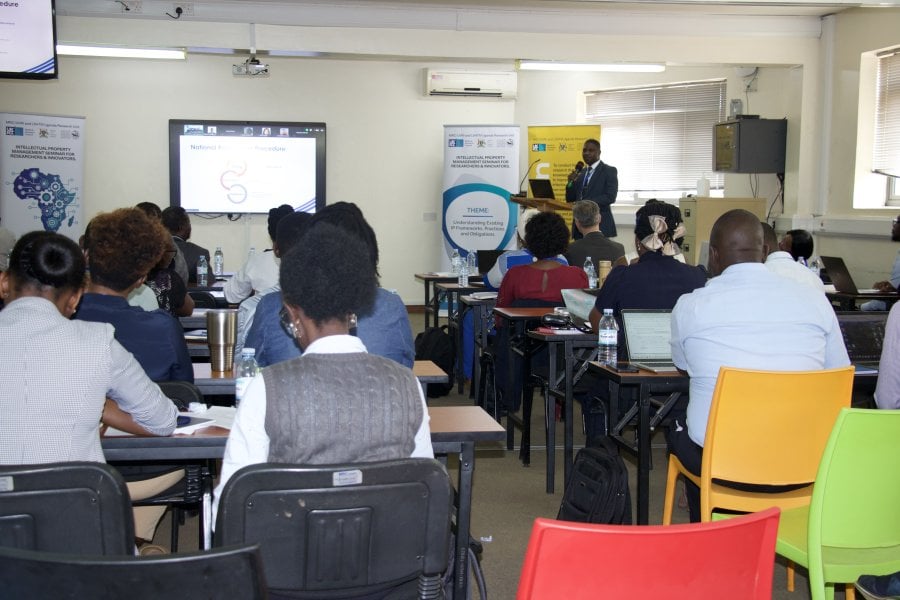
The MRC/UVRI & LSHTM Uganda Research Unit convened a seminar on Intellectual Property (IP) Management to strengthen collaboration and dialogue on translating research into tangible societal benefit. Held in partnership with the Uganda Virus Research Institute (UVRI), Uganda Registration Services Bureau (URSB), the World Intellectual Property Organization (WIPO), the African Regional Intellectual Property Organization (ARIPO), and the London School of Hygiene and Tropical Medicine (LSHTM), the seminar explored how IP frameworks can help ensure that scientific discoveries move beyond journals to influence policy, products and practice.
The seminar was the Unit's first engagement dedicated to IP which brought together researchers, innovators, and national and regional partners to explore how IP frameworks can support the responsible use of research knowledge. Discussions focused on how institutions can collectively build systems that allow discoveries to move beyond publications and directly inform policy, products and practices that improve lives.
“The Unit has always been at the forefront of generating world-class knowledge and the challenge before us now is ensuring that this knowledge is not only published, but also protected, translated, and transformed into solutions that improve human lives.” noted Professor Moffat Nyirenda, Professor of Medicine at LSHTM and Director of the MRC/UVRI and LSHTM Uganda Research Unit
Strengthening Research impact through IP
Experts from URSB, ARIPO, and WIPO guided participants through the fundamentals of IP management, from patent filing procedures to negotiating IP clauses in collaborative grants. The seminar highlighted the importance of establishing local filings before pursuing international protection, ensuring that African institutions retain ownership and leverage in global partnerships.
Alexandra Anderson, Senior Strategic Research and Knowledge Exchange Manager at LSHTM showcased LSHTM’s end-to-end IP pathway, its knowledge-exchange role, and policy of institutional ownership with revenue sharing, demonstrating how clear institutional frameworks can help translate innovations into equitable benefits.
Drawing on her experience, Dr Sheila Nina Balinda, a molecular virologist at the Unit, shared lessons from the IP process for the chimpanzee adeno-vector platform. She highlighted the need for early preparation, proper documentation and institutional support throughout the process.
“Once an innovation is protected, researchers are better positioned to engage in collaborative partnerships and attract further investment and funding,” she noted.
Navigating Emerging Technologies
Participants also examined how technologies such as artificial intelligence (AI) are reshaping the innovation landscape, from accelerating drug discovery to redefining ownership and authorship in science. The discussions highlighted the need for proactive ethical and context-aware frameworks to ensure that African researchers are not left behind in this evolving space.
Building pathways from research to innovation
A concluding roundtable led by Professor Pontiano Kaleebu (Director, UVRI), Rogers Bob Lumu (Senior Officer Technology & Innovation Support Centres, URSB), and Dr Ubani Nicola (Science for Africa Foundation) called for a coordinated effort to strengthen institutional IP and technology transfer systems. They emphasized that protecting innovations is both a scientific and ethical responsibility, ensuring that the benefits of research are shared equitably.
Panelists also noted the need for capacity building within Technology Transfer Offices, improved legal expertise, and stronger negotiation positions in international collaborations. They encouraged researchers to view IP not as an administrative burden but as a pathway to sustainability and impact.
“Every research agreement now involves intellectual property. Protecting innovations early and establishing clear frameworks ensures that scientific discoveries not only advance knowledge but also translate into solutions that benefit society,” said Prof. Kaleebu.
Looking ahead
While participants reflected on potential mechanisms such as licensing and spin-offs, the emphasis remained on building the foundations, strengthening collaboration, institutional readiness and awareness. The seminar concluded with a shared commitment to continue exploring how IP can serve as a bridge between scientific discovery and social good.
By enabling dialogue and shared learning across institutions, the Unit and its partners are laying the groundwork for future where African-led research is both protected and positioned to deliver lasting impact.
If you enjoyed this article and would like to build a career in global health, we offer a range of MSc programmes covering health and data, infectious and tropical diseases, population health, and public health and policy.
Available on campus or online, including flexible study that works around your work and home life, be part of a global community at the UK's no.1 public health university.